
StallCushion™
By Performance Footing®
Your horse can't tell you their hocks hurt. They can't ask for softer ground. But when you lay down a Stall Mattress, they'll show you — by actually lying down. Orthopedic foam-core cushioning sealed inside vulcanized rubber, designed to give your horse the deep, restorative rest that hard floors and thin mats never will. No installation. No tools. Just drop it in the stall and watch what happens.
Why owners pick it
Rest. Recovery. Return on investment.
A bed your horse will actually use — engineered to pay for itself in shavings savings while protecting hocks, joints, and sleep quality.
Rest
orthopedic foam cushions every lie—down, unlocking true REM sleep.
Recovery
helps reduce the pressure points associated with capped hocks and fetlock sores.
ROI
cuts bedding use up to 75% and lasts 20+ years.
The case for the Stall Mattress
More than a rubber mat — it's a bed
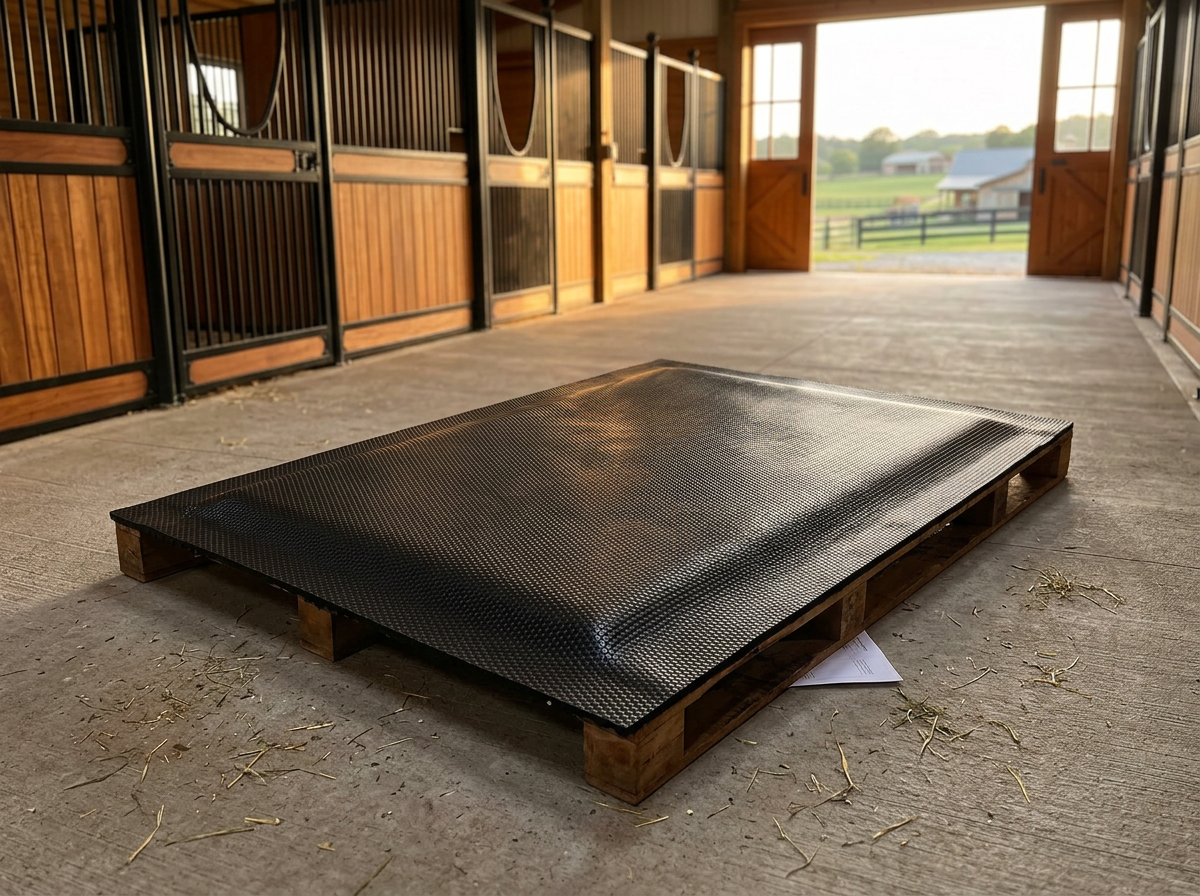
Stall mats protect the floor. The Stall Mattress protects the horse. Closed-cell orthopedic foam sealed between vulcanized rubber, sized to fit through stall doors and barn aisles.
- True REM sleep — cushioned enough that horses actually lie down
- Helps reduce hock sores — distributes weight, reduces pressure points
- 75% less bedding — replaces 4–6 inches of shavings
- Sealed & hygienic — non-permeable vulcanized rubber exterior
- Zero installation — no adhesive, no tools, two people in five minutes
- Closed-cell core — holds shape and density for 20+ years
- 6 ft × 4 ft panels — fit through stall doors and aisles
- Portable — move between stalls, run-ins, paddocks, or trailers
Why it matters
Your horse needs more than a rubber mat
Horses cannot reach REM sleep while standing — they doze, but the deep rapid-eye-movement stage that repairs muscle, consolidates memory, and balances temperament only happens when they lie down. A horse that won't lie down because the surface is too hard accumulates a sleep deficit that shows up as tension, poor recovery, behavioral changes, and diminished performance. The Stall Mattress is a closed-cell orthopedic foam core sandwiched between vulcanized rubber layers — thick enough to absorb the full weight of a horse lying down, resilient enough to hold its shape after years of daily use, and sealed tight enough that moisture, urine, and bacteria never reach the foam.
Sizing & installation
How many mattresses fit your stall?
Each mattress is a whole 6 ft × 4 ft panel — never cut or trimmed. Start with one comfort spot or build out to full wall-to-wall coverage. Mix orientations to fit any stall.
10 × 10 ft stall
1 mattress
Single comfort spot
2 mattresses
6 × 8 ft center pad
4 mattresses
Near full — 96 sq ft
10 × 12 ft stall
1 mattress
Single comfort spot
2 mattresses
6 × 8 ft center pad
4 mattresses
One side fully covered
5 mattresses
Full wall-to-wall
12 × 12 ft stall
1 mattress
Single comfort spot
2 mattresses
6 × 8 ft center pad
3 mattresses
Three centered
6 mattresses
Full wall-to-wall
12 × 14 ft stall
1 mattress
Single comfort spot
2 mattresses
6 × 8 ft center pad
4 mattresses
Against back wall
7 mattresses
Full wall-to-wall
14 × 14 ft stall
1 mattress
Single comfort spot
2 mattresses
6 × 8 ft center pad
4 mattresses
Center 8 × 12 rest area
7 mattresses
Maximum coverage
16 × 16 ft stall
1 mattress
Single comfort spot
2 mattresses
6 × 8 ft center pad
4 mattresses
Center 8 × 12 rest area
10 mattresses
Maximum coverage
Order Online · Volume Discounts Apply
Order online — volume pricing applied automatically
The more you order, the lower your per-unit price. Discount updates live as you change quantity.
Quantity
1–5 mattresses — $529 each
Add 5 more to drop to $499.00/mattress — save an extra $180.00.
Your order
StallCushion™
1 mattress
+ shipping at checkout
Specifications
Engineered to outlast the barn
Built for any level surface — concrete, compacted stone, packed dirt, or existing rubber stall mats.
Frequently asked questions
How many Stall Mattresses do I need for a 12×12 stall?
Two mattresses placed side by side create a 6 ft × 8 ft padded resting area in the center of the stall. Add shavings around the perimeter. For 12×14 or 14×14 stalls, use three mattresses.
Do horses really need to lie down to sleep?
Yes. Horses can doze standing up but cannot reach REM sleep — the deepest, most restorative stage — without lying down. REM sleep is essential for muscle recovery, memory consolidation, and nervous system repair.
Will a stall mattress help with hock sores?
Yes. Hock sores, capped hocks, and pressure sores are caused by repeated contact with hard floors. The orthopedic foam distributes weight and helps reduce the pressure points associated with these sores. Many owners report improvement after switching. Results vary by horse and stall conditions.
How much do stall mattresses save on shavings?
A Stall Mattress replaces the cushioning equivalent of 4–6 inches of shavings. Most owners reduce bedding use by 50–75% because shavings are only needed around the perimeter. This also cuts waste removal and mucking time.
Does the Stall Mattress require installation?
No. No adhesive, no tools. Level your existing stall floor, place the mattress in the center, and add shavings around the perimeter. The mattress is heavy enough that horses cannot shift or bunch it.
Can it be used outdoors or in a run-in shelter?
Yes. The foam core is completely sealed between non-permeable vulcanized rubber layers, so moisture and rain cannot reach the interior. Use in run-in sheds, partially covered shelters, paddock loafing areas, or trailers.
What's the difference between a stall mattress and a stall mat?
A stall mat is a flat 3/4 inch rubber sheet that protects the floor. A stall mattress has an orthopedic foam core sandwiched between rubber layers, providing true shock absorption. Stall mats help protect floors; stall mattresses are designed to help reduce pressure-related injury risk through orthopedic cushioning.
Will the foam flatten out over time?
No. The closed-cell orthopedic foam core holds its shape and density even after years of daily use. Unlike loose-fill systems or low-density foam, it does not compact, go lumpy, or lose its cushioning.
Can I use the Stall Mattress on top of my existing stall mats?
Yes. The mattress works on any level surface — concrete, compacted stone, packed dirt, or existing rubber stall mats. Placing it on top of thin mats can also help prevent them from curling at the edges.