
Why Sand Selection Is Only Half the Equation: A Guide to Footing That Actually Works
Sand alone won't fix a failing arena. Learn why particle shape, climate, discipline, and a modular FIBR / FLEX / LOCK system together build footing that actually performs.
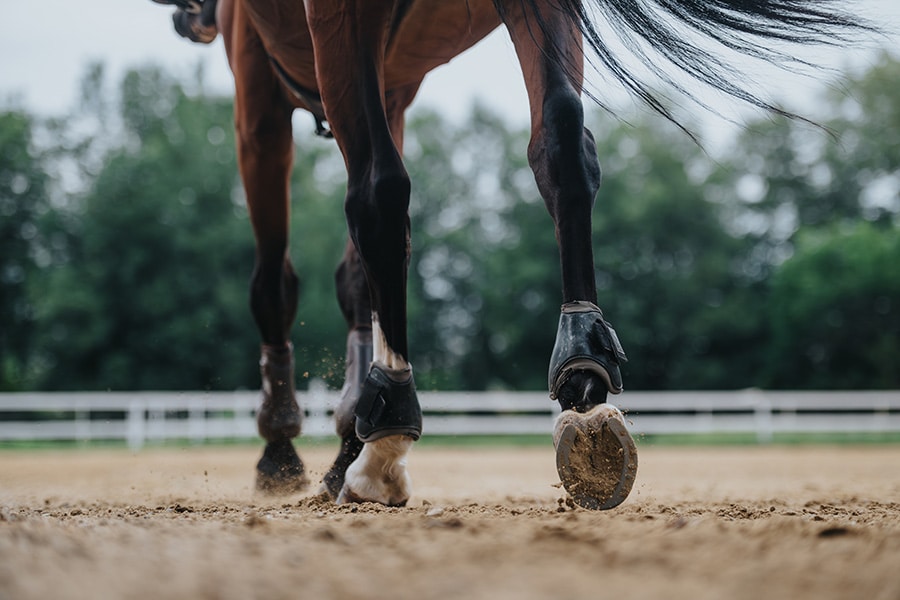
Quick answer: Good sand is the foundation, but it is not the entire system. Even excellent sand compacts, dries out, and generates dust under repeated hoof traffic. A modular footing system — sand selected for particle shape and gradation, then enhanced with FIBR (structural interlock), FLEX (shock absorption), and LOCK (dust and moisture management) — is what creates predictable, long-lived performance. The order matters: sand first, design second, additives third.
The equestrian footing industry is in the middle of an overdue reckoning. Across social media, at barns, and in communities of arena owners who have spent tens of thousands of dollars on surfaces that never stabilized, a single question keeps surfacing: what went wrong?
The frustration is real, and much of it is justified. But the conversation happening right now risks overcorrecting in a way that could leave horse owners with a different set of problems. The emerging narrative — that sand is everything and additives are the enemy — contains an important truth wrapped around a dangerous oversimplification.
This guide breaks down what the industry is getting right about sand, what it's still getting wrong about footing as a system, and how to make decisions based on your sand, your location, your discipline, and your goals — not someone else's.
The Problem the Industry Is Finally Talking About
A growing number of experienced footing professionals and arena owners are sounding the alarm about a pattern that has repeated itself across the country for years. The cycle looks the same almost everywhere: a horse owner invests in a footing system marketed as professional, engineered, or turnkey. The footing gets installed. Then the problems begin — deep spots, instability, fiber separation, excessive water consumption, and horses sinking into a surface that was supposed to be rideable out of the gate.
When they call the company that sold it to them, the answer is almost always the same: add more water, add more fiber, change your drag, buy a different groomer, try a dust suppressant.
Everything gets blamed except the sand.
As Jennifer, founder at Performance Footing, explains from years of evaluating sand across the country: "I only have 3–4 suppliers I will work with in New England. Sometimes customers will say, well, can we do it for less money from the plant right down the street? And it can be so hard to explain how that same sand on paper is nothing like the sand I need to utilize for stability. Even though they are both called the same thing."
That observation captures a fundamental problem. Two sands with identical names, identical sieve designations, and completely different behavior in an arena. One interlocks. One rolls apart. The label doesn't tell you which is which.
Why "Equestrian Sand" Doesn't Mean What You Think It Means
There is no ASTM specification for "equestrian sand." The term has no industry-standard definition, no governing body, and no certification process. When a quarry labels a product EQ100, that typically means nothing more than the material passes a #100 sieve. It is a screening designation, not a performance specification.
Passing a sieve tells you something about particle size. It tells you almost nothing about particle shape, angularity, mineral hardness, capillary behavior, moisture retention, or how those particles will interact with each other under repeated hoof traffic over months and years.
A sand can meet every sieve designation on a product sheet and still perform terribly in an arena. Rounded, polished particles — common in naturally weathered alluvial deposits — do not interlock well. They tend to roll against each other rather than stabilize. The result is footing that rides loose, deep, and unpredictable regardless of how carefully it was graded.
This is the foundation of the current industry frustration, and it is entirely valid. Too many arenas have been built on sand that was never capable of creating a stable surface, and too many horse owners have been told the problem is their maintenance when the problem was the material itself.
Before you buy: our Sand Selection Guide walks through particle shape, gradation, and fines content, and the Arena Sand Calculator returns realistic tonnage by blend density. If you want lab-grade certainty, request a Sand Analysis Kit before ordering a single load.
Where the Conversation Stops Too Soon
Here's where the current industry narrative needs to go further.
The argument making the rounds right now frames the problem as sand versus additives — as though the industry's mistake has been reaching for products instead of getting the sand right. For many of the worst arena failures, that framing is accurate. If the sand lacks the particle structure to interlock, no amount of fiber, rubber, or liquid binder will manufacture stability from nothing.
But the conclusion many arena owners are drawing — that good sand alone is the complete answer — misses something fundamental about how footing actually performs under horses over time.
Even properly selected, well-graded, angular sand will compact under repeated hoof traffic. It will lose moisture between waterings. It will develop hard spots in high-use zones and stay loose in underused areas. It will generate dust as particles abrade against each other. The surface will migrate laterally. The profile will shift vertically.
Sand is a mineral. It does not adapt. It does not recover. It does not self-correct.
That is what engineered footing additives are designed to address — not to rescue bad sand, but to extend the performance window of good sand. There is a fundamental difference between using products as a bandage over a flawed foundation and using them as precision tools within a properly designed footing system.
Jennifer notes that this trial-and-error approach — buying sand, hauling it in, discovering it doesn't work, ripping it out, starting over — is one of the most expensive and demoralizing experiences in horse ownership: "We see it constantly. An owner goes through 3 different materials before they find what works. One we helped remove after about a month because it was completely unsuitable." And in many cases, even the owner who finally finds a workable sand is still left with a surface that could perform meaningfully better with the right enhancements.
No Two Arenas Start from the Same Place
Jennifer hears a version of this concern regularly from owners across the country: "So, what is the solution here? Sounds like everyone, everywhere is kinda screwed with whatever they try."
That frustration makes sense — but only if you're looking for a single universal answer. The reality is that no two arenas start from the same place, and the solution shouldn't be the same everywhere either.
Sand Varies by Region
The sand available in the Southeast is fundamentally different from what's available in New England, the Midwest, the Pacific Northwest, the Mountain West, or anywhere else in the world. Geology varies by region. Particle shape, mineral composition, and weathering history vary by deposit. What comes out of a quarry in central Texas behaves nothing like what comes out of a pit in upstate Vermont, a riverbed in northern Germany, or a coastal deposit in Florida.
A silica-rich deposit in one region might produce angular, interlocking particles that form a naturally stable surface with minimal enhancement. A weathered alluvial deposit fifty miles away might produce rounded, polished grains that require significant structural reinforcement before they'll hold a profile. Both might be sold under the same "equestrian sand" label. Both might produce nearly identical sieve reports. And they will behave completely differently under horses.
This is why the idea of a single "correct" sand specification fails in practice. The right approach is not to chase a universal ideal — it is to understand the characteristics of what's available regionally and then design a footing system around those specific properties.
Climate Changes the Equation
An outdoor arena in the Arizona desert faces completely different moisture and dust challenges than one in the humidity of coastal Virginia or the freeze-thaw cycles of northern Colorado. Altitude, annual rainfall, prevailing humidity, wind exposure, seasonal temperature swings, and evapotranspiration rates all affect how a footing surface behaves over time and what it needs to stay consistent.
A sand that holds moisture beautifully in the Pacific Northwest may dry out in hours in the arid Southwest. A surface that rides perfectly in a climate-controlled indoor arena may freeze solid or waterlog outdoors depending on where it's located. These are not edge cases — they are the normal range of conditions arena owners deal with, and any footing approach that ignores climate is engineering in a vacuum.
Discipline Demands Are Different
A dressage arena needs uniform support and moderate grip across the entire surface. The horse is performing precise, collected movements that require predictable, consistent footing in every zone. A jumping arena needs a surface that provides solid push-off at takeoff, reliable cushioning at landing, and stable behavior under the high-impact loading of horses moving at speed over fences. A reining arena needs controlled slide — a surface firm enough to support the sliding stop without catching or grabbing. A multi-use facility has to find a profile that works across demands that are, in some cases, pulling in opposite directions.
Each of these disciplines places different biomechanical loads on the footing, requires different levels of shear resistance, and benefits from different cushion and energy-return profiles. A single footing formulation cannot optimally serve all of them.
The Owner's Goals and Usage Patterns Matter
A private owner riding four days a week has different wear patterns and maintenance capacity than a busy training barn with fifteen horses in daily work. A competition facility that hosts weekend shows needs a surface that holds up under concentrated traffic and recovers quickly between sessions. A lesson barn with beginners needs forgiveness and consistency above all else.
Usage intensity determines wear rate, maintenance frequency, and how quickly a surface's characteristics will change over time. Two arenas with identical sand can perform very differently simply because one sees ten hours of traffic per week and the other sees forty.
The sand is different. The climate is different. The discipline is different. The goals are different. Any footing approach that doesn't account for all four of those variables is a guess — and guessing is exactly how the industry ended up in the cycle of frustration horse owners are experiencing right now.
How FIBR, FLEX, and LOCK Work Within This Framework
This is why we built FIBR, FLEX, and LOCK as separate, modular products rather than a single premixed blend. Each one addresses a specific performance characteristic, and the rate, combination, and application method should be adjusted based on what the sand needs, where the arena sits, what the horses are doing, and what the owner is trying to achieve.
FIBR — Structural Interlock
FIBR creates a three-dimensional interlocking network through the sand profile. It resists shear, reduces lateral movement under dynamic hoof loading, and holds the particle matrix together through traffic cycles and grooming passes. It addresses the fundamental limitation of any loose granular surface: particles that are not physically connected to each other will eventually move apart under repeated loading.
FIBR works because the sand is right. In poorly graded or excessively rounded sand, the fiber network cannot form properly because the particles it's trying to bind are sliding past each other. This is exactly why sand selection comes first — not because additives don't matter, but because they need a competent substrate to work within.
A dressage rider working with a fine, well-graded local sand will need a different FIBR approach than a jumper barn working with a coarser material. The application rate, the depth of integration, and the maintenance strategy all adjust based on the starting sand and the performance goals.
FLEX — Shock Absorption and Energy Return
FLEX provides cushion, resilience, and energy return that sand — even excellent sand — physically cannot deliver on its own. Sand is a rigid granular material. It compacts under load and does not spring back. That characteristic is useful in road construction. It is not ideal for a horse landing off a jump, loading through collected work, or performing repetitive high-intensity training sessions.
FLEX adds a performance layer that mineral particles are incapable of providing regardless of how well they're selected. The degree to which an arena benefits from FLEX depends on the discipline (jumping and high-performance flatwork create more impact loading than light trail work), the horse's workload, the depth of the footing profile, and the owner's priorities around long-term soundness.
LOCK — Dust Control and Moisture Management
LOCK addresses the single biggest ongoing maintenance challenge in any sand arena: moisture loss and dust generation. Even beautifully graded, angular sand will dry out. When it does, it loses surface cohesion, generates airborne particulate, and becomes a different riding surface than it was when properly hydrated.
LOCK extends the interval between waterings, reduces dust at the surface, and helps the top layer of the footing maintain consistent behavior between maintenance cycles. It is not a substitute for proper watering — it is a tool that makes your watering program actually effective between applications.
The role of LOCK varies significantly by climate. An arena in a dry, windy environment with high evapotranspiration will rely on LOCK differently than an indoor arena with controlled conditions. The application rate and frequency should reflect local conditions, not a universal specification sheet.
The Real Problem Is the Order of Operations
The cycle that horse owners are frustrated about — add fiber, add water, add additives, buy a new groomer, try a different drag, call the company, get told to add more — is real. But the problem is not that those tools exist. The problem is the sequence in which they've been applied.
When someone installs sand without proper analysis, discovers the surface doesn't perform, and then starts layering products on top hoping to engineer stability after the fact, they've inverted the process. They're building from the roof down.
Jennifer often points out the economics of this to her clients: "EQ means the sand is double the price." And when that expensive sand doesn't perform, every dollar spent on products trying to fix it feels like money thrown away — because in that situation, it often is.
The correct sequence is straightforward.
- Understand the sand you have or the sand available to you regionally. Analyze particle shape, gradation, mineralogy, and fines content. Use the Sand Selection Guide and order a Sand Analysis Kit if you want lab-grade certainty before a single load is delivered.
- Factor in your climate, your discipline, and your goals. An outdoor jumping arena in Florida and a private dressage ring in Oregon are different projects even if they start with similar sand. The Arena Construction Guide walks through how subbase, drainage, and stabilization decisions change with each.
- Introduce the right additive modules at the right rates based on all of the above. FIBR for structural interlock. FLEX for shock absorption and resilience. LOCK for dust control and moisture management. Each one tuned to the specific conditions of the arena it's going into.
When you follow that order, additives are not an endless expense cycle. FIBR and FLEX are a one-time installation. LOCK is an ongoing maintenance product. Together, they create a footing system with measurable, repeatable performance — not a patch job on a surface that was never right to begin with.
If you'd rather have an engineer walk through this with you rather than self-diagnose, the ArenaSpec™ diagnostic returns a full Report Card from a three-minute set of inputs about your climate, discipline, and current arena.
Building Footing That Starts With Honesty
We know this is not the message most product companies deliver. The easier sell is to promise that a single product will solve everything. We've watched other companies take that approach, and we've watched their customers end up in the remediation cycle that has the entire industry frustrated.
We would rather tell a potential customer that their sand needs to change before we can help them. That conversation may cost a sale in the short term. But it earns something more valuable: a customer whose arena actually works, who trusts the system, and who understands why their footing performs the way it does.
Great footing exists. It exists in every region of the country, across every discipline, in every climate. But it does not come from sand alone, and it does not come from additives alone. It comes from understanding the material you're starting with, designing around the conditions you're working in, and enhancing the system with tools that address the specific limitations sand will always have as a granular mineral surface.
Sand is the foundation. It was never meant to be the entire building. FIBR, FLEX, and LOCK are the structure — and the way they're applied should be as specific to your arena as the sand underneath them.
Performance Footing® offers sand evaluation guidance and modular footing additive systems designed to be tuned to your sand, your climate, your discipline, and your goals. To learn more about whether your current sand is the right starting point — or whether it needs to change before anything else — explore the Horse Arena Footing overview, request a quick quote, or call (877) 835-0878.