
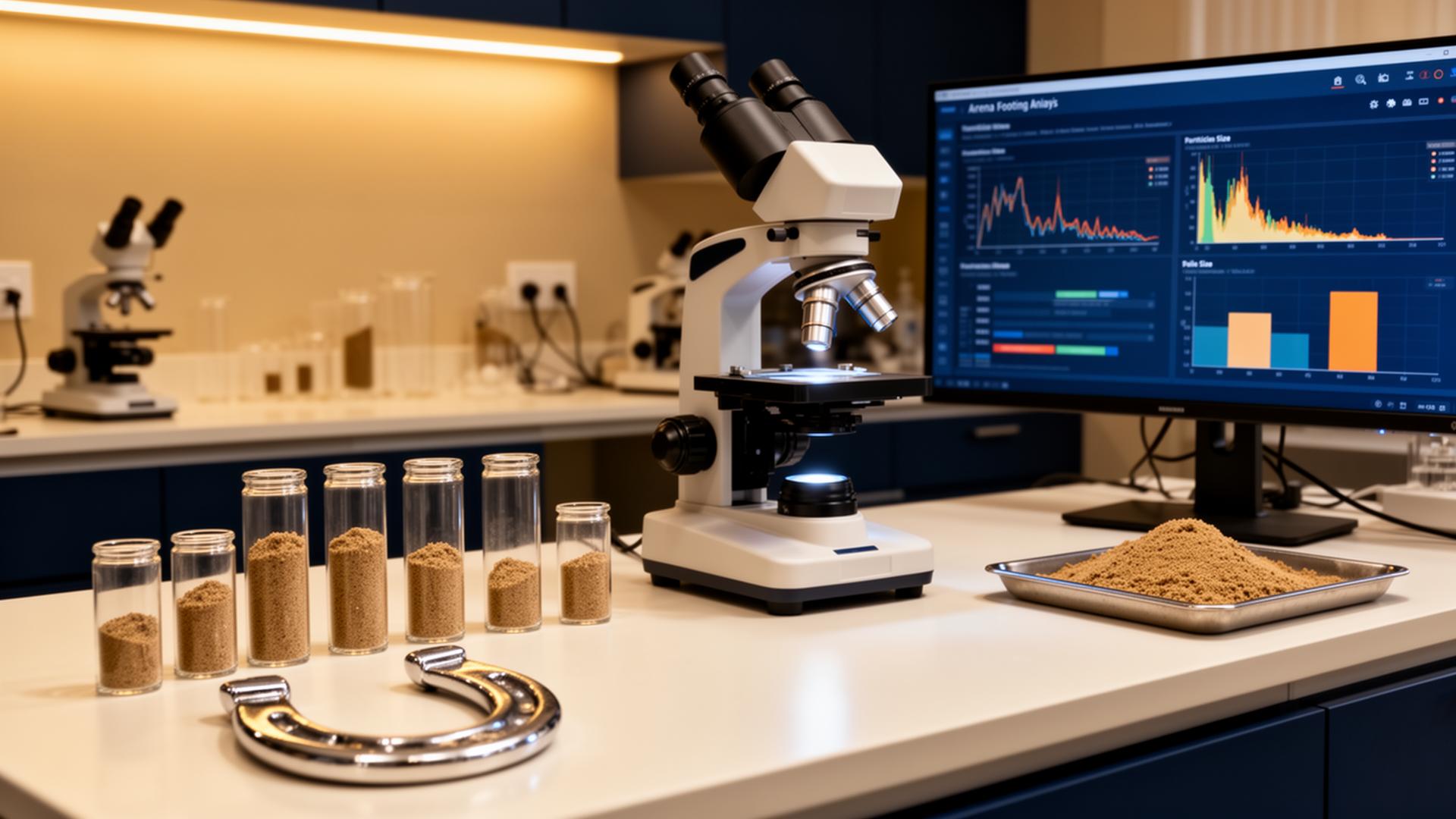
Stop Guessing. Start Riding on a Surface Built for Your Sand.
Lab-tested answers — not another season of trial and error.
Most arena problems trace back to one thing: the sand. Our lab + ArenaSpec™ profile turn your surface into a custom tuning plan — so every dollar you spend on footing, additives, and maintenance actually works.
How It Works
From Sample to Tuning Plan in 3 Steps
Order Your Kit
We ship everything you need to collect and return a sample — no hunting for supplies or shipping labels.
Sample & Profile
Send your sample back in the prepaid mailer and complete your arena profile in the ArenaSpec™ assessment form.
Get Your Custom Plan
Receive a full lab report paired with your ArenaSpec profile — gradation, particle shape, and a discipline-specific footing tuning plan.
One Kit. One Report. Years of Better Rides.
Today saves thousands in wrong sand, wrong additive, and wrong fixes. Order now — beta pricing ends at 250 kits.
What's In The Kit
Arena Sand Analysis Kit
Beta pricing — first 250 arena owners
Ships within 2 business days of order
Lab analysis turnaround: 5–7 business days from sample receipt
Kit Includes
- PF-branded collection bag (heavy-duty, sealed, labeled)
- Step-by-step sampling instructions (illustrated card)
- Prepaid return shipping label (USPS Priority Mail)
- ArenaSpec™ app access link and QR code
What the Lab Analyzes
- 7-point sieve analysis (ASTM C136) — US Mesh 18, 35, 60, 100, 140, 270, and pan
- Particle shape and magnification imaging
- Mineralogy and Mohs hardness assessment
- Fines fraction measurement (dust and silt content)
What You Receive
- Full gradation report with your results vs. PF indoor/outdoor targets
- Particle distribution comparison chart
- Magnified particle images showing grain shape
- Discipline-specific compatibility rating
- FIBR / FLEX / LOCK product compatibility assessment
- Custom footing tuning plan
Why Sand Analysis Comes First
Sand is 95 to 98 percent of your riding surface by mass. It is the foundation ingredient in every arena footing blend on earth — and it is the variable that most arena owners know the least about. There are over 10,000 distinct types of sand in North America. There is no ASTM material specification for "equestrian sand." The term has no regulated definition, no standard gradation, and no minimum quality threshold. When a quarry sells you "arena sand," they are selling you whatever they've sold to other horse owners before — often mason sand, concrete sand, or fill sand that happens to be the right color. And when a footing company recommends an additive without analyzing your sand first, they are guessing.
Performance Footing does not guess. Every footing tuning system we design — every FIBR, FLEX, and LOCK recommendation — begins in our lab with your sand sample on the sieve stack. Because the additive is not the recipe. The sand is the recipe. The additive is the seasoning. And you cannot season a dish you haven't tasted.
What We Test
Our in-house laboratory performs a comprehensive analysis covering every property that affects how your arena rides, drains, compacts, and ages. The deliverable is not a raw data sheet that leaves you guessing — it is an interpreted report paired with your ArenaSpec™ profile data to produce actionable recommendations tied to your discipline, your climate, and your goals.
The sieve analysis is the core of the report. We run your sample through a calibrated 7-mesh sieve stack (US Mesh 18, 35, 60, 100, 140, 270, and pan) per ASTM C136, weighing retained mass at each level to produce a complete particle size distribution curve. This tells us the ratio of coarse, medium, and fine particles in your sand — the single data point that determines whether your arena compacts into concrete, drains too slowly, generates excessive dust, or provides the cushion and responsiveness your horse needs. We compare your results against our proprietary indoor and outdoor sieve targets, which are calibrated to FEI surface science research and over a decade of field performance data across thousands of arenas.
Particle shape and magnification imaging is the second layer. We examine your sand under magnification to assess angularity — whether the grains are rounded, sub-angular, or angular. Round sand (common in river deposits and mason sand) does not interlock and creates a loose, shifting surface. Excessively angular sand (common in crushed manufactured stone) packs too tightly and becomes hard and unforgiving. Sub-angular is the target: enough geometry to grip, enough irregularity to resist over-compaction. We capture magnified images of your sample so you can see exactly what your sand looks like at the particle level — many owners are shocked to discover how round or angular their sand actually is.
Mineralogy assessment determines the hardness and longevity of your sand. Quartz and silica sands score 7 on the Mohs hardness scale and resist breakdown for decades. Limestone and carbonate sands are softer (Mohs 3–4) and degrade into fine dust over time, creating compaction and respiratory problems. We identify the dominant mineral composition of your sample and flag any degradation risk.
Fines fraction analysis quantifies the dust and silt content — particles smaller than 0.063 mm that are invisible to the eye but devastating to performance. Fines cause compaction, generate airborne dust, seal the surface against drainage, and create the hard, dead feeling that horses resist. Our outdoor target holds pan retention near zero. If your fines fraction is elevated, we identify the source (sand degradation, contamination, improper base separation) and address it in the tuning plan.
ArenaSpec™ — Your Arena's Data Profile
Lab data tells us what your sand is. ArenaSpec tells us what your arena is. Together, they produce a footing tuning plan that no lab report alone — and no phone questionnaire — can match.
When you purchase a Sand Analysis Kit, you receive a link and QR code to the ArenaSpec™ assessment at performancefooting.com/free-arena-consultation. While your sample is in transit to our lab, you complete a detailed arena profile in the assessment. ArenaSpec captures the information that shapes every recommendation we make: your primary discipline and whether you cross-train, your arena dimensions and whether it's indoor, outdoor, or covered, your base construction type and drainage setup, your daily horse traffic and intensity level, your current moisture management system, the groomer or drag you use and how often you drag, what problems you're experiencing (compaction, dust, depth, drainage, inconsistency), and what outcome you're looking for — from a targeted improvement to a full rebuild.
This data pairs with your lab results in our analysis workflow. Your sieve gradation tells us what sand you have. Your ArenaSpec profile tells us how that sand is being used, maintained, and stressed. The combination produces recommendations that account for variables a lab alone cannot see — like a dressage rider in Arizona with no watering system whose sand is technically correct but functionally failing because of climate and maintenance, or a jumper barn in Vermont whose good sand is degrading because the arena is dragged with the wrong equipment.
ArenaSpec also becomes your ongoing arena record. As you retest annually and update your profile, the app tracks changes in your sand condition and surface performance over time — creating a longitudinal dataset that makes each subsequent tuning adjustment smarter and more precise.
What Makes Our Lab Different
Most footing companies offer some form of sand evaluation, but there are critical differences in what you actually receive and how the data is used.
Some competitors offer free sand analysis — but the analysis is a sales funnel, not a diagnostic tool. The "report" is a brief assessment designed to lead you toward their product line regardless of what your sand actually needs. If the sand doesn't suit their product, you may never hear that. The analysis serves the company, not the customer.
Other companies charge for lab testing but outsource it to a standard geotechnical soil lab. The lab runs ASTM C136 competently but has zero equestrian expertise. You receive a gradation report and no interpretation — no discipline-specific targets, no additive compatibility data, no footing tuning plan. You're left holding a technical document with no translation.
Performance Footing runs the lab work in-house, interprets it against proprietary discipline-specific targets developed from FEI surface science research and field-verified performance data, pairs it with your ArenaSpec™ arena profile, and delivers a tuning plan tied to our FIBR, FLEX, and LOCK product system. The analysis does not exist to sell you product — it exists to determine whether product is even what you need. Sometimes the answer is: your sand is wrong and no additive will fix it. Sometimes the answer is: your sand is excellent and you need less product than you think. The lab report tells the truth either way, because a system built on the wrong data fails — and that failure costs us a customer.
We maintain this standard because Performance Footing is not a product company. We are a tuning system. And every tuning system starts with measurement.
When to Get Your Sand Analyzed
There are six situations where sand analysis is not optional — it is the difference between a successful outcome and an expensive mistake.
Before you buy sand from a quarry: over 10,000 types of sand are sold in the US, and most quarries label "arena sand" based on prior sales, not tested specifications. Analyzing a quarry sample before purchasing can save you thousands in corrective work — or prevent you from buying the wrong material entirely. We can also review a quarry's existing gradation report if they have one.
Before you add any footing additive: fiber, elastomer, wax, polymer, and dust control products are each designed for specific sand gradations. Adding an additive to incompatible sand produces poor results, wasted money, and a surface that may perform worse than plain sand. Your sand analysis determines which products are compatible and at what application rate.
When your arena is underperforming: if your arena compacts too hard, feels too deep, generates excessive dust, drains poorly, develops inconsistent spots, or rides differently after rain — the cause is almost always in the sand. An analysis pinpoints whether the problem is gradation, fines accumulation, mineral degradation, or base contamination.
When you inherit an arena: if you've purchased a property with an existing arena and don't know what's in it, an analysis tells you exactly what you have, what condition it's in, and whether it can be improved or needs replacement.
Before a major event or facility inspection: FEI and USEF standards increasingly reference objective surface testing. Having a current sand analysis on file demonstrates due diligence for horse welfare and gives you baseline data for ongoing quality control.
As part of annual maintenance: sand degrades over time — particles fracture, fines accumulate, and the gradation curve shifts. An annual re-analysis catches these changes before they become performance problems, allowing you to adjust your tuning plan proactively rather than reactively. Reorder a kit each year to keep your ArenaSpec profile current.
Frequently Asked Questions
Building New? Don't Order Sand Without Testing First
We maintain a quarry reference library across the US. Before you buy from a local pit, let us analyze a sample — five minutes of testing can save thousands in corrective work.
Call 877-835-0878Pillar: Arena Sand & Testing
Sand & testing guides
Arena Sand Analysis: Expert Testing & Specification Guide
Professional arena sand analysis guidance for every discipline and region. Request your Sand Analysis Test and custom specification guide today.
Guide to Horse Arena Sand Types & Installation | Performance Footing
The most critical decision when building a horse arena is choosing the right horse arena sand. Explore this guide to selection, types, and installation.
Arena Sand Selection Guide: Expert Tips for Horse Arenas
Learn how to select the right arena sand using sieve analysis reports. Discover particle size specifications for horse arenas that protect your horse.
How to Choose the Right Horse Arena Sand Depth? | Horse Arena Footing
Consider the horse arena sand depth during the building process. Follow these helpful tips on how to choose the right Horse Arena Sand Depth.
Ultimate Guide to Sand Types for Horse Arenas | Performance Footing
The right horse arena sand has a big impact on safety, performance, and longevity. Here's your ultimate guide to sand types for horse arenas to get started.
How to Evaluate Arena Footing | Performance Footing
Evaluating your arena footing is a daunting task but it can help ensure a healthier arena. Check here the steps on how to evaluate arena footing.