
Arena Sand Sieve Analysis: The Complete Footing Guide
Learn how sieve analysis and sand shape drive arena footing performance and dust. See how Performance Footing's ArenaSpec™ program amends your footing — and how plant-based LOCK™ and natural-mineral HOLD+™ cut watering, dust, and labor for good.
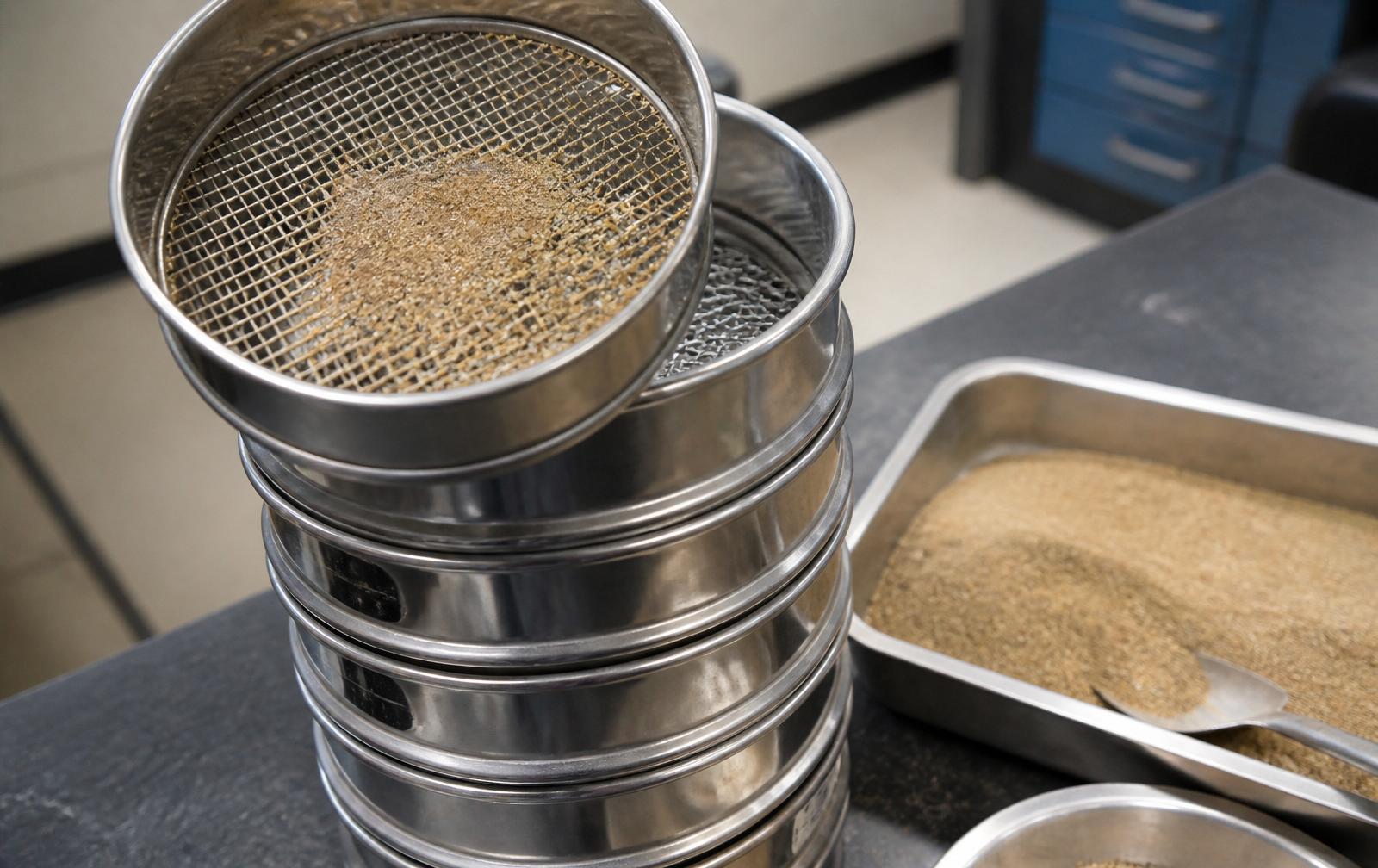
Quick answer. Arena sand sieve analysis tests particle size distribution by passing sand through stacked screens of decreasing mesh sizes (ASTM C136 method). Ideal gradation targets vary by discipline and arena type, but well-graded equestrian sand concentrates particles in the medium-sand range with sub-angular grain shapes and minimal fines. Performance Footing's ArenaSpec™ program runs the sieve analysis in-house, interprets the gradation curve for your discipline, and prescribes an amendment plan. Plant-based options include corrective sand, FIBR™ (natural plant-derived fiber for shear strength), and LOCK™ (plant-based waterless dust control). For moisture retention, it may recommend HOLD+™ (all-natural mineral moisture buffer). The goal is to fix the footing you have instead of replacing it.
Introduction
Research conducted by Dr. Mick Peterson at the University of Maine's Racing Surfaces Testing Laboratory found that sand size distribution accounts for up to 40% of the variation in arena surface performance — more than any other single factor except moisture content. Yet most horse owners select arena sand based on color, name (concrete, mason, silica, etc.), local availability, or price, without ever requesting a sieve analysis report.
Arena sand sieve analysis tests particle size distribution by passing sand through stacked screens of decreasing mesh sizes (ASTM C136 method). At Performance Footing®, our in-house lab — including high-end sieve shakers — is the engine behind ArenaSpec™, our footing amendment program. You send us a sample of your arena sand; we run the analysis, map your gradation curve against the target band for your discipline and climate, and prescribe a specific amendment plan to correct it.
Understanding sand gradation isn't just about achieving the perfect ride — it's about protecting your horse's joints, tendons, and respiratory health, and about escaping the endless labor and water bills that come from fighting a poorly graded surface. Standard arenas can demand 200 to 600 gallons of water per day just to keep dust down. That's a gradation problem being treated with a hose.
This guide covers the science of particle gradation, how to read a sieve analysis report, how shape and gradation create dust, how the ArenaSpec™ program turns lab data into a fix, and where footing treatments like LOCK™ and HOLD+™ end the watering treadmill entirely.
The Science of Sand Gradation and Equestrian Footing
Sand gradation describes how particle sizes are distributed within a sample. A sieve analysis — performed according to ASTM C136 standards — quantifies this distribution by weighing the material retained on each screen in a stacked series of sieves with progressively smaller openings.
The results produce a gradation curve, typically plotted with particle size on the horizontal axis and cumulative percentage passing on the vertical axis. This curve reveals everything from drainage capacity to compaction behavior — and, critically, dust potential.
Why gradation affects your horse
Dr. Lars Roepstorff of the Swedish University of Agricultural Sciences has published extensively on how arena surfaces influence equine biomechanics. His research demonstrates that footing consistency — heavily influenced by gradation — directly affects peak vertical forces on the hoof during landing.
When particle sizes are poorly graded:
- Too many fine particles (below 0.125 mm): The surface compacts excessively, becoming hard and concussive. Fines also generate respirable dust — particles small enough to penetrate deep into equine and human lungs.
- Too many coarse particles (above 2.0 mm): The surface becomes loose and unstable, offering inadequate support during push-off phases. Horses expend more energy and face increased injury risk from unpredictable footing.
- Gap-graded sand (missing middle sizes): The surface may feel adequate initially but deteriorates rapidly as fines migrate downward and coarse particles rise to the surface.
The goal is a well-graded sand with a balanced distribution across multiple sieve sizes. This creates what engineers call an "interlocking matrix" — particles of varying sizes nest together, providing both stability and controlled shear.
Key metrics: uniformity coefficient and fineness modulus
Two values derived from sieve analysis are particularly useful for evaluating arena sand:
- Uniformity Coefficient (Cu): Calculated as D60 / D10, where D60 is the particle size at which 60% of the sample passes and D10 is the size at which 10% passes. Cu between 2 and 4 indicates relatively uniform particle sizes — adequate for some applications but often too narrow for arena footing. Cu between 4 and 8 suggests better gradation for equestrian use, providing the particle variety needed for stable interlocking.
- Fineness Modulus (FM): A single number representing the average particle size. For arena sand, an FM between 2.0 and 3.0 typically works well. Below 2.0, the sand may compact too tightly and generate dust. Above 3.0, the particles may be too coarse for comfortable footing.
These metrics help you compare sand sources objectively, beyond subjective assessments like "it feels sandy." An ArenaSpec™ report calculates both for you and states plainly whether your sand needs amending — and with what.
How Gradation and Shape Create Arena Dust
Dust is not a separate problem from gradation. Dust is gradation — specifically, the fraction of your footing that has fallen below roughly 0.075 mm (passing the #200 sieve). Every dusty arena has one of two stories behind it, and a sieve analysis tells you which:
Story one: the sand arrived dusty. The source material carried excess fines from the quarry — silt, clay, or over-crushed material. This shows up immediately on a sieve report as high #200/pan percentages.
Story two: the sand is manufacturing its own dust. This is where particle shape and mineralogy take over. Rounded particles roll and grind against each other under hoof traffic instead of locking in place, and softer minerals (limestone, feldspar-rich sands) abrade into fines season after season. An arena that started clean gets dustier every year because the footing is literally milling itself into powder. Sub-angular silica (quartz) sand resists this attrition — the particles interlock rather than grind, and the hard mineral doesn't break down.
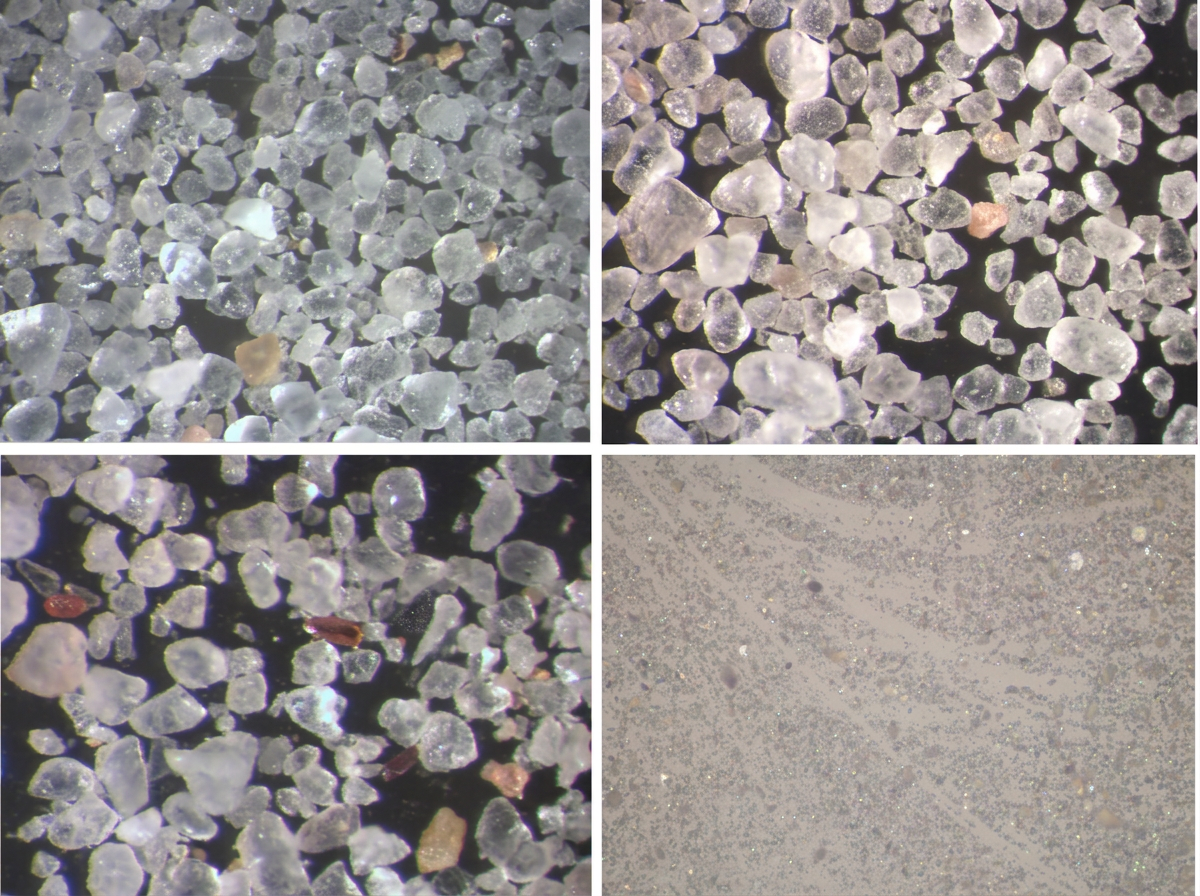
This is why two arenas with identical initial gradation curves can diverge completely within a few years, and why shape and mineral composition belong on every sand spec sheet alongside the sieve numbers.
Why We Fight So Hard Against Water and Dust
At Performance Footing, reducing water use and dust isn't a product angle — it's the reason the company builds what it builds.
For the horses and the people. Respirable arena dust penetrates deep into the lungs of every horse and rider in the building — hour after hour, session after session. Chronic dust exposure is linked to equine airway inflammation and respiratory disease, and the humans teaching, training, and grooming in that same air breathe it too. An indoor arena with a dust problem is an air-quality problem you stand inside of. (Guidance on equine facility air quality is well summarized by Penn State Extension's Equine Facility Management program.)
For the environment. An arena drinking 200 to 600 gallons a day, every day, is a well or municipal supply being poured onto sand to suppress a symptom. Multiply that across a boarding facility's arenas — or across a drought-prone region like the Southwest — and dust control by hose becomes one of the largest hidden water consumers on a horse property. Manual watering also routinely consumes 10–14 hours of labor per week, which at commercial facilities can translate into $15,000 or more in annual payroll spent moving water that evaporates by afternoon.
Watering treats the symptom on a cycle of hours. Amending the footing — correcting the gradation and treating the fines and moisture behavior at the source — treats the cause on a cycle of seasons.
ArenaSpec™: From Sieve Analysis to Amended Footing
ArenaSpec™ is Performance Footing's footing amendment program, built around our in-house sieve analysis lab. Instead of handing you a data sheet and wishing you luck, ArenaSpec™ closes the loop from testing to fix:
- Sample & Test. You collect samples from your arena (guidance below) and send them to our lab. We run a full ASTM C136-method sieve analysis on high-end sieve shakers and evaluate particle shape and composition.
- Interpret. We map your gradation curve, uniformity coefficient, fineness modulus, fines content, and shape profile against the target band for your discipline, climate, and arena type (indoor vs. outdoor).
- Prescribe. You receive a specific amendment plan: corrective sand blending to fill gradation gaps, FIBR™ to restore shear strength and traction, LOCK™ to shut down dust at the source, and/or HOLD+™ to buffer moisture and add traction — matched to what your sieve data actually shows.
- Amend & Verify. Apply the plan yourself with our guidance, or have our arena services team execute it. Because the plan is built on your lab data, you amend the footing you have instead of paying to remove and replace it.
The economics matter: a full footing replacement is one of the most expensive line items in arena ownership. In most cases, ArenaSpec™ identifies a targeted amendment that restores performance for a fraction of that cost.
Ready to test your footing? Request a quick quote or call 877-835-0878 to start an ArenaSpec™ analysis.
How LOCK™ and HOLD+™ Stop Dust — And the Watering Bill
When a sieve analysis shows elevated fines or a footing that can't hold moisture, you have three options: replace the footing, dilute the problem with corrective sand, or treat the footing so the fines stay down and the moisture stays put. For most arenas, treatment is the fastest and most cost-effective path — and it's where LOCK™ and HOLD+™ work as a team.
LOCK™ is Performance Footing's plant-based, waterless dust-control concentrate, built on plant-based chemistry. Applied diluted, it coats the sand and locks the dust down so fines stay put and the surface stays consistent — dramatically reducing, or eliminating, the need to water. One treatment carries the arena for a full season, and it's virtually odorless in use.
HOLD+™ is a dry, broadcast-applied blend built on a natural mineral that works like a moisture reservoir for your footing. It absorbs water when there's plenty and releases it slowly as the surface dries, buffering the sand against the drying-out that causes dust and inconsistency between waterings. All-natural re-wetting support keeps the blend fresh, while its graded structure adds traction and helps the surface pack evenly. HOLD+™ is a one-time structural treatment with only light top-ups after the first year.
Together, what that means in practice:
- Dust is held down at the source. LOCK™ locks the respirable fines your sieve report flagged into the surface; HOLD+™ keeps the footing in the moisture zone where fines don't go airborne in the first place.
- Watering labor collapses. The daily 200–600 gallon watering cycle — and the hours of hose-dragging or sprinkler runs behind it — is dramatically reduced. For facilities paying staff to water, that's real payroll recovered, and thousands of gallons of water conserved per arena, per year.
- The surface stays consistent. No more riding the swing between morning-watered-heavy and afternoon-dust-dry. Traction and cushion stay predictable through the day — and through the seasons.
LOCK™ and HOLD+™ work alongside — not instead of — good gradation. If your sand is severely gap-graded or the fines content is extreme, ArenaSpec™ may prescribe corrective sand or FIBR™ first, with LOCK™ and HOLD+™ applied to finish and protect the amended surface. That's the point of the program: the sieve analysis tells us why your arena is dusty and unstable, so the amendment plan targets the actual mechanism instead of guessing.
How to Conduct and Interpret a Sand Sieve Analysis
Whether you're evaluating a new sand source or diagnosing problems in an existing arena, a proper sieve analysis provides the data you need for informed decisions.
Step 1: Collect representative samples
Sampling methodology matters as much as the test itself. For a new sand source:
- Request that the supplier provide a recent sieve analysis report (within the past 6 months).
- If ordering a large quantity, request samples from the specific pile or location your delivery will come from — gradation can vary within a single quarry.
- Collect at least 2 kg (about 4.5 lbs) for testing.
For an existing arena (and for ArenaSpec™ submissions):
- Take samples from at least 5 locations distributed across the arena.
- Sample the full depth of the footing layer, not just the surface.
- Combine samples into a composite and mix thoroughly before testing.
- Collect 2–3 kg total.
Step 2: Choose a testing method
- ArenaSpec™ lab testing. Send your composite sample to Performance Footing's in-house lab. You get an ASTM C136-method sieve analysis plus interpretation and a written amendment plan — not just raw numbers.
- Independent laboratory testing. Materials testing labs (often affiliated with universities or construction firms) also perform ASTM C136 sieve analysis. Based on quotes we've gathered, expect independent testing to run $750 or more per sample — and that typically buys you certified numbers, not an equestrian interpretation or an amendment plan.
- Field screening. For preliminary evaluation, you can purchase a set of testing sieves (#8, #16, #30, #50, #100, #200) and perform a simplified gradation analysis yourself. While not as precise as laboratory testing, this approach identifies obvious problems and helps you compare sand sources before committing.
Step 3: Read the gradation report
A standard sieve analysis report includes:
- Sieve sizes tested — listed in descending order from largest to smallest openings.
- Weight retained — mass of material held on each sieve.
- Percent retained — weight retained divided by total sample weight.
- Cumulative percent retained — running total of percent retained.
- Percent passing — 100 minus cumulative percent retained; this is what's typically plotted on gradation curves.
As a general-purpose starting point, well-graded riding arena sand concentrates its mass in the medium-sand sieves (#30–#50, 0.30–0.60 mm), tapers off at the coarse end, and keeps material passing the #200 sieve to a few percent at most.
Important — gradation targets vary by discipline and arena type. A reining arena is specified far coarser and cleaner than a dressage arena; indoor bands run slightly finer for moisture retention while outdoor bands run slightly coarser for drainage. Rather than chasing a single universal table, download the discipline-specific target bands — including per-sieve tolerances for delivered loads — from the Sand Selection Guide by Discipline in our Resources section. Take that guide to your quarry and compare their current sieve analysis against the band before you buy.
The universal warning zone doesn't change: the #200 sieve and the pan. Fines above roughly 3% mean dust is already in the system, and above 8–10%, treatment or partial replacement moves from optional to necessary.
Step 4: Evaluate beyond the numbers
Sieve analysis tells you particle size, but not particle shape or mineral composition — and those two factors determine whether your sand will keep manufacturing dust. Request additional information from your supplier:
- Particle shape — sub-angular particles are essential for arena use.
- Mineral content — silica sand (quartz) is preferred. Limestone, calcium carbonate, or feldspar-rich sands break down faster and generate problematic fines over time.
- Wash status — washed sand has had fines removed; unwashed may contain clay or silt that affects performance.
Performance Footing's Sand Calculator helps you determine the volume of sand needed once you've selected an appropriate source.
Why Sand Shape Matters for Arena Footing
Gradation describes size distribution, but particle shape determines how those particles interact under load. For equestrian footing, shape may be as important as gradation.
The shape spectrum
Geologists classify sand particle shapes along a continuum:
- Angular — sharp edges and corners, irregular surfaces. Common in crushed or manufactured sands. Provides excellent interlocking but can be abrasive and uncomfortable.
- Sub-angular — slightly rounded edges with some irregular surfaces. The ideal shape for arena footing — enough angularity for stability, enough rounding for comfort.
- Sub-rounded — more spherical with few sharp edges. Acceptable for arena use but may require more frequent maintenance to prevent looseness.
- Rounded — smooth, spherical particles. Common in river sands and beach sands. Poor choice for arenas — particles roll past each other rather than interlocking, creating unstable, deep footing that grinds itself into dust over time.
How shape affects performance
Research published in the Equine Veterinary Journal by Dr. Rachel Murray of the Animal Health Trust found that surface stability correlates strongly with what equestrian surface scientists call "shear strength" — the resistance to particles sliding past each other. Similar principles underpin the FEI Equestrian Surfaces White Paper, which remains the reference document for competition footing.
Sub-angular particles interlock at multiple contact points. When a horse's hoof strikes the surface, these interlocked particles resist displacement, providing support during the loading phase. Then, as the hoof rotates through push-off, the particles shear past each other in a controlled manner, providing the "give" that reduces concussive forces.
Rounded particles cannot achieve this balance. They slide freely under load, requiring the horse to expend more energy maintaining balance and increasing strain on soft tissue structures. And every slide is a grind: rounded, soft-mineral sands abrade under traffic, feeding the fines fraction that becomes tomorrow's dust cloud.
Identifying particle shape
Visual inspection with a 10× magnifying loupe reveals particle shape. Compare samples to reference images (widely available online through geological resources). For critical projects, shape analysis is included in ArenaSpec™ evaluation.
As a practical test: squeeze a handful of damp sand and release. Sub-angular sand holds its shape momentarily before crumbling. Rounded sand falls apart immediately. This "clump test" isn't scientific, but it identifies obvious problems.
What Is the Best Sand Particle Size for Horse Arenas?
There is no single "best" particle size for every horse arena — the right gradation depends on your discipline, climate, and arena type. As a general rule, well-graded footing sand concentrates in the medium-sand range with sub-angular shapes and minimal fines, but the specific target bands differ meaningfully:
- Discipline. Dressage arenas benefit from finer, tightly-graded sand for hoof purchase during collected movements. Jumping and eventing arenas run slightly coarser for stable push-off and shock-tolerant landings. Reining and speed-event arenas are specified coarsest and cleanest of all — fines held near zero — so the surface releases for a controlled slide. Per-sieve target bands and acceptable delivery tolerances for each discipline are published in the Sand Selection Guide by Discipline.
- Climate. Humid climates can accommodate slightly finer sand because ambient moisture helps control dust. Arid climates require coarser gradation plus treatments like LOCK™ and HOLD+™ to keep fines down and moisture stable without constant irrigation.
- Footing additives. When using fiber or treatment products, sand gradation requirements shift. Performance Footing's FIBR™ — a natural, plant-derived structural fiber — works with specific sand gradations to rebuild shear strength and traction. The ArenaSpec™ report specifies the right sand characteristics for your chosen amendments.
How Do LOCK™ and HOLD+™ Stop Arena Dust and Reduce Watering?
Arena dust is the fine fraction of your footing (particles below ~0.075 mm) becoming airborne under hoof and equipment traffic — and constant watering is the labor-intensive band-aid most owners apply to it. LOCK™ and HOLD+™ attack the mechanism instead of the symptom, from two directions:
- LOCK™ is a plant-based, waterless dust-control concentrate built on plant-based chemistry. Applied diluted, it coats the sand and locks the dust down so fines stay put — one treatment carries the arena for a full season, recovering the hours per week and hundreds of gallons per day that hose-based dust control consumes.
- HOLD+™, built on a natural mineral with all-natural re-wetting support, gives the footing what sand fundamentally lacks: a moisture reservoir. It takes in excess water when the surface is wet and releases it slowly as the surface dries, keeping the footing in the stable, dust-resistant moisture zone far longer between waterings — while its graded structure adds traction and even packing. It's a one-time structural treatment with only light top-ups after the first year, and it performs indoors and outdoors, through seasonal extremes.
Which treatment — or combination — fits your arena depends on your fines content, particle shape, moisture behavior, and climate. That's exactly the question an ArenaSpec™ analysis answers.
How Does Sand Gradation Differ for Indoor Versus Outdoor Arenas?
Indoor and outdoor arenas require different gradation strategies due to environmental exposure, moisture management, and maintenance capabilities. As a rule of thumb: indoor target bands run slightly finer for moisture retention; outdoor bands run slightly coarser for drainage. The discipline spec sheets in the Sand Selection Guide publish separate indoor and outdoor target columns for this reason.
Indoor arenas operate in controlled environments with minimal weather exposure. Gradation can be optimized purely for performance and horse welfare without drainage compromises. Key considerations:
- Finer gradation is acceptable because rainfall doesn't saturate the surface.
- Dust control becomes paramount — without natural moisture, fines become airborne more readily, and the enclosed air is what horses and riders breathe for hours. LOCK™ locks the fines down without watering; HOLD+™ extends the interval between waterings by buffering the only moisture the footing receives.
- Maintenance schedules can be precise and consistent, allowing use of gradations that require more frequent grooming.
Outdoor arenas face rain, freeze-thaw cycles, wind erosion, and sun exposure. Gradation must balance performance with durability:
- Slightly coarser gradation improves drainage, preventing standing water and mud formation.
- A well-designed base layer becomes critical — Performance Footing's Arena Construction Guide details proper base preparation.
- Gap-graded sand should be strictly avoided outdoors, as rainfall accelerates fine migration and surface degradation.
- Moisture swings are sharper outdoors — mud after a storm, dust days later. HOLD+™ buffers in both directions, absorbing the excess and releasing it through the dry spell.
- Particle shape becomes even more important — angular particles resist wind erosion better than rounded particles.
For facilities with both indoor and outdoor arenas, maintaining different footing specifications for each is typically worthwhile. The controlled indoor environment allows for premium, finely-tuned footing, while the outdoor arena prioritizes durability and drainage.
Troubleshooting Common Gradation Problems
Even well-designed arenas can develop gradation-related issues over time. Understanding the causes helps you implement effective solutions — and an ArenaSpec™ analysis confirms the diagnosis before you spend on the fix.
Problem: dust despite regular watering
Cause. Excess fines (particles below 0.075 mm), often from particle breakdown over years of use or from sand with poor mineral composition or rounded shape.
Solution. Apply LOCK™ — a plant-based, waterless dust-control concentrate that coats the sand and locks the dust down for a full season — and add HOLD+™ so the surface holds a stable moisture level between waterings instead of drying to dust within hours. Long-term, if the sieve analysis shows the footing is still generating fines (rounded or soft-mineral sand), consider top-dressing with sub-angular silica sand or adding FIBR™ to restore shear strength across the profile. Have a sieve analysis performed to quantify the fine content — if fines exceed 8–10%, ArenaSpec™ will tell you whether treatment, blending, or partial replacement is the cost-effective path.
Problem: surface compacts to hardpan
Cause. High fines content combined with inadequate maintenance, causing particles to pack into a dense, impermeable layer.
Solution. Deep tilling to break up the compacted layer, followed by addition of coarse sand or fiber additives to improve gradation — HOLD+™'s graded structure also adds compaction-resisting structure to the profile. Increase maintenance frequency using an appropriate arena drag.
Problem: deep, loose footing that won't stabilize
Cause. Sand too coarse, too rounded, or gap-graded (missing middle particle sizes).
Solution. Add medium-fine sand to fill gradation gaps, or incorporate FIBR™ to rebuild shear strength and restore grip. FIBR™ is a natural, plant-derived structural fiber that weaves through the footing to create a mechanical binding matrix — restoring the interlock that rounded or worn sand alone can no longer provide.
Problem: footing performance varies across the arena
Cause. Inconsistent sand delivery (different loads from different quarry locations), poor initial mixing, or uneven base causing differential drainage and particle migration.
Solution. Take sieve samples from multiple arena locations to identify variation — ArenaSpec™ can test location-specific samples to map the inconsistency. Address underlying base issues if drainage is uneven. Thoroughly blend footing using multiple passes with an aggressive drag. For future sand purchases, request all loads from a single, tested source, and hold deliveries to the per-sieve variance tolerances published in the Sand Selection Guide spec sheets.
Selecting the Right Sand: A Practical Checklist
Use this checklist when evaluating sand sources for a new arena or footing replacement:
- ☐ Request a sieve analysis report dated within the past 6 months.
- ☐ Download the discipline spec sheet from the Sand Selection Guide and compare the quarry's report against your target band, sieve by sieve.
- ☐ Confirm fines content (passing #200 sieve) sits within your discipline's band — for most disciplines that means just a few percent.
- ☐ Inspect particle shape using a magnifying loupe — require washed, sub-angular particles.
- ☐ Check mineral composition — silica (quartz) sand is preferred over limestone or feldspar.
- ☐ Request a sample delivery before committing to large orders, and re-verify each delivered load against the variance tolerances.
- ☐ Test the sample by wetting and compacting a small area, then evaluating stability and drainage.
- ☐ Document everything — keep sieve analysis reports for future reference, and re-test annually as the surface ages.
- ☐ Or skip the guesswork: submit samples to ArenaSpec™ and get the analysis, interpretation, and amendment plan in one report.
Performance Footing's Arena Building Services team can assist with sand source evaluation, testing coordination, and specification development for your project.
Conclusion
Sand sieve analysis transforms arena footing decisions from guesswork into science. The 40% variation in surface performance that Dr. Mick Peterson's research attributes to particle distribution represents the difference between footing that protects your horse and footing that contributes to injury, respiratory issues, and poor performance.
The same lab data that explains your ride also explains your dust — and your water bill. Gradation and particle shape determine whether an arena stays clean or grinds itself into a respirable haze that demands hundreds of gallons of water a day to suppress. With ArenaSpec™, that data becomes a prescription: corrective sand where the curve has gaps, FIBR™ where the matrix needs shear strength and traction, plant-based LOCK™ to lock the dust down without watering, and natural-mineral HOLD+™ to hold moisture steady — reclaiming the labor, the water, and the clean air that horses and riders deserve.
Every arena investment starts with the sand. Make yours count.
Ready to amend your footing based on real data? Start an ArenaSpec™ analysis, browse the discipline gradation spec sheets in our Sand Selection Guide, or request a quick quote. Call 877-835-0878 for expert guidance on sand testing, amendment planning, and arena design.