
The Complete Guide to Arena Footing: What Every Horse Owner Needs to Know
Understanding the fundamentals of arena footing — from sand selection to additive ratios — is the first step to building a surface that performs for your discipline and climate.
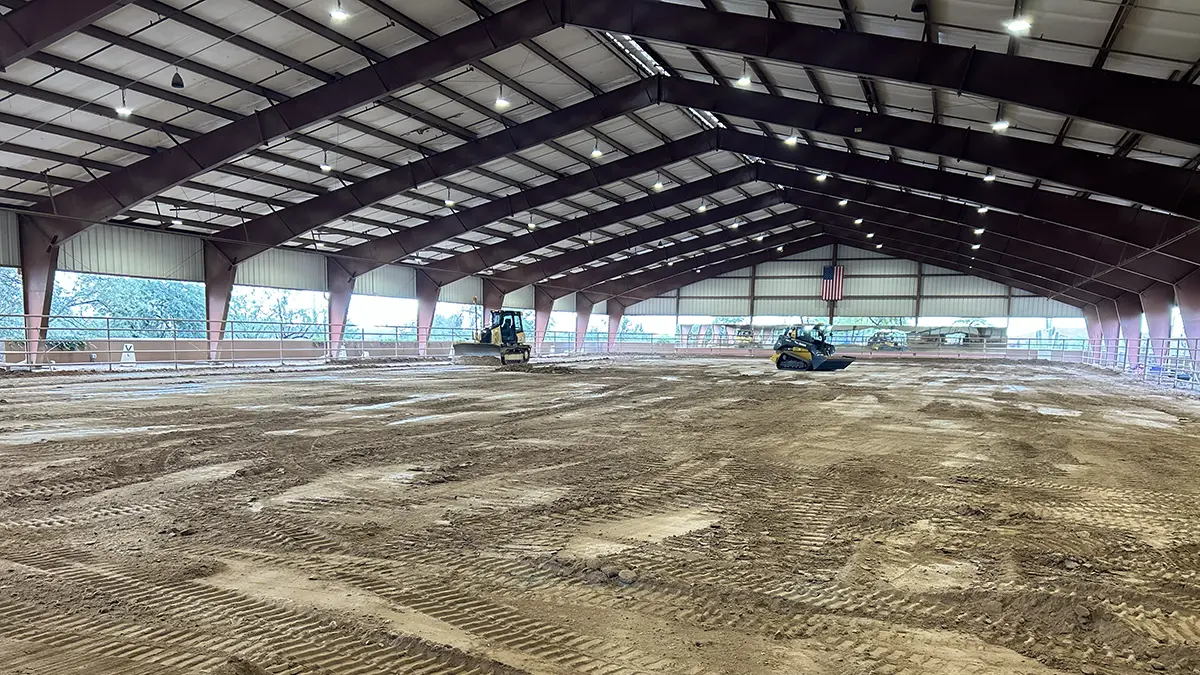
Arena footing is the single largest variable in the soundness, longevity, and rideability of every horse that steps onto your surface. It outweighs shoeing decisions, training program details, and almost every other facility-level choice you will make. And yet it is the one piece of the facility most owners build by intuition, by what the neighbor used, or by whatever a single vendor recommended on the day the checkbook came out.
This guide is the working answer the Performance Footing® team gives owners who want to understand the fundamentals before they spend a dollar on sand, fiber, or installation. It is written for the rider planning a new arena, the barn owner trying to fix one that isn't working, and the trainer who has decided that the current surface is no longer acceptable. There is no product pitch here — just the framework we use on every consult.
What "footing" actually means
The word footing gets used loosely in the equine world, often as a synonym for whatever is on top of the arena. That definition is the source of more bad decisions than any other single thing in our industry. Footing is not a layer. Footing is a system.
A correctly designed arena has three engineered layers working together. The subbase provides structural support and dictates how the entire surface drains. The base sits on top of the subbase and creates the consistent, level plane your sand depth is measured from. The surface layer — the sand, possibly with an additive — is the part the horse actually touches. When riders complain about footing, the surface layer gets blamed nine times out of ten. In our experience, the failure is almost always in one of the two layers beneath it.
If you take only one idea from this guide, take this one: the surface is the last thing you design, not the first. You cannot fix a bad base with better sand, and you cannot fix bad sand with more additive.
What the layers actually look like
The two cross-sections below show the same engineered build-up from the native soil up to the footing. The foundation is identical in both: native soil subgrade, a compacted sub-base of four to six inches, and a non-woven geotextile separation fabric. The only thing that changes is the arena base — either a BaseCore™ HD cellular grid at three to four inches, or crushed screenings compacted in lifts to the same depth.
Arena build-up — BaseCore™ HD grid base
- Footing (surface layer)
- Sand specified by sieve analysis for your discipline and climate — with a natural additive only if the spec calls for one.
- Arena base — BaseCore™ HD grid
- Cellular confinement locks the base aggregate in place, holding a level plane and resisting rutting and migration under hoof load.
- Non-woven geotextile separation fabric
- Separates the base from the sub-base so fines cannot pump upward and aggregate cannot punch downward, while water still passes through.
- Sub-base
- Compacted structural fill placed to grade and slope. This layer carries load and sets the drainage path for the whole system.
- Native soil (subgrade)
- Organics removed, soft spots corrected, and the surface graded before anything engineered is placed on top of it.
Arena build-up — compacted screenings base
- Footing (surface layer)
- Sand specified by sieve analysis for your discipline and climate — with a natural additive only if the spec calls for one.
- Arena base — compacted screenings
- Crushed stone screenings compacted in thin lifts to a tight, uniform plane that footing depth can be measured from.
- Non-woven geotextile separation fabric
- Separates the base from the sub-base so fines cannot pump upward and aggregate cannot punch downward, while water still passes through.
- Sub-base
- Compacted structural fill placed to grade and slope. This layer carries load and sets the drainage path for the whole system.
- Native soil (subgrade)
- Organics removed, soft spots corrected, and the surface graded before anything engineered is placed on top of it.
Read the drawings bottom to top, because that is the order the arena gets built and the order the decisions have to be made. Every layer depends on the one beneath it being correct.
Sand: the part that gets oversimplified
Sand is not sand. Two truckloads from two different quarries can look identical to the eye and behave like noticeably different materials in an arena. The reason is particle size distribution — the percentage of grains that fall into each size category when the sand is run through a stack of graduated sieves. Particle size distribution determines how the sand compacts, how it drains, how much give it provides, how it responds to moisture, how dusty it gets, and how it interacts with the hoof at landing.
For most outdoor general-purpose arenas, the target distribution concentrates the bulk of particles in the medium-to-fine range, with carefully controlled amounts of finer material to provide cohesion and minimal coarse material that would otherwise create concussion at landing. Indoor arenas shift the spec because they lack the natural weathering and rain compaction that outdoor surfaces benefit from. Dressage, hunter/jumper, reining, and barrel surfaces each pull the spec in different directions because each discipline asks the surface for a different kinetic profile.
Beyond particle size, two other properties matter. Angularity describes whether the grains are sharp and irregular or smooth and rounded. Angular grains interlock and create stability without compaction; rounded grains roll past each other and migrate. Mineral composition matters because some sands are silica-rich and durable, while others contain softer minerals that break down into fines over time and progressively turn your arena into a dust problem.
You do not need to memorize any of this. You need to run a sieve analysis on the sand you are considering and compare the result against a performance spec for your discipline and climate. Five hundred dollars of lab work and an honest conversation about the report will save you tens of thousands of dollars in remediation.
The base: the layer nobody photographs
The base is the most expensive, most disruptive, and most consequential part of any arena. It is also the layer most owners try to economize on because nobody ever takes a photo of a base. Every rider photo on every barn website is of the surface — never of the four to eight inches of engineered material beneath it that determines whether the surface will perform for ten years or fail in eighteen months.
A properly engineered base does three things. It supports load so the surface does not bottom out and the sand does not migrate down into the subgrade. It drains so water moves laterally through the system rather than pooling in the surface above. It establishes a consistent plane so footing depth stays uniform across the entire riding area.
Without those three properties, no sand specification will rescue the arena. The footing will get deep in some places and shallow in others. Water will sit in low spots after every storm. The surface will compact unevenly and form hard spots that change with every weather cycle. We have walked dozens of arenas where the owner spent freely on premium sand and a high-end fiber additive over a base that was never engineered, and the result is always the same — an expensive surface that rides badly and degrades quickly.
If you are building a new arena, base engineering is where the most thoughtful share of your budget belongs. If you are renovating, the honest first question is whether the existing base needs work before any sand decision is even worth having.
Additives: smaller than you have been told
The additive industry has done a remarkable job convincing the equine market that fiber is the solution to every footing problem. It isn't. An additive performs two narrow jobs — modest moisture retention and a small amount of fiber-to-grain binding so the sand stays cohesive under load. It does not create stability. It does not determine impact characteristics. It does not rescue bad sand or fix a failing base.
There are two broad categories. Natural fiber additives are plant-based, biodegradable, and do exactly what an additive is supposed to do without introducing chemistry that wasn't already in the soil. Synthetic additives are petroleum or industrial waste-derived, often carry chemical loads that leach into groundwater, and are increasingly linked in the field data to soft tissue injury patterns that veterinarians did not see before synthetic fiber became widespread.
Our Natural-First materials policy is the result of two decades of watching how each category performs across hundreds of arenas. When an additive is the right answer, it should be natural, it should be specified to your sand rather than sold to you as a universal solution, and it should be the smallest, least invasive intervention that solves the specific problem you are trying to solve.
Moisture: the variable that hides in every surface
Almost every footing complaint — too dusty, too deep, too hard, too shifty, too slippery — has a moisture component. Sand behaves differently wet than dry. The same arena can ride beautifully on Tuesday and feel like concrete on Friday because the moisture content changed, and most owners do not realize that is the variable they are fighting.
A correctly designed surface includes a moisture strategy from the beginning, not as an afterthought. That strategy might be a planned watering schedule with a properly-sized irrigation system. It might be an above-arena sprinkler grid for outdoor surfaces. It might be a sub-surface ebb-and-flow system that holds moisture from below in the most demanding facilities. The right answer depends on climate, water access, discipline, and budget — but it should be a designed choice, not an emergency response to dust.
A natural fiber additive helps stabilize the wet/dry cycle by holding moisture more evenly than bare sand, but it is not a substitute for a moisture management plan. The plan comes first.
Discipline matters more than people realize
A barrel racing surface and a dressage surface are not the same product with different marketing. Sliding stops require a specific kinetic profile that emphasizes controlled slide. Dressage rewards energy return and uniform cushion. Hunter/jumper surfaces have to handle both the takeoff and landing forces of fences and the flatwork between them. Reining wants slide where the dressage rider wants grip.
When you commission an arena, the discipline conversation should drive the sand specification, the additive decision, and even some base details. A surface engineered for the wrong discipline is a surface that will be remediated within a few years. Be specific about how the arena will actually be used, including which secondary disciplines need to work on the same surface, and let the spec follow from that.
A simple decision framework
If you are building, renovating, or trying to honestly evaluate an existing arena, here is the order of operations the Performance Footing® team uses on every consult. Follow it and the cost-effective answers tend to reveal themselves.
Start with a sand sieve analysis of the material you are considering or already have. The ArenaSpec™ report tells you exactly where your sand sits relative to engineered performance targets for your discipline and climate. This is the highest-value step in the entire process and almost nobody does it before they buy.
Confirm your base condition next. Grade, compaction, drainage path, and edge containment. If the base is wrong, no surface decision will save the arena. If the base is right, you have unlocked every option above it.
Define your moisture strategy before you select an additive. A clear watering plan changes the additive conversation entirely. Many arenas that get sold a fiber additive actually need a sprinkler system.
Select the additive last, choose it natural, and size it to the smallest amount that does the narrow job an additive is capable of doing. If your sand and base are correctly specified, you may not need an additive at all — and that is increasingly the answer in well-engineered modern facilities.
Build a maintenance program that matches the surface. Watering schedule, drag pattern, depth checks, manure removal cadence. The best surface in the world will degrade quickly without a maintenance discipline behind it, and the most modest surface will outperform expectation with one.
What good arena ownership looks like
The owners who get the most out of their arenas share a few habits. They treat the surface as a system rather than a product. They invest in the base before they invest in the surface. They get their sand tested before they buy it and again every few years to track how it is aging. They pick a moisture strategy and stick to it. They choose materials they understand the full life cycle of. They are honest about what their discipline asks of the surface, and they say no to vendors selling them a generic blend instead of a specification.
There is nothing complicated about any of this. It is engineering applied to a problem the equine market has historically tried to solve with marketing. When you put the layers in the right order, every decision downstream becomes simpler, cheaper, and more durable.
Your arena is the surface your horse will spend thousands of hours on. It is worth getting right. The framework above is the one we use every day, and it works for facilities at every budget and every level of the sport. If it's important, it's not worth compromising.