
Arena Sand Analysis: Expert Testing & Specification Guide
Professional arena sand analysis guidance for every discipline and region. Request your Sand Analysis Test and custom specification guide today.
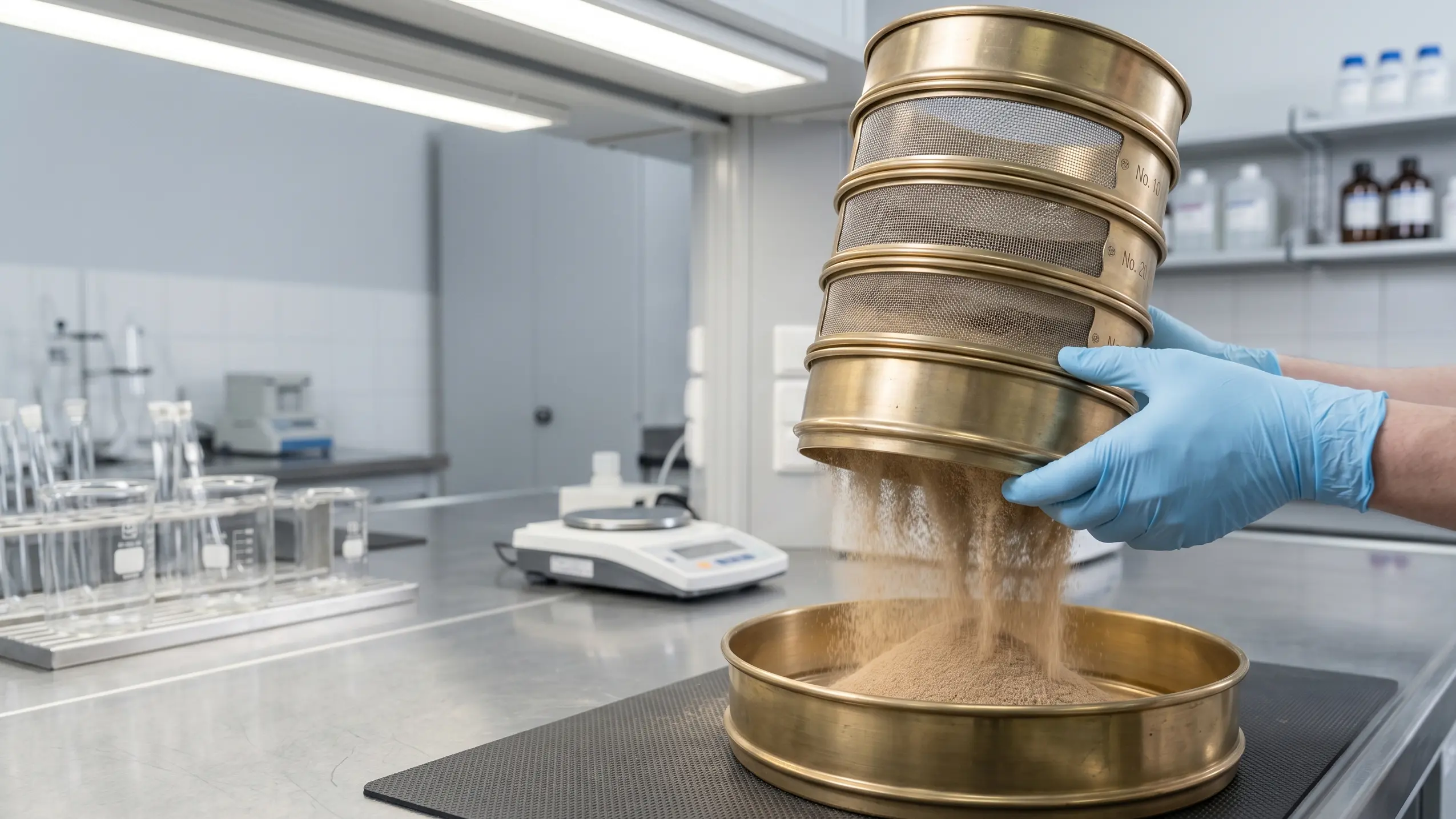
Two arenas built in the same week, using sand from the same county, can perform differently within a single riding season. One rides consistent, cohesive, and supportive for years. The other turns to concrete in summer and soup in winter, generates dust that damages equine lungs, and develops patches of inconsistent depth that raise lameness risk. The entire difference is captured in one document: a professional sand sieve analysis. This comprehensive guide explains how arena sand analysis works, what every number on the report actually means, and how to work with Performance Footing to commission a test and receive specifications tuned to your specific discipline, climate, and facility.
Why Sand Analysis Is the Foundation of Every Arena Decision
Rachel Murray’s 2010 Animal Health Trust study surveyed 2,554 British Dressage members and found that 33% of dressage horses had been lame at some point in their careers. The risk factors the research identified were specific: arenas that became deeper in wet conditions, sand arenas without stabilizing additives, and inconsistent depth across the working surface. Each of these problems traces back to the sand itself — to the distribution of particle sizes, the shape of those particles, their mineral composition, and the percentage of fines the sand contains.
The Stakes of Getting It Wrong
A single moderate lameness episode costs $2,700 to $7,400 in diagnostics, treatment, and rehabilitation. A torn suspensory ligament can exceed $14,000 in veterinary costs alone, and that figure does not account for lost training time, competition entries, or the horse’s long-term soundness. Against those numbers, the cost of a professional arena sand analysis is small — and the cost of installing the wrong sand across a 20,000 square foot arena is substantial.
Penn State Extension documents that a galloping horse inhales up to 600 gallons of air per minute. When the wrong sand degrades into fines or generates dust, every breath a horse takes during work moves that respirable particulate deep into the respiratory system. Sand analysis catches these problems before they reach the horse.
Why Appearance Fools Everyone
Beach sand, river sand, mason sand, concrete sand, and crushed industrial sand can all look similar in a bucket. Tan, fine, clean to the touch. Under a microscope and on a sieve stack, they behave nothing alike. Beach sand rolls like ball bearings. Crushed sand locks into concrete-hard layers. River sand may drain too fast to hold cohesion. Mason sand can contain too many fines to pass dust standards. Only laboratory analysis reveals the truth about what you are actually buying.
This is why the Racing Surfaces Testing Laboratory’s Arena Bulletin, authored by Peterson, Stavermann, and Hernlund, recommends evaluating sand by particle-size distribution, mineralogy, and durability rather than appearance or price.
Ready to find out what’s really in your arena? Order a Sand Analysis Test through Performance Footing and receive a professional laboratory report on your current footing or a prospective sand source. Call 877-835-0878 or visit performancefooting.com.
What Arena Sand Analysis Actually Measures
A comprehensive arena sand analysis evaluates four distinct characteristics of a sand sample. Each characteristic predicts a different aspect of how the sand will behave under a horse’s hoof.
Particle Size Distribution
Also called gradation, this is the percentage of sand retained on each of a standard series of sieves. Gradation controls cohesion, drainage rate, compaction behavior, and dust generation. It is the single most informative output of any sand analysis.
Particle Shape
Reported as rounded, sub-angular, or angular. Shape determines how grains interact under load — whether they slide past each other, interlock briefly then release, or lock permanently into a dense mass.
Mineralogy
The percentage of silica versus softer minerals. Mineralogy controls how long the sand lasts before degrading into fines and dust. A high-silica sand can serve an arena for a decade or more; a soft limestone-rich sand may begin degrading within two years.
Fines Content
The percentage of material smaller than 0.075 mm (passing the #270 sieve and collecting in the PAN). Too few fines, and the sand lacks cohesion. Too many, and the sand compacts, generates dust, and raises respiratory risk.
A sample that looks acceptable can fail on any of these four measurements independently. A professional arena sand analysis tests all four together, and the interpretation of those results is where discipline-specific and regional expertise matters most.
Understanding the US Mesh Sieve System
Sand gradation reports use the US Mesh system, a standard confirmed by ASTM E11. The number refers to how many openings per linear inch exist in the sieve screen — so a higher number means a finer sieve and smaller particles pass through.
The Six Sieves That Govern Arena Sand
- Mesh #18 — 1.00 mm openings (coarse sand)
- Mesh #35 — 0.50 mm openings (medium sand)
- Mesh #60 — 0.25 mm openings (medium-fine sand)
- Mesh #100 — 0.15 mm openings (fine sand)
- Mesh #140 — 0.106 mm openings (very fine sand)
- Mesh #270 — 0.053 mm openings (ultra-fine sand)
- PAN — Everything smaller than #270 (silt, clay, respirable dust)
The lab weighs the sand retained on each sieve, calculates it as a percentage of the total sample, and presents the results in a standard table format. That percentage distribution is what determines how your arena rides under every horse that works on it.
Reading a Sieve Report
A complete report includes three columns of percentages that describe the same distribution from different angles. The percentage retained per sieve shows what portion of your sample stopped on that specific screen. The cumulative percentage retained sums the retention from the coarsest sieve down to the current one. The percentage passing is the inverse, showing how much of the sample moved past that sieve to smaller ones.
Interpreting a sieve report against the right specification for your discipline, climate, and facility is where the value of professional consultation shows up. The raw laboratory numbers mean different things for a humid-southeast dressage barn than they do for an arid-southwest reining facility.
Industry Benchmarks for Arena Sand Specifications
Published research and industry standards establish reasonable ranges that arena sand specifications typically fall within. These ranges give owners a starting framework for the conversation with a quarry or footing consultant.
The USGA Adjacent Benchmark
The USGA putting-green specification — often cited as an adjacent quality benchmark for arena footing — requires at least 60% of particles in the 0.25 to 1.00 mm range and no more than 5% combined silt and clay. Arena footing specifications follow similar logic: enough medium-grade particles to build the working structure, not so many fines as to compact or aerosolize under hoof disturbance.
The Published Research Range
The Racing Surfaces Testing Laboratory’s Arena Bulletin and the FEI Equine Surfaces White Paper frame arena sand within broad ranges rather than single fixed values. Industry-published ranges typically look like the following, with the actual target within each range depending on discipline and climate:
- Mesh #18 — Generally 0% to 5% retained (most arena sand has little coarse content)
- Mesh #35 — Roughly 5% to 15% retained
- Mesh #60 — Roughly 35% to 55% retained (a primary cohesion-building sieve)
- Mesh #100 — Roughly 25% to 40% retained (the second primary cohesion sieve)
- Mesh #140 — Roughly 5% to 10% retained
- Mesh #270 — Typically less than 2% retained
- PAN — Typically less than 1%
These are industry-wide ranges, not a specification. Where your sand should sit within each range depends on whether the arena is indoor or outdoor, dressage or jumping, in Arizona or Georgia. A dressage arena in humid climate will target a different point within these ranges than a reining arena in dry climate.
Why the #60 and #100 Sieves Dominate Every Specification
Across virtually every published arena sand specification, the #60 and #100 sieves carry the largest percentages. Particles between 0.15 mm and 0.25 mm are large enough to interlock for shear strength under hoof impact, yet small enough to create the capillary water bridges that hold moisture and build cohesion between grains. This specific particle size range is where arena sand physically does its work, regardless of discipline or climate.
Sand that under-delivers on these two sieves rides loose, slippery, and inconsistent. Sand that over-delivers tends toward compaction. The precise target within the industry range is where professional specification guidance earns its keep.
Want the exact specification for your situation? Request your Custom Sand Guide from Performance Footing. Tell us your discipline, climate zone, and facility type, and receive a specification tuned to your needs — not a generic range. Call 877-835-0878 or visit performancefooting.com.
Particle Shape: The Variable That Doesn’t Appear on a Sieve Report
A sieve analysis tells you size distribution. It does not tell you shape. Shape matters just as much — and a quarry can match a sieve target perfectly while delivering sand that fails because the shape is wrong.
The Three Shape Categories
Rounded sand — Found in beach and river deposits where long water transport has worn the grains smooth. The grains act like ball bearings under hoof load. Horses slip on rounded sand, and it never develops true cohesion because the smooth surfaces cannot interlock.
Angular sand — Freshly crushed from quarry rock with sharp, fractured corners. The grains interlock too aggressively and compact into a brick-hard surface within weeks of installation. Angular sand also abrades hoof walls and generates rapid fine-particle production from edge-to-edge grinding under hoof impact.
Sub-angular sand — The target for every arena. These grains have experienced enough transport to break off their sharpest corners but retain enough edge to interlock productively. Sub-angular sand delivers the combination of traction, shear strength, and void space for drainage and slight hoof penetration that defines a good riding surface.
Requesting Shape in Addition to Gradation
Arena owners should specifically request sub-angular silica sand when sourcing. Ask the quarry about the geological origin: is the sand from a river deposit where water transport has rounded the grains? From a dune deposit where wind transport has produced rounder grains still? From a freshly crushed quarry feed where the grains remain sharply angular? The answer predicts shape.
Performance Footing’s arena specialists can help interpret quarry source information during sand sourcing conversations, particularly in regions where sub-angular silica sources require more effort to identify.
Mineralogy: Why Silica Content Determines Longevity
Sand mineralogy determines how long your arena lasts before the material breaks down into dust and needs replacement.
The Mohs Hardness Scale Explained
Silica and quartz sands sit at Mohs hardness 7. They resist breakdown under repeated hoof impact for years or decades. Softer limestone, feldspar-rich, and calcareous sands sit at Mohs 3 through 6, and they degrade into fines within a few years of regular use.
The 90% Silica Benchmark
Competition-grade arena specifications typically call for greater than 90% silica content. This level is now verifiable under ASTM F3419-22, which uses X-ray diffraction to characterize the mineral composition of sand samples. Arena owners commissioning new footing or evaluating an unfamiliar quarry source should request mineralogy verification in addition to sieve analysis, particularly in regions where limestone-based sands are common.
What Happens When Non-Silica Sand Degrades
Softer sands compress under hoof impact, fragment at grain contact points, and eventually reduce to fines. Those fines accumulate in the PAN fraction, and when the arena dries out, they loft as respirable dust. The arena that tested well at installation can fail dust standards two to four years later as the mineralogy breaks down. Verifying silica content at installation prevents this slow-motion failure.
The PAN Fraction: Getting Fines Content Right
Every sand sample includes material small enough to pass through the #270 sieve. This PAN fraction is reported separately on the analysis and carries outsized importance relative to its small percentage.
Why Fines Are a Double-Sided Problem
Too few fines, and the sand lacks cohesion. It will not hold together under a hoof strike, and it loses moisture retention capacity. Too many fines, and the sand compacts into a dense, poorly-draining layer that also generates airborne dust when dry.
Tight discipline on fines content — typically capping #270 retention well under 2% and PAN under 1% in quality specifications — is one of the parameters that quarries most commonly miss without explicit instruction. The fines end of the distribution receives less attention than the middle sieves in general construction sand supply.
How to Collect a Sand Sample for Analysis
Sample collection quality determines whether your analysis reflects reality. A poorly pulled sample produces a misleading report regardless of laboratory precision — and a misleading report leads to bad arena decisions.
Proper Sampling Procedure
- Sample from multiple points — At least five locations distributed across the arena. Include corners, center, and high-traffic zones near gates where footing composition often differs from less-used areas.
- Sample at full working depth — Pull from the entire depth of the working layer, not just the surface. A one-inch surface sample misses compaction patterns and stratification below. Use a small hand trowel or tube sampler to collect the full profile at each sub-sample location.
- Combine and mix thoroughly — Place all sub-samples in a clean container and blend thoroughly before bagging the final sample. Uneven mixing reports the composition of whichever sub-sample happened to dominate the bagging scoop rather than the arena as a whole.
- Bag and label clearly — Use a clean plastic bag, seal tightly, and label with the date, arena location, sample depth, and the number of sub-sample points combined.
- Document conditions — Note whether the sand is dry or damp, the last watering or grooming event, the age of the footing, any recent additive applications, and the overall working depth. These conditions affect interpretation.
When to Test
- Before purchasing a property with an existing arena — Test to understand what you are inheriting and what renovation may be required.
- Before a major arena renovation — Test to determine whether the existing sand can be amended or whether it needs full replacement.
- When performance changes — Test when the arena begins behaving differently, developing dust problems, compaction, or inconsistent depth.
- When footing ages past four years — Test as a maintenance checkpoint, particularly for arenas built with lower-silica sand sources.
- When evaluating a new quarry source — Test the source material before committing to a full arena installation to verify the match against specifications.
Not sure how to sample your arena? When you order a Sand Analysis Test through Performance Footing, you receive sampling guidance and a professional laboratory report on your sand’s gradation, with interpretation against a specification tuned to your discipline and region. Call 877-835-0878 to get started.
Matching Analysis to Your Riding Discipline
Sand specifications and additive strategies differ by discipline. A specification that produces excellent dressage footing may produce poor jumping footing in the same climate, and vice versa. Performance Footing’s Custom Sand Guide tunes recommendations to match the specific demands of how you ride.
Dressage Arenas
Dressage places continuous, repetitive loads on the same hoof pattern sequences — repeated lateral work, transitions, and collected gaits on relatively tight figures. The surface needs consistent cohesion, uniform depth, and enough responsiveness to support collection without exhausting the horse’s topline musculature.
Dressage specifications typically shift within the industry range toward finer particle distribution to maximize cohesion. The #60 and #100 sieves carry particular weight. Dressage arenas often benefit from the FLEX™ moisture-retentive additive to hold cohesion through long schooling sessions, paired with careful moisture management to prevent the depth inconsistency that Murray’s epidemiology identified as a lameness risk factor.
Jumping Arenas
Jumping arenas experience high peak loads at takeoff and landing, concentrated in specific zones around fences. The surface needs traction under shear load, controlled cushioning to reduce concussive impact on landing, and enough elasticity to support the next stride without becoming fatiguing.
Jumping specifications typically allow slightly more coarse content than dressage specifications to build shear strength. The FoamFooting TPE cushioning additive addresses peak impact absorption particularly in high-intensity jumping programs.
Reining and Western Performance
Reining surfaces need controlled slide — enough traction for stops and turnarounds, but enough release for sliding stops. This balance places specific demands on particle shape and moisture content, because over-cohesive footing will not release for a slide and under-cohesive footing will not support a stop.
Reining specifications often sit in a different zone of the industry range than dressage or jumping, emphasizing a shape and moisture profile that supports slide behavior. Moisture management and additive selection become particularly important for consistent slide across changing weather.
Eventing and Cross-Training Facilities
Eventing horses benefit from surface variety — a finding reinforced by Murray’s research, which identified cross-training on different surfaces as a protective factor against lameness. Eventing facility owners often maintain multiple surfaces: a dressage arena tuned for cohesion, a jumping arena tuned for shear strength, and outdoor conditioning tracks with different characteristics entirely.
A Performance Footing arena consultant can coordinate specifications across multiple surfaces within a single facility to ensure each arena serves its intended discipline while maintaining consistency within itself.
Multi-Use Private Arenas
Most private arenas host multiple disciplines across different horses and riders. Multi-use specifications sit toward the center of the industry ranges and rely on additive strategy to tune performance for the primary discipline. The specification conversation becomes one of compromise and prioritization — which discipline is primary, which are occasional, and where the surface tuning should sit on the cohesion-versus-release spectrum.
Get the specification that matches your riding. Request your free Custom Sand Guide from Performance Footing for discipline-specific sieve targets, additive recommendations, and quarry-sourcing guidance. Call 877-835-0878 or visit performancefooting.com.
Regional Sourcing: Why Climate and Geology Matter
Arena sand is a heavy, bulky material. Transporting it long distances adds substantial cost, which means regional geology largely determines what sand is practical to source. Performance Footing’s arena consultants tune recommendations to match regional realities.
Arid Southwest Considerations
The American Southwest offers abundant silica sand sources from desert and alluvial deposits, but the dry climate places heavy demands on moisture management. Arenas in Arizona, New Mexico, southern Nevada, and west Texas often need aggressive dust control strategies and moisture-retentive additives to compensate for rapid evaporation.
Southwestern specifications often sit slightly toward the finer end of the industry range to maximize cohesion in low-moisture conditions. The FLEX™ moisture-retentive additive and the DustHalt binder for arena dust control are particularly valuable in this region. For facilities that want to cut routine watering, LOCK™ delivers a dust-free surface that rides almost waterless in southwestern conditions.
Humid Southeast Considerations
The Southeast presents the opposite challenge. Humidity keeps sand moist, but heavy rain events saturate outdoor arenas and raise the risk of the “deeper when wet” pattern Murray’s research flagged as a lameness risk factor. Silica sand is available throughout the region, but proper drainage base construction becomes critical.
Southeastern specifications may shift slightly coarser than arid-region specifications to improve drainage behavior. The BaseCore HDPE geocell base stabilization supports the sand layer from below and maintains drainage performance in regions with high annual rainfall.
Temperate Midwest Considerations
The Midwest deals with freeze-thaw cycles that expand and contract moisture-laden footing across a wide temperature range. Sand mineralogy and particle shape become especially important because freeze-thaw accelerates the breakdown of softer mineralogy.
Midwestern arena owners should request mineralogy verification as part of any sand analysis and prioritize higher silica content to extend footing life through repeated freezing cycles.
Cold Northeast Considerations
Northeastern arenas face extended winter use of indoor facilities and compressed outdoor riding seasons. Indoor arena specifications become particularly important, as do dust control strategies that work in the low-humidity winter conditions typical of heated indoor facilities.
Pacific Northwest Considerations
The Pacific Northwest combines regular rainfall, moderate temperatures, and regionally variable sand geology. Sourcing silica-rich sand can require more effort than in regions with abundant quartz-based deposits, and base drainage construction receives extra emphasis given sustained wet-season conditions.
A Performance Footing arena consultant familiar with regional sand availability can save considerable effort in the sourcing phase by directing owners toward quarries known to produce material matching the target specifications.
How to Deliver the Analysis to Your Quarry
This is where many arena projects succeed or fail — in the conversation between the arena owner and the quarry that will supply the sand.
The Quarry Conversation
When you have a specification in hand — either from a Custom Sand Guide or from working with a Performance Footing consultant — the quarry conversation requires three specific asks:
- Sieve distribution match — The quarry should confirm it can deliver sand matching the percentage targets across mesh #35 through mesh #270. Ask for a recent sieve analysis of the stockpile you will actually be buying from, not a generic specification sheet.
- Particle shape confirmation — Request sub-angular grains specifically. Ask about the source material: is it river sand, dune sand, or crushed quarry feed? Ask whether the stockpile has been washed, which affects fines content.
- Silica content verification — Ask for greater than 90% silica content, verified by mineralogy documentation. In regions where limestone-based sands are common, this question alone can rule out several potential sources before you invest in testing.
What to Do When the Quarry Cannot Match
Not every local quarry stocks sand that matches arena specifications. If the nearest source falls short, arena owners have three paths forward:
- Source from a farther quarry — A quarry 100 miles away that matches the specification often produces a better long-term outcome than a local quarry that does not, even after accounting for transport cost.
- Blend two local sources — Combining sands from two quarries can approximate a target distribution that neither source alone can match. This requires careful testing of the proposed blend ratio.
- Request Performance Footing sourcing guidance — Performance Footing specialists maintain familiarity with quarry sources across multiple regions and can often direct owners toward sources known to work.
Why Analysis Connects to the Full Footing System
Sand analysis is the foundation of arena footing, but it is not the entire system. The 2014 FEI Equine Surfaces White Paper identifies five functional properties of arena footing — impact firmness, cushioning, responsiveness, grip, and uniformity — and sand alone does not fully deliver any single one of them.
The Additive Layer Tunes Performance
Once the correct sand is sourced, additives tune the surface for specific discipline demands, climate realities, and use patterns. Performance Footing’s product line addresses each FEI property:
- Cushioning is addressed by the FoamFooting TPE cushioning additive
- Consistency is addressed by the FLEX™ moisture-retentive additive, which retains 65% more moisture than plain sand
- Dust control and respiratory safety are addressed by the DustHalt™ binder, which keeps dust settled at floor level, and by LOCK™ for longer-lasting control
- Base stability is addressed by the BaseCore HDPE geocell system that supports the sand layer from below
The analysis tells you what sand to buy. The additive recommendations tell you how to make that sand perform for your discipline, climate, and use pattern. For the broader context of how these technologies developed, the arena footing history timeline documents how each innovation solved a specific welfare problem across 2,400 years of arena evolution.
Working With Performance Footing From Analysis Through Installation
Arena owners benefit most when sand analysis is treated as the opening step of a coordinated specification process rather than a standalone laboratory exercise.
The Full Consultation Path
When you speak with a Performance Footing arena consultant, the conversation typically covers:
- Current footing condition — What is installed now, how old it is, and what problems you have observed
- Riding discipline and use intensity — Who rides, what disciplines, and how many hours per week
- Regional climate and facility type — Indoor, outdoor, or both, and what climate challenges you face
- Budget and project scope — Full replacement, top-dressing, additive-only amendment, or new construction
- Sampling and analysis — Arranging for a Sand Analysis Test on current footing or prospective quarry sources
- Specification delivery — Receiving a Custom Sand Guide with discipline- and region-tuned targets
- Quarry sourcing — Identifying quarries capable of matching the target specifications
- Additive and base recommendations — Selecting the product combination that addresses the five FEI properties for your specific situation
- Installation coordination — Timing, depth, and technique for installing sand and additives
This coordinated path produces arenas that perform as specified rather than arenas that meet one parameter in isolation while missing others.
Conclusion
Arena sand analysis is the document that converts arena building from guesswork into engineering. Six sieve numbers, one particle shape category, one mineralogy percentage, and one fines cap — together, these specifications define whether your arena will ride consistent and protect your horse, or whether it will drift into the problems every era of arena footing history has tried to solve.
Performance Footing’s Sand Analysis Test delivers the laboratory data. Performance Footing’s Custom Sand Guide delivers the specification tuned to your discipline, climate, and facility. Together, they convert the industry ranges in this article into the exact targets that will work for your arena.
Two actions to take today:
1. Order your Sand Analysis Test to understand what is actually in your current footing or a prospective sand source. Professional laboratory analysis with expert interpretation.
2. Request your free Custom Sand Guide tuned to your discipline and regional climate. Discipline-specific sieve targets, additive recommendations, and quarry-sourcing guidance delivered to you.
Call 877-835-0878 or visit performancefooting.com to start either service.
FAQ
1. How do I order a Sand Analysis Test through Performance Footing?
Contact Performance Footing at 877-835-0878 or through the company website to order a Sand Analysis Test. The service includes sample collection guidance, professional laboratory analysis of gradation and particle characteristics, and interpretation by an arena specialist who can recommend specifications for your discipline and region.
2. What is a Custom Sand Guide and how is it different from a general specification?
A Custom Sand Guide is a specification document tuned to your specific discipline, regional climate, indoor or outdoor facility, and use intensity. Published industry ranges give a starting framework, but where your sand should sit within those ranges depends on how you ride, where you ride, and what your arena needs to do. Request your free Custom Sand Guide by calling 877-835-0878 or visiting performancefooting.com.
3. What does a sand sieve analysis actually tell me?
A sieve analysis reports the percentage of sand retained on each of six standard US mesh sieves, from #18 (1.00 mm) down to #270 (0.053 mm), plus the PAN fraction. It reveals particle size distribution, which predicts how the sand will behave under hoof strike for cohesion, drainage, dust generation, and compaction behavior.
4. What industry ranges do most arena sand specifications fall within?
Published industry research generally places the two primary cohesion sieves — #60 and #100 — within ranges of roughly 35% to 55% and 25% to 40% retention respectively. Coarser sieves typically fall below 15% retention and the PAN fraction typically stays under 1%. Where your specific specification should sit within these ranges depends on discipline and climate, which is why a Custom Sand Guide is worth the short conversation to produce.
5. What if my local quarry cannot match the specification I receive?
Arena owners have three options: source from a farther quarry that matches, blend two local sources to approximate the target distribution, or contact Performance Footing at 877-835-0878 for regional sourcing guidance. Performance Footing specialists maintain familiarity with quarry sources across multiple regions and can direct owners toward suitable options.
This article references publicly available information from the Fédération Equestre Internationale, ASTM International, Penn State Extension, the Racing Surfaces Testing Laboratory, the USGA, the Animal Health Trust, and peer-reviewed research published by Murray, Peterson, Stavermann, Hernlund, and colleagues. Source material includes the FEI Equine Surfaces White Paper (2014), ASTM F3400-19 and F3419-22 standards, and Murray et al. (2010) epidemiological research. Industry ranges cited are drawn from published research and standards rather than any single proprietary specification. Results described are specific to the organizations mentioned and may vary based on local sand availability, arena use, discipline, and climate. For professional sand testing, a Custom Sand Guide tuned to your discipline and region, or arena consultation, visit www.performancefooting.com or call 877-835-0878.