
Arena Footing Systems
Arena Footing Additive Mistakes: 7 Costly Errors That Harm Your Horse
Performance Footing · October 30, 2026 · 16 min read
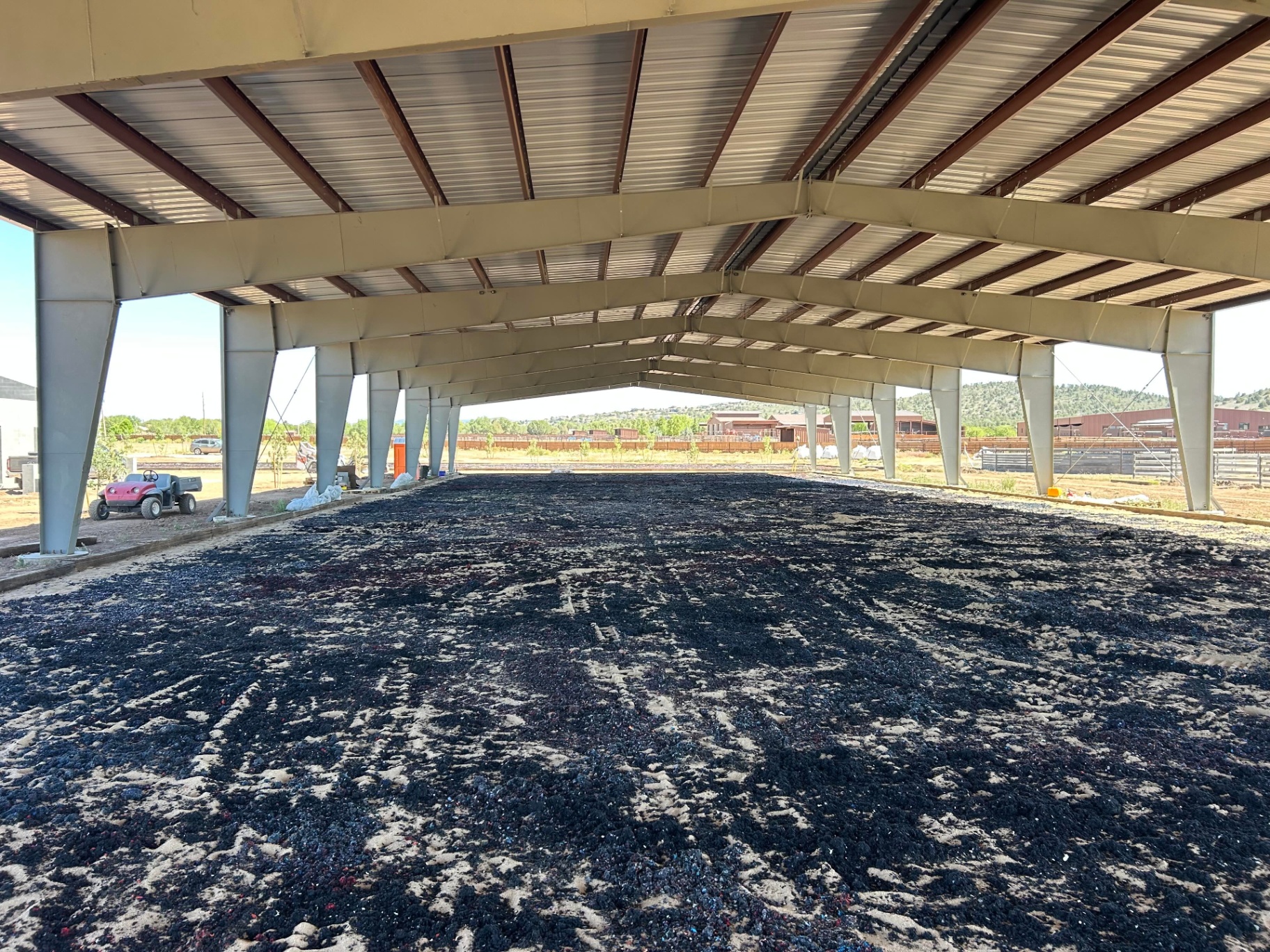
Avoid costly arena footing additive mistakes. Learn why used motor oil, rubber-only additives, and DIY shortcuts harm horses — and what actually works.
A 2019 study published in the Equine Veterinary Journal found that footing surface characteristics account for up to 90% of the variation in peak vertical loading on equine limbs during movement — making what you add to your arena sand one of the most consequential decisions for your horse's soundness. Yet arena owners routinely introduce additives that degrade footing performance, create health hazards, or contaminate soil for decades.
The most common arena footing additive mistakes include using motor oil or waste oil for dust control, adding rubber crumb without fiber reinforcement, over-applying additives without sieve analysis, and relying on household products that create slippery or inconsistent surfaces. These shortcuts often seem cost-effective initially but lead to respiratory issues, joint stress, environmental contamination, and expensive remediation. Performance Footing addresses these problems through the ArenaSpec system — a sand-first, diagnose-then-specify approach that matches additives to your arena's actual particle distribution, climate, and discipline requirements.
This article examines seven specific footing additive mistakes arena owners make, explains the science behind why each one fails, and provides evidence-based alternatives that protect your horse's health and your investment.
On this page
The Science Behind Footing Additives: Why Composition Matters
Mistake #5: Over-Applying Additives Based on Manufacturer Ratios
Mistake #6: Using Household Products for Dust or Moisture Control
How to Avoid Arena Footing Additive Mistakes: A Diagnostic Approach
The Science Behind Footing Additives: Why Composition Matters
Arena footing functions as a biomechanical system. When a horse's hoof strikes the surface, the footing must absorb impact energy, provide traction during the stance phase, then release cleanly during breakover. Research by Dr. Mick Peterson at the University of Kentucky's Racing Surfaces Testing Laboratory demonstrates that this performance depends on precise relationships between particle size distribution, moisture content, and additive integration.
Sand alone cannot deliver consistent performance. Pure silica sand compacts under repeated traffic, losing the air voids that provide cushion. It migrates under hoof action, creating deep spots and hard spots. Without moisture management, it either becomes dusty (creating respiratory hazards) or waterlogged (becoming slippery and heavy). Additives address these limitations — but only when selected based on the sand's actual gradation curve and the facility's specific conditions.
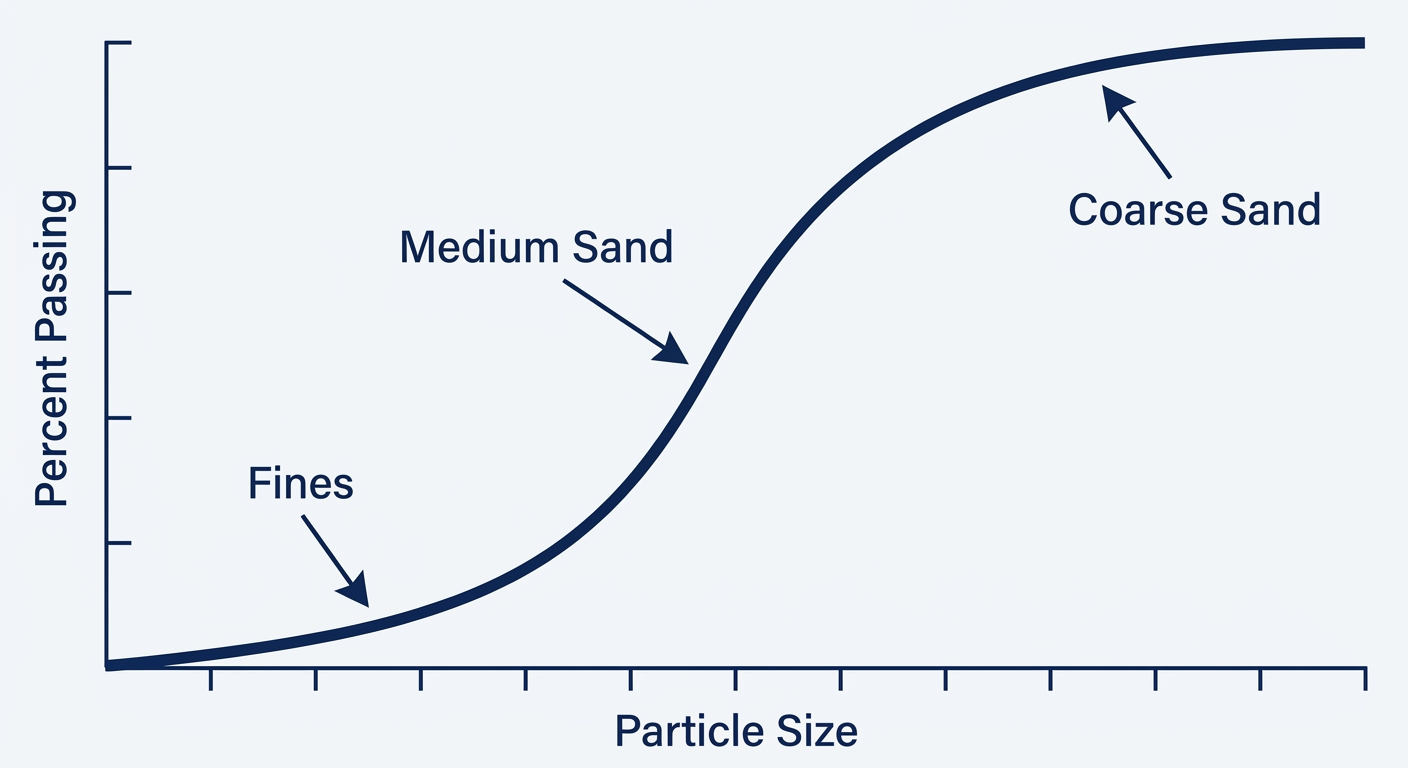
Sieve analysis identifies the exact particle distribution to determine which additives your sand requires.
The Fédération Équestre Internationale (FEI) requires competition surfaces to meet specific standards for grip, cushioning, and responsiveness. These standards emerged from decades of research correlating surface characteristics with injury rates. Dr. Lars Roepstorff's work at the Swedish University of Agricultural Sciences established that inconsistent footing — surfaces that vary in firmness, grip, or response across the arena — increases strain on tendons and ligaments because the horse cannot anticipate surface behavior.
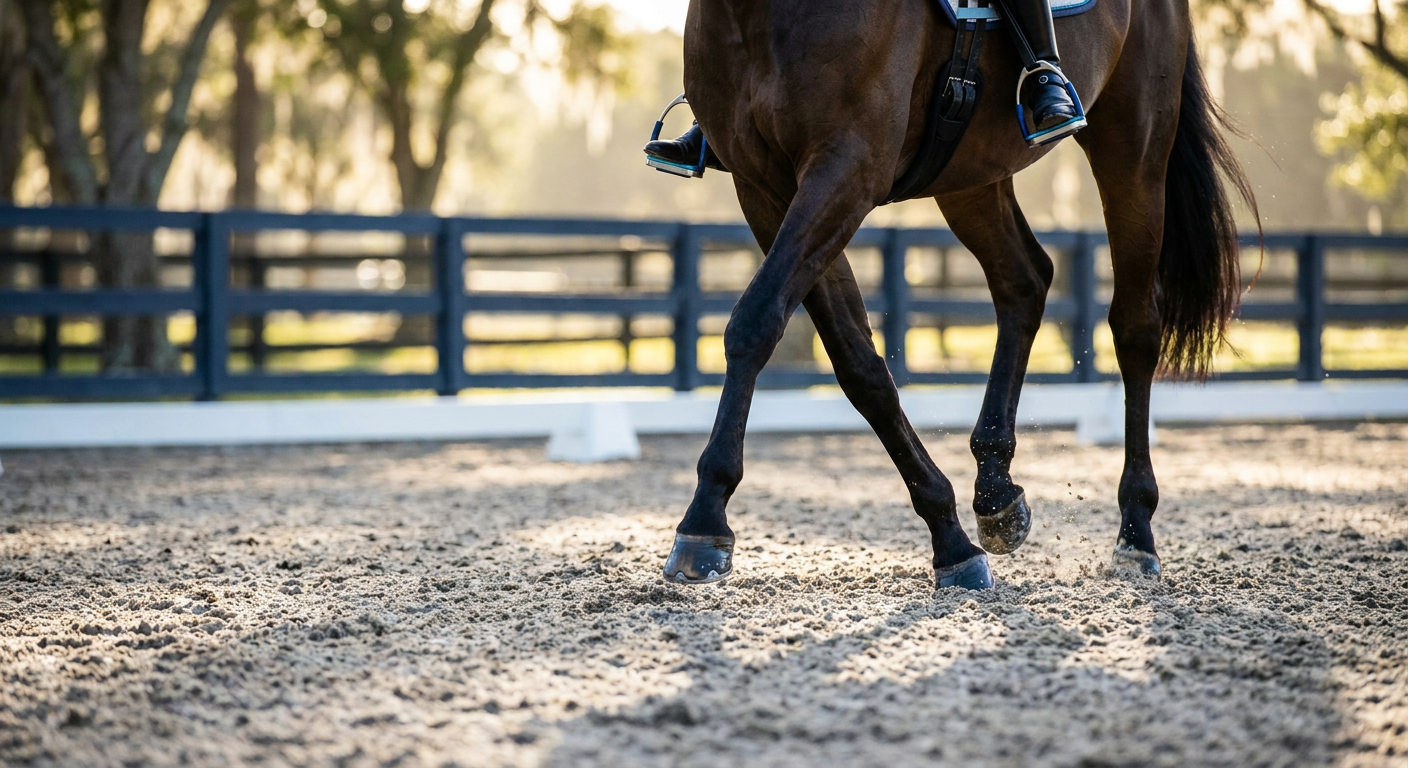
A stable footing system functions as a biomechanical tool to absorb impact and provide predictable traction.
This scientific foundation explains why "arena footing additive mistakes" matter so much: the wrong additive doesn't just fail to help — it actively disrupts the biomechanical relationships that keep horses sound. Understanding these principles helps you evaluate any additive recommendation critically.
Mistake #1: Using Motor Oil or Waste Oil for Dust Control
The most dangerous arena footing additive mistake involves using motor oil, transmission fluid, or other petroleum-based waste oils as dust suppressants. This practice persists because oil does temporarily bind fine particles and reduce airborne dust. However, the consequences make this one of the worst possible choices for any equestrian facility.
Why Oil Fails as Arena Dust Control
Motor oil contains polycyclic aromatic hydrocarbons (PAHs), heavy metals from engine wear, and combustion byproducts — all classified as environmental contaminants by the EPA. When applied to arena surfaces, these compounds don't stay contained. Horses ingest contaminated particles during normal activity. Rain events carry oil into groundwater. The contaminated sand cannot be legally disposed of as normal waste in most jurisdictions.
Beyond contamination, oil fundamentally changes sand behavior in ways that compromise footing performance. Petroleum products coat sand grains, reducing the inter-particle friction that provides traction. Over time, oil-treated footing becomes slippery when temperatures rise (oil viscosity drops) and unpredictably grippy when cold. This inconsistency — the exact condition Dr. Roepstorff's research links to increased injury risk — makes the surface dangerous regardless of discipline.
The Penn State Extension equine facility management program explicitly warns against oil-based dust suppressants, noting that remediation costs for contaminated arena surfaces routinely exceed $15,000–$50,000 depending on arena size and local regulations.
What Actually Works for Dust Control
Effective dust suppression requires binding respirable fines — particles smaller than 10 microns that penetrate deep into equine and human lungs — without compromising surface mechanics. Performance Footing's ArenaSpec LOCK uses plant-oil-based compounds specifically formulated to suppress dust while maintaining consistent traction across temperature ranges. Unlike petroleum products, LOCK is biodegradable, groundwater-safe, and doesn't accumulate toxic compounds over time.
Mistake #2: Adding Rubber Crumb Without Fiber Reinforcement
Rubber crumb — granulated material from recycled tires — offers legitimate benefits: cushioning, some dust reduction, and relatively low cost. Many arena owners add rubber directly to sand expecting improved performance. This approach fails because rubber alone doesn't address the primary mechanical deficiencies of sand-only footing.
The Rubber-Only Problem
Rubber particles (such as those from tires) and sand particles have different densities. Rubber (specific gravity approximately 1.15) is significantly lighter than silica sand (specific gravity 2.65). Under the mechanical action of hooves — particularly the shearing forces during sliding stops, rollbacks, and lateral movements — lighter rubber particles migrate upward while heavier sand sinks. Within weeks of use, rubber-only arenas develop a distinct layering pattern: rubber-rich surface over sand-rich subsurface.
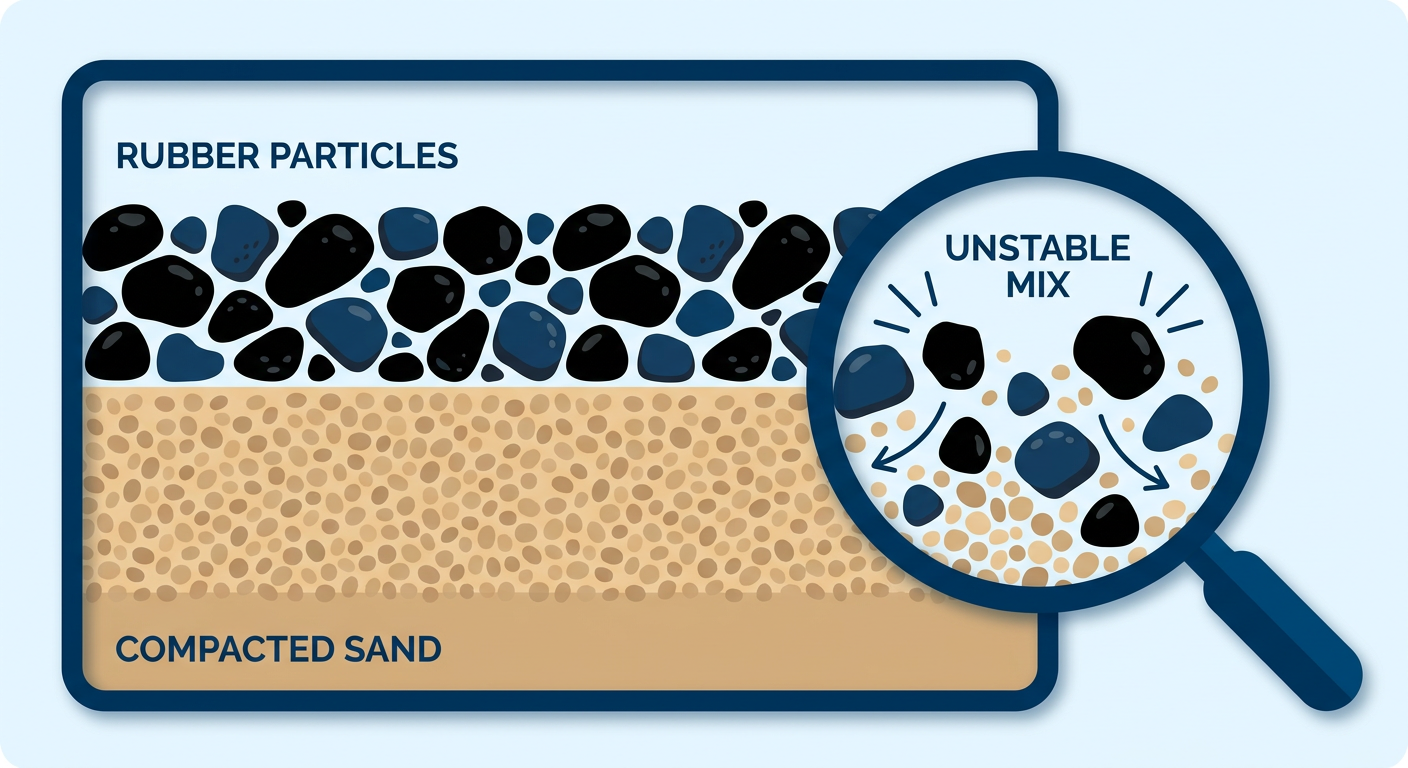
Without fiber reinforcement, lighter rubber particles migrate to the surface, causing inconsistent and shifty footing.
Without fiber reinforcement, lighter rubber particles migrate to the surface, causing inconsistent and shifty footing.
This separation creates multiple problems. The rubber-rich surface layer loses the structural stability that sand provides, becoming shifty and unpredictable. The sand-rich sublayer compacts without the cushioning benefit the rubber was supposed to provide. Horses experience the worst of both materials rather than the intended blend.
Research published in the Journal of Equine Veterinary Science examined rubber-additive arenas and found that surfaces without fiber reinforcement showed significantly more vertical variation (measured in millimeters of depth inconsistency) than fiber-stabilized surfaces after equivalent use periods. This variation correlates directly with increased limb loading variability.
The Fiber Solution
Fiber additives create a three-dimensional matrix that holds dissimilar particles in suspension. The fibers physically interlock with both sand and rubber, preventing gravity-driven separation. ArenaSpec FIBR uses plant-based natural fiber specifically engineered for shear strength and binding in the sand profile. When combined with cushioning elements, FIBR maintains the intended particle distribution rather than allowing stratification.
This doesn't mean rubber is wrong for arenas — it means rubber alone is incomplete. A properly designed footing system integrates cushioning elements (rubber, synthetic foam, or engineered elastomers) with structural fiber to create a stable, consistent surface.
Mistake #3: Applying Additives Without Sieve Analysis
Perhaps the most pervasive arena footing additive mistake involves treating all sand as equivalent. Arena owners purchase additives based on manufacturer recommendations or neighbor suggestions without understanding their specific sand's particle size distribution. This approach guarantees suboptimal results because additive requirements vary dramatically based on sand gradation.
Why Sand Gradation Determines Additive Needs
A sieve analysis reveals the percentage of particles in each size fraction — from coarse particles (retained on larger mesh sieves) to fines (passing through smaller meshes). The gradation curve determines nearly every performance characteristic: drainage rate, compaction tendency, dust generation, and moisture retention.
Sand with excessive fines (more than 10–15% passing a #200 sieve) already retains moisture effectively but generates problematic dust. Adding a moisture-retention product to this sand creates waterlogged, heavy footing. Conversely, uniformly graded coarse sand drains too quickly and compacts readily — it needs both moisture management and structural reinforcement.
Dr. Mick Peterson's Racing Surfaces Testing Laboratory emphasizes that footing prescriptions must begin with laboratory analysis of the existing sand. The laboratory's published protocols specify sieve analysis as the foundational diagnostic step before any additive recommendation.
The Sand-First Approach
Performance Footing's sand analysis kit provides the diagnostic foundation for accurate additive specification. The laboratory analysis reveals your sand's actual gradation curve, moisture characteristics, and structural properties — information that determines whether you need fiber reinforcement, moisture buffering, cushioning additives, or some combination.
Sieve analysis identifies the exact particle distribution to determine which additives your sand requires.
This sand-first philosophy means every ArenaSpec recommendation is customized to your specific sand, not a generic formulation applied universally. The difference between generic additives and sand-matched additives often determines whether a footing investment succeeds or fails.
Don't guess at your arena's additive needs. Performance Footing's sand analysis kit provides the diagnostic data for accurate specification. Request a quick quote or call 877-835-0878 to discuss your arena's specific conditions.
Mistake #4: Using Carpet Fiber or Textile Waste
Recycled carpet fiber appears in arena footing discussions as a low-cost fiber alternative. Some manufacturers sell carpet scraps or textile waste as "arena fiber." While genuine fiber additives provide essential structural benefits, carpet-derived materials create problems that legitimate arena fiber products avoid.
The Carpet Fiber Problem
Carpet manufacturing involves multiple synthetic polymers, adhesive backing compounds, stain treatments, and fire retardants. When carpet is shredded for recycling, these compounds remain attached to the fibers. As carpet fiber degrades in arena conditions — UV exposure, moisture cycling, mechanical abrasion — these chemicals leach into the footing matrix.
Beyond chemical concerns, carpet fibers weren't engineered for arena applications. The fiber length, diameter, and surface characteristics that work for floor covering don't optimize shear strength in sand. Carpet fibers tend toward inconsistent lengths (creating uneven distribution), may include rigid backing fragments (hoof hazards), and often mat together when wet rather than maintaining dispersed structural function.
Environmental testing of carpet-fiber arenas has detected elevated levels of volatile organic compounds (VOCs) and phthalates — endocrine disruptors that accumulate in biological systems. While direct health effects on horses from arena-level exposure remain under-studied, the precautionary principle suggests avoiding unnecessary chemical introduction.
Purpose-Engineered Fiber Alternatives
Legitimate arena fiber products are manufactured specifically for equestrian applications. Performance Footing's FIBR uses plant-based natural fiber selected for consistent length, appropriate diameter for sand integration, and biodegradability. The material performs its structural function without introducing synthetic compounds that persist in the environment.
The cost difference between carpet waste and purpose-engineered fiber is typically 15–25% — a modest premium that eliminates chemical exposure concerns and provides predictable performance characteristics.
Mistake #5: Over-Applying Additives Based on Manufacturer Ratios
Additive manufacturers provide application ratios — typically expressed as pounds or cubic yards of additive per square foot of arena. These ratios represent starting points based on average sand characteristics. Arena owners who apply manufacturer ratios without adjustment often end up with too much additive, too little, or the wrong distribution pattern.
Why Generic Ratios Fail
Consider two arenas of identical size. Arena A uses well-graded angular silica sand with 8% fines. Arena B uses rounded beach sand with 18% fines. The fiber requirement for Arena A — which needs significant structural reinforcement due to particle shape — might be 50% higher than Arena B, which already has some natural binding from the fine fraction. Applying the same fiber ratio to both arenas leaves one under-reinforced and the other with excess fiber that impedes drainage.
Moisture-management additives show even greater sensitivity to sand characteristics. Products that buffer moisture swings work by adsorbing and releasing water vapor based on ambient humidity. The appropriate application rate depends on the sand's native moisture retention, local humidity patterns, watering frequency, and drainage characteristics. Generic ratios cannot account for this variability.
Over-application creates its own problems. Excess fiber can form clumps that create inconsistent footing texture. Too much moisture-retention product in humid climates produces footing that stays wet longer than desired. Excessive cushioning additives may reduce the firmness that certain disciplines require.
Calibrated Application Through Analysis
The ArenaSpec system avoids generic ratios by specifying each product's application rate based on sieve analysis results, climate data, discipline requirements, and usage intensity. A free arena footing consultation with Performance Footing establishes the diagnostic foundation for accurate specification — ensuring you apply the right amount of each product for your specific conditions.
Mistake #6: Using Household Products for Dust or Moisture Control
Internet forums and word-of-mouth recommendations sometimes suggest household products for arena dust control or moisture management: dish soap, fabric softener, vegetable oil, salt, or various cleaning agents. These suggestions typically stem from observations that the product temporarily affects dust or moisture in small-scale tests. Scaling to arena applications reveals why these shortcuts fail.
Why Household Products Don't Scale
Dish soap and fabric softener contain surfactants that temporarily suppress dust by reducing surface tension. However, these products wash out with the first significant rain, requiring repeated application. Residual surfactants can create slippery conditions when wet — precisely the opposite of safe footing. Some formulations contain fragrances and dyes that serve no functional purpose but introduce unnecessary chemicals.
Salt (sodium chloride or calcium chloride) absorbs atmospheric moisture, keeping surfaces damp. This approach works for gravel roads but creates problems in arenas. Salt concentrations sufficient for effective dust control approach levels that damage plants (relevant for outdoor arenas with surrounding vegetation), corrode metal infrastructure, and may irritate equine hooves and skin during prolonged contact. Salt also accelerates freeze-thaw damage in cold climates.
Vegetable oil shares some problems with motor oil — it coats particles and affects friction coefficients — though without the toxic contamination concerns. The primary issue is rancidity: vegetable oils oxidize and decompose, creating unpleasant odors and potentially attracting pests. The application quantities needed for arena-scale dust control make this approach economically impractical compared to purpose-designed products.
Engineered Products for Specific Functions
Professional arena additives are formulated for specific functions with predictable performance characteristics. ArenaSpec LOCK suppresses dust through a plant-oil-based concentrate engineered for arena conditions — UV-stable, rain-resistant, and consistent across temperature ranges. ArenaSpec HOLD+ buffers moisture swings using natural mineral compounds that adsorb and release water vapor based on ambient conditions, maintaining consistent firmness without salt-related drawbacks.
The cost comparison between household products (requiring frequent reapplication with inconsistent results) and purpose-designed additives (requiring less frequent application with predictable performance) typically favors the engineered products over any reasonable time horizon.
Mistake #7: Neglecting Climate and Discipline Matching
Arena footing additive selection must account for local climate patterns and primary discipline use. An additive system optimized for a covered dressage arena in Arizona requires different specifications than an outdoor reining arena in Florida. Treating additives as universal solutions ignores the environmental and biomechanical variables that determine success.
Climate Variables That Matter
Humidity affects moisture retention requirements. Arid climates (annual relative humidity below 40%) require more aggressive moisture management to prevent excessive dust and maintain adequate cushion. Humid climates (annual relative humidity above 60%) need moisture-buffering additives that prevent waterlogging during wet periods while maintaining adequate moisture during dry spells.
Temperature extremes affect additive behavior. Some dust-control products become less effective at temperature extremes — either too viscous when cold or too fluid when hot. Moisture-retention additives perform differently as evaporation rates change with temperature. Freeze-thaw cycling in northern climates creates mechanical stress that some additives handle better than others.
Precipitation patterns determine drainage requirements. Arenas in high-rainfall regions need footing systems that drain quickly without losing moisture-retention additives. Covered arenas in the same regions face different challenges — they don't receive direct rainfall but may experience humidity-driven moisture accumulation.
Discipline-Specific Requirements
Different disciplines place different demands on footing surfaces. Dressage arena footing requires consistent firmness for collected movements and precise footfall placement. Reining arena footing must accommodate sliding stops and rapid directional changes — requiring specific shear characteristics. Western performance footing for barrel racing needs controlled slide with quick recovery.
Additive selection affects these discipline-specific characteristics. Cushioning additives improve comfort but may reduce the firmness dressage horses need for engagement. Fiber reinforcement affects slide distance and recovery speed. Moisture levels influence grip differently for collected work versus speed events.
Performance Footing's specification process accounts for both climate and discipline variables. The ArenaSpec system includes FLEX — an engineered elastomer module for cushion and impact absorption — calibrated to discipline requirements. FIBR reinforcement is adjusted based on whether the primary use involves collected work, speed events, or mixed use.
How to Avoid Arena Footing Additive Mistakes: A Diagnostic Approach
The common thread connecting all seven mistakes is applying solutions without diagnosis. Motor oil, rubber-only additives, generic ratios, and household products all represent attempts to solve problems without understanding the underlying sand characteristics, climate conditions, and discipline requirements that determine what actually works.
Step 1: Analyze Your Sand
Before purchasing any additive, obtain a sieve analysis of your existing or proposed arena sand. The Performance Footing sand analysis kit provides laboratory-grade particle size distribution data. This analysis reveals whether your sand tends toward dustiness (excess fines), compaction (uniform gradation), poor drainage (wrong particle shape), or other characteristics that additives must address.
Step 2: Document Your Conditions
Record your climate data: average annual humidity, seasonal temperature ranges, precipitation patterns, and whether your arena is covered or outdoor. Note your primary discipline use and weekly riding hours. This information shapes additive selection as much as sand characteristics.
Step 3: Specify Based on Diagnosis
With sand analysis and condition documentation, you can specify additives matched to actual needs rather than generic recommendations. The ArenaSpec system — FIBR for structural reinforcement, LOCK for dust and moisture control, HOLD+ for moisture buffering, and FLEX for cushioning — provides targeted products that can be combined based on diagnostic results.
Step 4: Verify Through Consultation
A free arena consultation with Performance Footing's specialists verifies that your specification addresses all relevant variables. This conversation often identifies factors that sand analysis alone doesn't capture — existing base conditions, watering system capabilities, maintenance equipment limitations, or discipline-specific preferences that refine the recommendation.
Ready to move beyond additive guesswork? The ArenaSpec system matches additives to your arena's actual characteristics. Request a quick quote or call 877-835-0878 to start with proper diagnosis.
Why Do Horse Owners Add Motor Oil to Arenas?
Horse owners add motor oil to arenas because it appears to work for dust control in the short term, costs nothing if using waste oil, and spreads easily with basic equipment. The practice typically starts from well-intentioned cost-saving efforts or recommendations from non-equestrian sources (agricultural or industrial applications where oil-based dust control is more appropriate).
The critical distinction is that arena surfaces involve direct, prolonged contact with horses — creating exposure pathways that don't exist in road or parking lot applications. Plant-based dust control products like ArenaSpec LOCK provide equivalent dust suppression without the contamination, health, and liability concerns that petroleum products introduce.
Can I Use Rubber Mulch Instead of Arena Footing Additives?
Rubber mulch can provide cushioning in arena footing but cannot replace a complete additive system because it doesn't address dust control, moisture management, or structural reinforcement. Rubber mulch products vary widely in particle size, contamination levels, and processing quality — landscaping-grade rubber mulch often contains wire fragments or other debris unsuitable for equestrian use.
If rubber cushioning is desired, use equestrian-grade rubber crumb combined with appropriate fiber reinforcement to prevent separation. The arena sand selection guide provides additional context on integrating cushioning materials into complete footing systems.
How Much Fiber Additive Does My Arena Need?
Fiber additive requirements range from 1 to 6 pounds per square foot depending on sand gradation, particle shape, discipline use, and existing footing conditions. Well-graded angular sand typically needs less fiber than uniformly graded round sand. Speed disciplines often require less fiber than collected work disciplines to maintain appropriate slide characteristics.
Accurate fiber specification requires sieve analysis. Performance Footing's sand analysis kit provides the diagnostic data for precise fiber recommendations calibrated to your specific sand and use requirements.
Conclusion: Diagnosis Before Additives
The research connecting footing characteristics to equine soundness — the 90% variation in peak vertical loading that opened this article — underscores why arena footing additive mistakes matter. Every shortcut, from motor oil to generic ratios, introduces variables that compromise the consistent, predictable surface your horse's musculoskeletal system requires.
Avoiding these mistakes requires a fundamental shift from "what's cheapest" or "what worked for someone else" to "what does my specific sand and situation require." The ArenaSpec system — built on sand-first diagnosis, climate and discipline matching, and targeted product specification — provides the framework for additive decisions that actually improve footing performance.
Request a quick quote to discuss your arena's specific conditions, or call Performance Footing at 877-835-0878 to start with proper diagnosis rather than costly guesswork.
Frequently Asked Questions
Is used motor oil safe for arena dust control?
No. Used motor oil contains heavy metals, PAHs, and combustion byproducts classified as environmental contaminants. It creates slippery conditions as temperatures change, contaminates groundwater, and produces disposal liabilities. Use plant-based dust control products like ArenaSpec LOCK instead.
Why does rubber crumb separate from arena sand?
Rubber (specific gravity 1.15) is lighter than sand (specific gravity 2.65). Hoof action pushes lighter particles up and heavier particles down, creating distinct layers within weeks. Adding fiber reinforcement creates a matrix that holds dissimilar particles together and prevents separation.
Do I need a sieve analysis before adding footing additives?
Yes. Sieve analysis reveals particle size distribution that determines drainage, compaction, dust generation, and moisture retention — all factors affecting additive requirements. Performance Footing's sand analysis kit provides laboratory-grade diagnostic data for accurate specification.
Can I use dish soap for arena dust control?
Dish soap temporarily suppresses dust but washes out with rain, creates slippery conditions when wet, and requires frequent reapplication. Purpose-engineered products like ArenaSpec LOCK provide rain-resistant, consistent dust control without safety compromises or repeated application costs.
How do climate and discipline affect footing additive selection?
Arid climates need more moisture management; humid climates need moisture buffering. Dressage requires consistent firmness; reining needs controlled slide. Performance Footing's free consultation matches additive specifications to your specific climate patterns and primary discipline use.
This article is for informational purposes only. The information provided reflects published equestrian research, FEI and governing-body guidelines, and Performance Footing's product expertise. Surface conditions, climate, soil type, and facility use vary widely — consult Performance Footing or a qualified arena builder for site-specific recommendations. For current product information, pricing, and availability, visit performancefooting.com or call 877-835-0878.