
Arena Footing Systems
The Role of Geotextile Fabric in Constructing Durable Horse Arenas
Performance Footing · October 14, 2026 · 15 min read

Learn how geotextile fabric prevents footing contamination, improves drainage, and extends arena life. Expert guidance from Performance Footing.
Research from the Racing Surfaces Testing Laboratory at the University of Kentucky demonstrates that arena footing contaminated with subgrade fines loses up to 40% of its drainage capacity within three years—transforming what began as responsive, well-draining footing into a compacted, waterlogged surface that compromises both horse soundness and rider safety. The invisible culprit behind this degradation is often the absence of a single, inexpensive layer: geotextile separation fabric.
Geotextile fabric is a permeable synthetic textile installed directly beneath the geocell or footing layer in equestrian arenas, serving as a permanent barrier that prevents subgrade soil from migrating upward into the footing while allowing water to drain freely downward. This separation function preserves footing consistency, extends surface lifespan by years, and protects the significant investment arena owners make in quality sand and additives. Without geotextile, even the best-engineered arena becomes vulnerable to contamination from the ground up.
This guide explains how geotextile fabric works within the arena construction stack, why its placement matters for long-term performance, and how to select the right specification for your facility. Whether you're building a new arena or diagnosing drainage problems in an existing one, understanding geotextile function is essential to protecting your footing investment.
The Engineering Science Behind Geotextile Separation
Geotextile fabrics belong to a broader category of geosynthetics—engineered materials used in civil construction to improve soil behavior. In equestrian applications, the primary function is separation: maintaining a clean boundary between two distinct material layers that would otherwise mix under load and moisture cycling.
The mechanism is straightforward but critical. When horses move across an arena surface, their hooves generate dynamic loads that transmit through the footing, through any base layer, and into the subgrade below. These repetitive loads—combined with water movement from rain, irrigation, or snowmelt—create hydraulic pumping action that drives fine soil particles upward from the native clay or silt subgrade.
Dr. Mick Peterson, director of the Racing Surfaces Testing Laboratory, has documented this phenomenon extensively in racetrack surfaces. His research shows that clay particles as small as 2 microns can migrate through 12 inches of aggregate in a single wet season when no separation layer exists. Once these fines reach the footing layer, they fundamentally alter the sand's behavior—binding particles together, reducing permeability, and creating the hard, slippery conditions that increase injury risk.
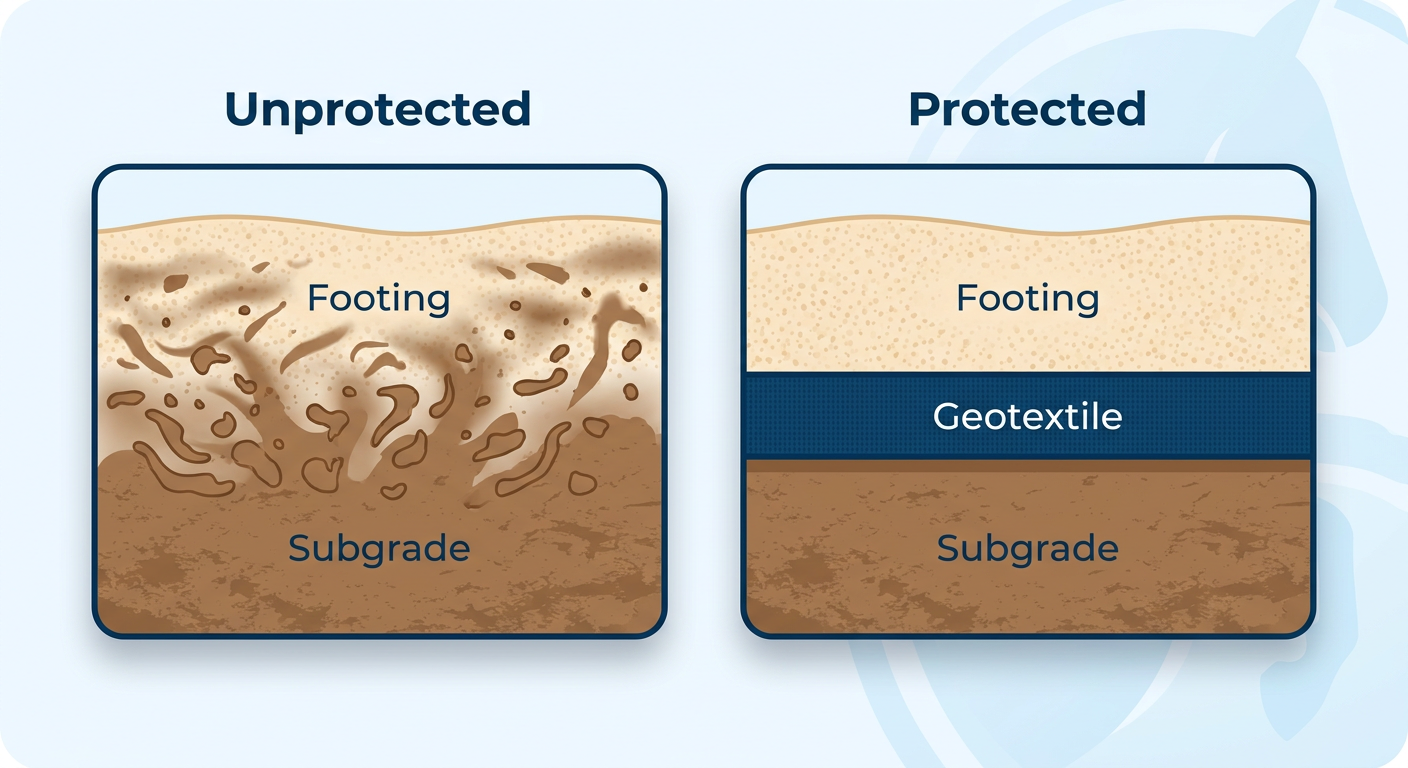
Geotextile prevents this migration through two properties working in tandem. The fabric's apparent opening size (AOS)—measured in microns—is engineered to be smaller than the subgrade particles but larger than water molecules. This allows drainage while blocking soil migration. Simultaneously, the fabric's tensile strength distributes point loads across a wider area, reducing the localized pressure that drives pumping action.
The ASTM D4751 standard governs geotextile opening size testing, establishing consistent specifications across manufacturers. For equestrian applications over clay-heavy subgrades, fabrics with AOS values between 70 and 140 indicate appropriate filtration for most conditions.
Where Geotextile Fits in the Arena Construction Stack
Proper geotextile placement requires understanding the complete arena profile from top to bottom. The canonical construction stack for a Performance Footing arena follows this sequence:
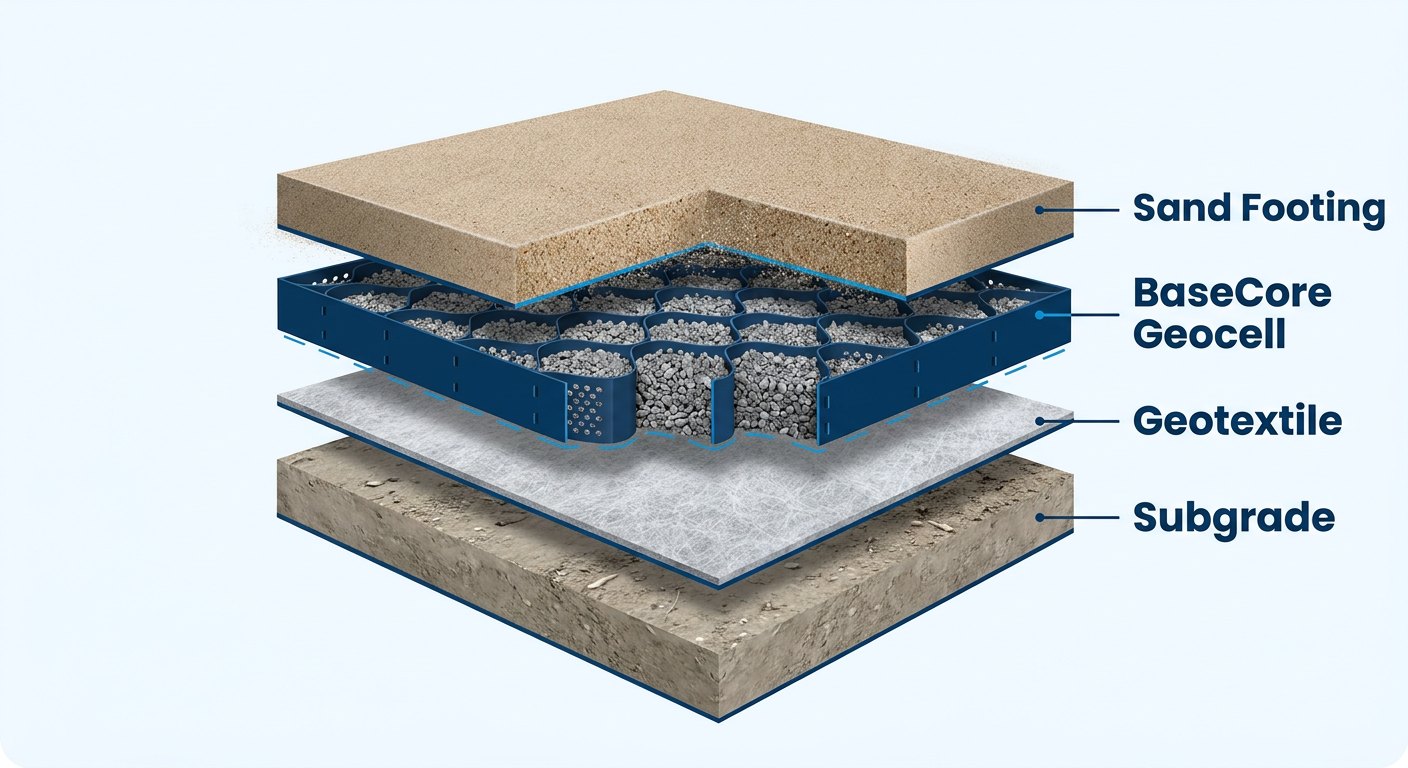
The engineered layers of a high-performance horse arena, showing geotextile placement beneath the geocell base.
Layer Typical Depth Function Custom sand footing blend 2–6 inches (discipline-dependent) Riding surface providing cushion, traction, and response BaseCore HD geocell panels 3–4 inches (typical for arenas) Structural base preventing rutting and distributing loads Geotextile membrane Single layer Separation barrier preventing subgrade contamination Optional engineered subbase4–8 inches where required Additional drainage or structural support for poor soils Compacted subgrade Native soil Prepared foundation graded for drainage
The critical placement rule: geotextile installs directly under the BaseCore geocell mats, never beneath aggregate subbase layers. This position maximizes separation effectiveness because it intercepts migrating fines before they can enter the structural base or footing layers above.
When drainage stone or engineered subbase is specified—typically on sites with expansive clay, high water tables, or poor percolation—that layer sits below the geotextile membrane. The fabric then serves a dual function: separating the subbase from native soil below while preventing footing contamination from above.
Performance Footing's ground stabilization systems integrate geotextile as a standard component precisely because of this separation function. The arena construction guide details layer-by-layer installation sequences for different site conditions.
How Geotextile Protects Your Footing Investment
The financial case for geotextile becomes clear when examining replacement costs. Quality arena footing sand—properly graded, washed, and specified for equestrian use—typically costs $25–$45 per ton delivered, depending on location and gradation requirements. A standard 20m × 60m dressage arena requires approximately 180–220 tons of sand at optimal depth.
When subgrade contamination occurs, the damage isn't limited to surface performance. Clay and silt particles that migrate into the sand profile cannot be removed through grooming or maintenance. The contaminated footing must be stripped entirely, disposed of, and replaced—a process costing $15,000–$30,000 for materials alone, before labor and equipment.
Geotextile fabric, by contrast, adds $0.15–$0.40 per square foot to construction costs. For that same 20m × 60m arena (approximately 12,900 square feet), the geotextile investment totals $1,935–$5,160—a fraction of single footing replacement.
Beyond direct material protection, geotextile preserves the performance characteristics you select when specifying footing. Disciplines like dressage require consistent firmness for collected work, while reining demands reliable slide zones. Contamination from below eliminates these carefully engineered properties regardless of how much you invest in surface maintenance above.
The dressage arena footing specifications emphasize this consistency requirement. Without geotextile separation, even premium blends degrade toward generic, compromised surfaces within years rather than decades.
Selecting the Right Geotextile Specification
Not all geotextile fabrics perform equally in equestrian applications. Specifications must match site conditions, particularly subgrade soil type, expected traffic loads, and drainage requirements.
Fabric Weight and Durability
Geotextile weight—measured in ounces per square yard—indicates material density and puncture resistance. Equestrian applications typically require 4–8 oz/yd² non-woven fabrics. Lighter weights (3–4 oz) suit well-prepared sandy subgrades with minimal fine content. Heavier weights (6–8 oz) provide better puncture resistance over rocky subgrades or where equipment access during installation increases damage risk.
Permeability and Flow Rate
Water must move through geotextile faster than it accumulates above. Permittivity—the rate of water flow perpendicular to the fabric plane—should exceed 1.5 sec⁻¹ for most arena applications. Lower permittivity creates bottleneck drainage, pooling water at the fabric interface rather than allowing free movement to the subgrade.
Apparent Opening Size
Match AOS to your subgrade soil characteristics. Clay-heavy native soils require smaller openings (70–100 AOS) to block fine particle migration. Sandy subgrades tolerate larger openings (100–140 AOS) while maintaining separation function. Soil testing or a simple jar settlement test reveals the fine content requiring filtration.
Performance Footing's geotextile products are specified for equestrian applications, with weight and permeability balanced for arena conditions rather than road or landscape use. Generic landscape fabrics often fail in arena environments because they prioritize weed suppression over water movement—opposite the functional requirement for riding surfaces.
Building or renovating an arena? Performance Footing's technical team can review your soil conditions and specify appropriate geotextile weight and permeability. Request a quick quote or call 877-835-0878 for site-specific recommendations.
Installation Best Practices for Maximum Effectiveness
Correct installation determines whether geotextile performs as designed or fails prematurely. The following sequence ensures proper function:
Subgrade Preparation
Before geotextile placement, the native subgrade must be properly graded and compacted. Remove organic material, large stones, and debris that could puncture the fabric. Grade the surface to direct water toward designated drainage outlets—typically a 1–2% slope for outdoor arenas. Compact the subgrade to 95% Standard Proctor density to prevent settling that creates fabric stress points.
Fabric Placement and Overlap
Roll geotextile perpendicular to the primary drainage direction, allowing water to flow across seams rather than under them. Overlap adjacent panels by 12–18 inches minimum—24 inches over unstable or wet subgrades. Secure overlaps with landscape staples every 3–4 feet to prevent shifting during subsequent layer installation.
Extend fabric 6–12 inches beyond arena perimeter boundaries to prevent edge contamination. This extension tucks beneath perimeter edging or curbing to maintain separation at arena borders where lateral water movement concentrates fines.
Protection During Construction
Geotextile is remarkably durable but vulnerable during installation. Avoid driving heavy equipment directly on exposed fabric—use plywood tracking or install base material immediately behind the fabric crew. Sharp aggregate edges can puncture lightweight fabrics; round or sub-angular stone reduces this risk.
The arena building services team follows these protocols on every installation, coordinating geotextile placement with geocell and footing delivery to minimize exposure time and handling damage.
Common Geotextile Mistakes and How to Avoid Them
Even experienced contractors make errors with geotextile installation that compromise long-term arena performance. Understanding these failure modes helps arena owners supervise construction quality.
Wrong Placement in the Profile
Installing geotextile beneath drainage stone rather than above it defeats the separation purpose. Fines migrate through the drainage layer and accumulate at the fabric surface—the reverse of intended function. The fabric becomes a contamination trap rather than a barrier. Always specify geotextile directly under the geocell or structural base layer, never under aggregate.
Insufficient Overlap at Seams
Seams are the weakest points in any membrane system. Skimping on overlap—12 inches instead of 18, or 6 inches instead of 12—creates pathways for fine migration. The cost difference between adequate and inadequate overlap is negligible; the performance difference is substantial.
Using Landscape Fabric Instead of Geotextile
Woven landscape fabric designed for weed suppression restricts water movement and degrades under UV exposure. These products are engineered for shallow burial under mulch, not structural loading under arena surfaces. True geotextile maintains dimensional stability, permeability, and filtration function under the dynamic loads equestrian use generates.
Omitting Geotextile Entirely
Budget pressures sometimes lead to geotextile elimination as a "cost savings." This decision rarely survives contact with reality. The arena FAQ addresses this question directly: eliminating geotextile typically triggers footing replacement costs 5–10 times higher than the fabric investment within 3–7 years.
Geotextile and Geocell: A Complementary System
Geotextile and geocell technologies serve different functions but work synergistically within the arena stack. Understanding this relationship helps arena owners evaluate complete ground stabilization systems rather than isolated components.
Geocell—the cellular confinement system exemplified by Performance Footing's BaseCore HD—provides structural support by confining base materials within a honeycomb matrix. This confinement prevents lateral displacement under load, distributes point pressures across wider areas, and maintains consistent footing depth even under heavy traffic.
Geotextile provides the separation layer that allows geocell to function correctly over time. Without geotextile beneath the geocell panels, subgrade fines migrate into the cells, compromising drainage and reducing the load distribution that makes geocell effective.
The combination addresses the complete spectrum of arena performance requirements: structural support from geocell above, separation and filtration from geotextile below, with free drainage through both layers. Performance Footing specifies this pairing as standard practice in the ground stabilization product line.
Climate Considerations for Geotextile Selection
Regional climate affects both geotextile specification and installation timing. Understanding these variables helps arena owners plan construction appropriately.
High-Rainfall Regions
Areas receiving 40+ inches annual precipitation require higher permittivity ratings to handle water volumes. Specify fabrics with permittivity exceeding 2.0 sec⁻¹ for Pacific Northwest, Gulf Coast, and Eastern Seaboard installations. The regional guidance pages detail climate-specific recommendations.
Freeze-Thaw Climates
Northern locations experience frost heave that stresses geotextile seams and can pump fines during spring thaw cycles. Increase overlap to 24 inches and consider heavier fabric weights (6–8 oz/yd²) for additional dimensional stability. Install during dry fall conditions before ground freezes to ensure proper seam seating.
Arid Climates
Desert and semi-arid regions face different challenges: wind-driven fines and occasional flash flooding. Geotextile in these environments must handle episodic high flow rates rather than sustained moisture. Standard specifications typically suffice, but ensure fabric extends fully to perimeter edging to prevent wind-blown contamination at arena edges.
When to Replace or Repair Geotextile
Quality geotextile installed correctly lasts 20–30 years or longer—often exceeding the lifespan of the footing above it. However, certain conditions warrant inspection or replacement.
Signs of Geotextile Failure
Visible symptoms include persistent drainage problems despite adequate surface grooming, footing that becomes increasingly heavy or clay-like over time, and water pooling in specific arena areas after rain. These indicate either geotextile damage or improper original installation.
Inspection Protocol
If footing replacement becomes necessary for other reasons (surface wear, discipline change, additive upgrade), inspect the geotextile during excavation. Look for tears, collapsed seams, or fabric degradation. Intact fabric can remain in place for the new footing installation; damaged sections require patching or replacement before new material placement.
Upgrade Opportunities
Older arenas built without geotextile present retrofit challenges. Complete excavation and fabric installation is the most reliable solution but requires removing all existing footing and base materials. For arenas with minimal contamination, some owners choose to install a fresh geotextile layer above the existing base, accepting reduced effective footing depth as a tradeoff for improved separation going forward.
The rebuild versus refresh guide helps arena owners evaluate whether full reconstruction or surface-layer renovation better suits their situation and budget.
How Often Should I Inspect My Arena's Geotextile?
Visual inspection of geotextile isn't practical once the arena is constructed—the fabric is buried beneath several inches of base and footing material. Instead, monitor surface symptoms that indicate underlying problems.
Check drainage performance after heavy rain events. Water should percolate through the footing within 2–4 hours for properly functioning systems. Persistent puddling or slow drainage suggests either clogged fabric or inadequate permeability. Annual soil sampling from the footing layer can reveal increasing clay or silt content that indicates subgrade migration past a compromised geotextile barrier.
Can I Install Geotextile in an Existing Arena?
Retrofitting geotextile into an existing arena requires removing all footing and base materials to access the subgrade level. This process essentially rebuilds the arena from the ground up, making it practical only when combined with other major renovations.
For arenas experiencing contamination symptoms, evaluate whether the existing footing remains salvageable. If so, stockpile it during excavation, install proper geotextile and base layers, then replace the cleaned footing. If contamination has compromised the sand's properties, new footing material is required regardless. The free arena consultation service can assess your specific situation.
What's the Difference Between Geotextile and Landscape Fabric?
Landscape fabric and geotextile serve fundamentally different purposes despite superficial similarity. Landscape fabric prioritizes weed suppression through limited water permeability—exactly opposite the requirement for arena drainage. It also degrades under UV exposure, assuming shallow burial under mulch rather than structural loading.
Geotextile is engineered for civil construction applications: high water flow, dimensional stability under load, and long-term durability without UV stabilization (since it's permanently buried). Arena applications demand geotextile specifications, not landscape products. The price difference is minimal; the performance difference is substantial.
How Does Geotextile Affect Arena Maintenance?
Properly installed geotextile simplifies long-term arena maintenance by preserving consistent footing characteristics. Without subgrade contamination, the sand profile maintains its engineered properties—cushion, drainage, and response—as originally specified.
This consistency means maintenance routines remain predictable. Grooming frequency, watering schedules, and additive top-up rates don't accelerate due to degrading base conditions. Arena owners can focus maintenance efforts on surface-level care rather than fighting underlying problems they can't directly address.
Conclusion: The Foundation You Can't Afford to Skip
Geotextile fabric represents one of the lowest-cost components in arena construction yet delivers disproportionate value in protecting the investment above it. The research is clear: arenas without proper separation lose drainage capacity, footing consistency, and ultimately require premature, expensive replacement.
For a material costing less than $0.40 per square foot, geotextile prevents contamination that would otherwise require $20,000+ footing replacements. It preserves the performance characteristics you select when specifying footing for your discipline. And it allows the geocell and footing systems above to function as engineered rather than degrading toward compromised, generic surfaces.
Performance Footing integrates geotextile into every ground stabilization system as standard practice—not as an upsell, but as essential infrastructure. For arena owners building new or evaluating existing surface problems, geotextile should be the starting point of any conversation about long-term footing performance.
Ready to build a durable arena foundation? Request a quick quote from Performance Footing or call 877-835-0878 to discuss geotextile specifications for your site conditions and construction timeline.
Frequently Asked Questions
How long does geotextile fabric last under an arena?
Quality geotextile installed correctly lasts 20–30 years or longer, often exceeding the lifespan of the footing above it. The fabric is protected from UV degradation by burial and designed for long-term dimensional stability under cyclic loading. Performance Footing's geotextile products carry specifications validated for equestrian structural applications.
Do I need geotextile if my arena has a gravel base?
Yes—gravel bases increase the need for geotextile rather than eliminating it. Without separation fabric, subgrade fines migrate into gravel voids, eventually filling them and destroying drainage capacity. Install geotextile directly under the gravel layer to maintain long-term base function and prevent contamination from reaching the footing above.
Can geotextile be installed over wet ground?
Geotextile can be placed on damp subgrade but not standing water or saturated soil. Excess moisture prevents proper compaction and creates installation quality problems. Address drainage issues before fabric placement—install French drains or allow drying time—then proceed with geotextile installation on prepared, moist-but-not-wet subgrade.
What weight geotextile should I use for a horse arena?
Most equestrian arenas perform well with 4–8 oz/yd² non-woven geotextile. Choose lighter weights (4–5 oz) over well-prepared sandy subgrades and heavier weights (6–8 oz) over rocky soils or where construction equipment access increases puncture risk. The arena construction guide details specifications by soil type.
How much does geotextile add to arena construction cost?
Geotextile typically adds $0.15–$0.40 per square foot to construction costs, totaling $1,500–$5,000 for a standard 20m × 60m arena. This investment prevents footing contamination that would otherwise require $15,000–$30,000 replacement costs within 3–7 years—making geotextile one of the highest-value components in the entire arena construction budget.
This article is for informational purposes only. The information provided reflects published equestrian research, FEI and governing-body guidelines, and Performance Footing's product expertise. Surface conditions, climate, soil type, and facility use vary widely—consult Performance Footing or a qualified arena builder for site-specific recommendations. For current product information, pricing, and availability, visit performancefooting.com or call 877-835-0878.