
Arena Footing Systems
The Ultimate Guide to Sustainable Horse Property Solutions: Eco-Friendly Footing and Mud Prevention
Performance Footing · October 13, 2026 · 16 min read
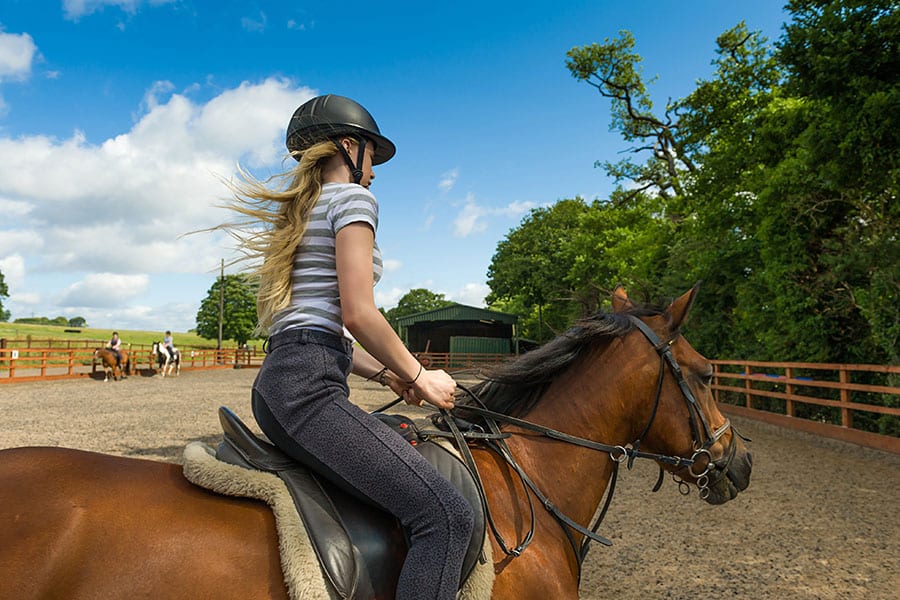
Discover sustainable horse property solutions that protect horse health and the environment. Expert guide to eco-friendly footing and green arena design.
A single horse produces approximately 50 pounds of manure daily, and when combined with poorly managed surfaces, this organic load can contaminate groundwater and contribute to erosion that damages local watersheds, according to Penn State Extension research on equine facility management. Yet the environmental impact of horse properties extends far beyond manure—the surfaces beneath our horses' hooves determine everything from stormwater runoff patterns to dust emissions that affect regional air quality.
Sustainable horse property solutions integrate eco-friendly arena footing, permeable ground stabilization systems, and natural dust control methods to create facilities that protect both horse health and environmental resources. These approaches use plant-based additives, recyclable geocell systems, and water-conserving maintenance practices to reduce the ecological footprint of equestrian operations while improving surface performance and longevity. Performance Footing has pioneered many of these sustainable technologies, developing arena systems that eliminate the need for constant watering while preventing harmful runoff.
This comprehensive guide covers the science behind sustainable equestrian surfaces, practical implementation strategies for eco-friendly footing and mud prevention, and the long-term economic benefits of building green from the ground up. Whether you're constructing a new facility or retrofitting an existing property, you'll find actionable guidance for creating a horse property that performs at the highest level while honoring environmental stewardship.
The Environmental Science of Horse Properties
Understanding the ecological systems at play on your horse property is the foundation of sustainable management. Every equestrian facility operates within a broader watershed, and the surfaces you install directly influence how water, nutrients, and particles move through your local environment.
Water Cycle Impacts and Stormwater Management
Traditional arena construction often creates impermeable or semi-permeable surfaces that dramatically alter natural hydrology. When rainwater cannot infiltrate the ground beneath your arena or paddock, it sheets across the surface, picking up sediment, manure particles, and any chemical treatments before flowing into drainage systems, streams, or groundwater recharge zones.
Research from the Environmental Protection Agency identifies equestrian facilities as potential contributors to nonpoint source pollution when surfaces lack proper permeability and drainage design. The nitrogen and phosphorus in horse manure become particularly problematic when transported by runoff, contributing to algal blooms and aquatic ecosystem degradation downstream.
Sustainable surface design prioritizes controlled infiltration. Systems like BaseCore geocell ground stabilization create structural integrity while maintaining permeability, allowing water to filter through the soil profile where natural biological processes break down contaminants before they reach groundwater.
Dust, Air Quality, and Respiratory Health
Arena dust represents both an environmental and health concern that sustainable design must address. The respirable fines generated by traditional sand arenas—particles small enough to penetrate deep lung tissue—affect not only the horses and riders using the space but can drift beyond property boundaries to impact neighboring air quality.
Dr. Rachel Murray's research at the Animal Health Trust documented that horses exercising in dusty environments show significantly higher rates of inflammatory airway disease, with chronic exposure linked to reduced athletic performance and long-term respiratory compromise. Traditional solutions involve heavy water application, which creates its own sustainability problems through water consumption and runoff generation.
The ArenaSpec additive system represents a paradigm shift in dust management—using plant-based compounds to control dust at the particle level rather than relying on constant moisture application. This approach eliminates the water waste associated with traditional dust control while providing superior air quality outcomes.

Plant-based additives bind dust particles at the molecular level, providing a waterless solution to respiratory irritants.
Material Lifecycle and Resource Consumption
Sustainability extends beyond operational impacts to encompass the full lifecycle of materials used in arena construction. Conventional approaches often rely on synthetic polymers, petroleum-based products, and materials that require energy-intensive manufacturing processes and create disposal challenges at end-of-life.
Truly sustainable horse property solutions prioritize materials with favorable lifecycle profiles: plant-based additives that biodegrade safely, recyclable structural components, locally-sourced aggregates that minimize transportation emissions, and systems designed for longevity that reduce replacement frequency.
Sustainable Arena Footing: Components and Principles
Eco-friendly arena footing begins with understanding that every arena is a custom system. Climate, discipline, usage intensity, and local soil conditions all influence the optimal sustainable solution. The sand analysis kit provides the diagnostic foundation for specifying footing that performs while minimizing environmental impact.
Sand Selection for Sustainability
The sand base of any arena footing represents the largest material volume and carries significant sustainability implications. Sourcing sand locally reduces transportation emissions, while selecting appropriate particle size distribution minimizes the need for dust-control interventions.
Optimal sustainable sand exhibits:
Sub-angular to angular particle shape for stability without excessive dust generation
Gradation curves that minimize fines content (particles under 75 microns) while maintaining cohesion
Silica content appropriate to discipline requirements without unnecessary processing
Sourcing within reasonable transport distance of the installation site
The arena sand selection guide details how particle characteristics influence both performance and environmental outcomes, helping facility owners make informed choices that balance these considerations.
Plant-Based Additives: The ArenaSpec Approach
ArenaSpec represents Performance Footing's commitment to sustainable chemistry in arena surfaces. Each component serves a specific function while maintaining environmental responsibility:
FIBR — Structural Matrix: Natural plant-based fibers reinforce the sand profile, providing shear strength and traction without synthetic polymers. These fibers biodegrade safely over time, never accumulating as microplastic pollution or requiring special disposal.
LOCK — Dust & Moisture Controller: Plant-oil-based concentrates bind fine particles and regulate moisture without the environmental concerns associated with petroleum-derived dust suppressants. LOCK contains no PFAS compounds, no heavy metals, and poses no risk to groundwater.
HOLD+ — Moisture & Traction Buffer: Natural mineral compounds with plant-derived co-factors buffer moisture fluctuations, maintaining consistent footing firmness without constant water application. This mineral absorption approach works with natural soil chemistry rather than against it.
FLEX — Comfort & Rebound Module: Engineered elastomers provide cushion and impact absorption for high-impact disciplines. These UV-stable components are designed for maximum longevity, reducing replacement frequency and associated resource consumption.
The ArenaSpec system exemplifies the sustainable principle of designing for specific conditions rather than applying generic solutions. A free arena consultation determines which components your facility needs based on sieve analysis, discipline requirements, climate conditions, and usage patterns.
Water-Free Dust Control
Traditional arena maintenance consumes enormous water volumes—a typical 20m × 60m dressage arena might require 3,000-5,000 gallons per watering session, with multiple applications needed weekly in dry climates. Beyond the direct water consumption, this approach creates runoff, increases humidity-related surface inconsistency, and requires energy for pumping and distribution.
Sustainable dust control eliminates this water dependence entirely. The LOCK additive in the ArenaSpec system maintains dust suppression through molecular binding rather than moisture weight, creating surfaces that perform consistently regardless of ambient humidity while consuming zero water for dust management.
Ready to eliminate water waste from your arena maintenance routine? Request a quick quote for a dust-free, waterless ArenaSpec system customized to your facility, or call 877-835-0878 to discuss your sustainable footing goals.
Ground Stabilization: The Foundation of Sustainable Properties
Mud represents one of the most significant environmental and horse welfare challenges on equestrian properties. Beyond the obvious inconvenience, chronic mud conditions create bacterial breeding grounds, contribute to hoof disease, generate runoff that carries sediment and pathogens off-property, and render valuable land unusable for extended periods.
How Geocell Systems Prevent Environmental Degradation
Cellular confinement technology—the engineering principle behind BaseCore geocell systems—provides sustainable mud prevention by addressing the root causes rather than treating symptoms. The three-dimensional honeycomb structure distributes point loads across a broader area, preventing the soil compaction that destroys natural drainage patterns.
When horses' hooves concentrate weight on unstabilized soil, they compress the soil particles together, eliminating the pore spaces through which water infiltrates. This compaction creates a positive feedback loop: water pools on the surface, softening surrounding soil, which compacts further under traffic, expanding the muddy zone outward. Traditional solutions like repeated gravel application sink into the mud, wasting materials and failing to address the underlying compaction.
Distributes hoof loads to prevent point-source compaction
Maintains vertical pore structure for water infiltration
Provides a stable base that prevents aggregate migration into subsoil
Creates permanent infrastructure that eliminates repeated material applications
The Sustainable Arena Stack
Proper layering ensures maximum performance with minimum environmental impact. From top to bottom, the sustainable arena ground stack consists of:
Layer Material Typical Depth Sustainability Function
1. Footing Custom sand blend with ArenaSpec additives2–4 inches depending on discipline Plant-based dust control, water-free maintenance
2. Stabilization BaseCore HD geocell panels 3–4 inches for arenas Load distribution, compaction prevention, recyclable HDPE
3. Separation Geotextile membrane N/A (fabric layer) Prevents material mixing, extends system life
4. Subbase (optional) Engineered drainage stone As site requires Enhanced drainage where soil conditions demand
5. Subgrade Compacted native soil N/A (prepared surface) Utilizes existing soil rather than importing fill
This stack sequence is critical—the geotextile membrane sits directly under the BaseCore panels, never beneath drainage stone or aggregate layers. This positioning ensures the separation fabric functions as intended, preventing footing materials from migrating downward while allowing water to pass through to the drainage profile below.
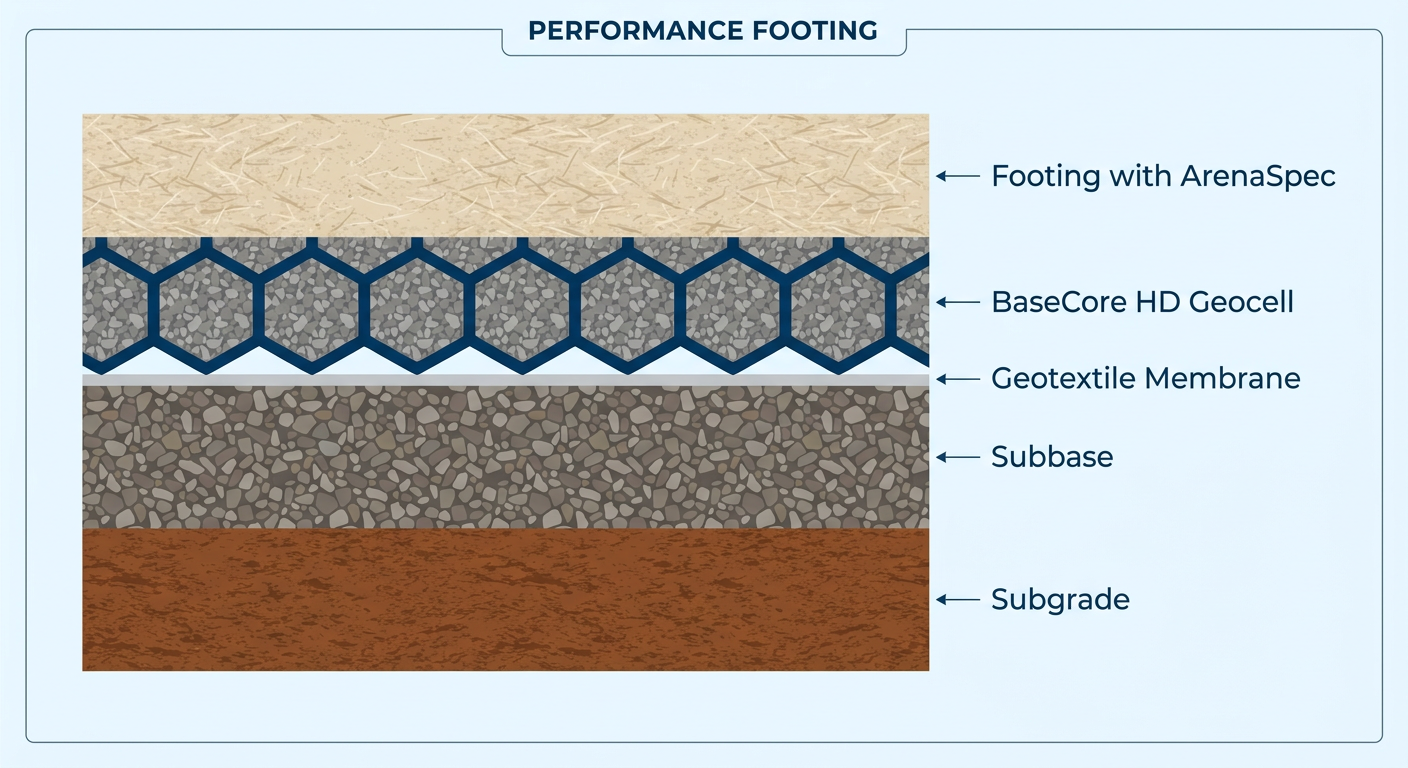
A properly engineered arena stack ensures long-term drainage and surface stability.
Paddock and High-Traffic Zone Solutions
Sustainable mud prevention extends beyond arena construction to address the full property footprint. Paddocks, gates, feeding areas, and water trough surroundings experience concentrated traffic that quickly degrades unstabilized surfaces.
BaseCore installation in these high-traffic zones typically uses 3–4 inch panel depth, with infill material selected for the specific application:
Angular aggregate (3/4-inch clean stone) for vehicle access and heavy equipment zones
Smaller angular stone or screenings for walkways and barn aisles
Native soil or topsoil with grass seed for paddocks where vegetated surfaces are desired
The arena construction guide provides detailed specifications for various applications, helping facility owners match stabilization solutions to their specific site conditions and usage patterns.
Implementing Sustainable Solutions: Step-by-Step Guidance
Transforming your horse property into a sustainable facility requires systematic planning and implementation. The following framework applies whether you're building new or retrofitting existing surfaces.
Assessment and Diagnosis
Sustainable solutions begin with understanding your specific conditions. Before specifying materials or designing systems, conduct thorough site assessment:
Soil Analysis: Understanding your native soil type determines drainage requirements, subgrade preparation needs, and appropriate infill materials. Clay soils require more aggressive drainage design than sandy loams; rocky subsoils may need different preparation than organic-rich topsoils.
Hydrological Survey: Map how water currently moves across and through your property. Identify existing drainage patterns, low spots where water collects, and the relationship between your property and surrounding watershed features. Sustainable design works with natural hydrology rather than fighting it.
Usage Audit: Document actual traffic patterns across your property. Where do horses concentrate? Where does vehicle traffic occur? Which gates see heaviest use? This information guides where stabilization infrastructure provides greatest return.
Sand Testing: If retrofitting an existing arena, sand analysis reveals whether your current footing base can be enhanced with sustainable additives or requires replacement. The sieve analysis determines particle size distribution, while visual assessment identifies contamination or degradation.
Design and Specification
With assessment complete, design sustainable solutions matched to your conditions:
Arena Footing Specification: Based on sand analysis results, discipline requirements, climate, and usage intensity, specify the appropriate ArenaSpec component combination. A dressage facility in a humid climate requires different additive ratios than a reining arena in an arid region. The footing by discipline guide provides discipline-specific recommendations.
Drainage Integration: Design drainage systems that handle peak stormwater volumes while maximizing infiltration during normal conditions. Sustainable drainage often incorporates bioswales, rain gardens, or infiltration basins that filter runoff naturally before it leaves the property.
Material Sourcing: Identify local sources for sand, aggregate, and fill materials. Transportation represents a significant portion of construction's carbon footprint; sourcing materials within 50 miles dramatically reduces this impact while supporting local economies.
Installation Best Practices
Proper installation ensures sustainable systems perform as designed for maximum longevity:
Subgrade Preparation: Achieving appropriate compaction and grade on the native soil subgrade creates the foundation for everything above. Rushing this step compromises system performance and longevity, ultimately requiring premature intervention that wastes resources.
Geotextile Installation: Install separation fabric in continuous runs with appropriate overlap (typically 6–12 inches) at seams. Secure fabric to prevent shifting during subsequent layer installation. The geotextile sits directly under geocell panels, never under drainage stone.
Geocell Panel Connection: BaseCore panels connect to create a unified structural matrix. Proper connection ensures load distribution across the entire surface rather than concentrating stress at panel boundaries.
Infill Placement and Compaction: Fill geocell chambers with specified infill material, compacting in lifts to achieve target density. Over-compaction defeats the purpose of geocell installation; follow specifications for your specific application.
Footing Installation: Place footing material to specified depth (typically 2–4 inches depending on discipline and site conditions), achieving uniform coverage without over-compaction that would affect surface performance.
Maintenance for Long-Term Sustainability
Sustainable systems require appropriate maintenance to deliver their environmental and performance benefits over time:
Regular Grooming: The arena groomer selection depends on your footing composition and usage intensity. Proper grooming redistributes displaced material, prevents localized compaction, and maintains the consistent surface texture that ArenaSpec additives are designed to provide.
Periodic Assessment: Monitor footing depth and condition throughout the year. Sustainable systems reduce but don't eliminate the need for periodic material refresh; tracking depth allows planned additions rather than reactive emergency measures.
Drainage Maintenance: Even well-designed drainage systems require occasional attention. Clear outlet structures, inspect bioswales for sediment accumulation, and verify that water moves through the system as designed.
Horse Health Benefits of Sustainable Surfaces
Environmental sustainability and horse welfare are not competing priorities—properly designed sustainable systems deliver superior outcomes for equine health across multiple dimensions.
Respiratory Health and Air Quality
The respiratory benefits of dust-free footing cannot be overstated. Dr. Mick Peterson's Racing Surfaces Testing Laboratory research has documented the relationship between arena dust exposure and equine respiratory inflammation. Horses exercising in dusty conditions experience airways insult that triggers inflammatory cascades, reducing oxygen exchange efficiency and compromising athletic performance.
Water-free dust control through ArenaSpec's LOCK additive provides consistent dust suppression without the humidity fluctuations that destabilize footing feel. Horses experience the same air quality regardless of ambient conditions or recent maintenance timing—a level of consistency that water-based dust control cannot achieve.
Musculoskeletal Protection Through Consistent Surfaces
Sustainable footing systems deliver remarkably consistent surfaces that protect horses from the repetitive strain variations that accumulate into injury. When footing depth varies across an arena—deeper in heavily-trafficked areas, shallower at the rail—horses make constant micro-adjustments that stress tendons, ligaments, and joints.
The structural integrity provided by BaseCore stabilization beneath properly specified footing eliminates the base failure that creates these inconsistencies. Combined with ArenaSpec additives that maintain uniform texture regardless of moisture conditions, sustainable systems provide the predictable surfaces that allow horses to move confidently and efficiently.
Hoof Health and Mud Prevention
Chronic mud exposure creates devastating hoof health consequences. Standing in wet conditions softens the hoof wall, making it vulnerable to mechanical damage and pathogen invasion. Thrush, white line disease, and abscesses proliferate in muddy environments where horses cannot escape moisture.
Beyond direct hoof damage, mud forces horses into postural compensations that stress the entire musculoskeletal system. Horses standing in unstable footing engage muscles continuously to maintain balance, creating fatigue and strain that accumulate over time.
Sustainable ground stabilization through geocell installation eliminates these chronic health stressors by creating firm, well-drained surfaces that protect hoof integrity and allow natural movement patterns.
Economic Benefits of Sustainable Design
Sustainable horse property solutions often require higher initial investment than conventional approaches, but lifecycle cost analysis consistently favors environmentally responsible design.
Water Cost Elimination
For facilities currently watering arenas for dust control, the water savings alone can justify sustainable footing investment within 3–5 years. A facility applying 4,000 gallons three times weekly at $0.005 per gallon spends over $3,000 annually on arena water alone—before accounting for pump energy, distribution system maintenance, and labor time. Waterless ArenaSpec systems eliminate this ongoing expense entirely.
Reduced Material Replacement
Conventional arena maintenance involves periodic footing replacement as materials degrade, migrate into the base, or become contaminated with fine particles. BaseCore stabilization prevents footing migration, extending material life substantially. ArenaSpec additives are designed for longevity, with refresh applications required far less frequently than water-based treatment alternatives.
Infrastructure Longevity
Geocell ground stabilization provides decades of service when properly installed. Unlike repeated gravel applications that sink and require replacement, BaseCore creates permanent infrastructure that eliminates recurring material and installation costs. The reviews from facility owners consistently highlight the long-term value proposition of stabilization systems.
Property Value Enhancement
Equestrian properties with properly designed sustainable infrastructure command premium prices. Buyers increasingly recognize the value of facilities that won't require immediate surface renovation or present ongoing maintenance headaches. Sustainable systems represent visible investment in property quality.
Discover how sustainable solutions can reduce your long-term facility costs while improving horse health and environmental outcomes. Request a quick quote or call Performance Footing at 877-835-0878 to discuss your property's specific needs.
How deep should eco-friendly arena footing be?
Eco-friendly arena footing depth depends on discipline, climate, and base construction, typically ranging from 2–4 inches. Dressage and flatwork arenas generally use 2–3 inches of footing over properly stabilized bases, while jumping and high-impact disciplines may require 3–4 inches for adequate cushion. The arena sand calculator helps determine precise material quantities once you've specified appropriate depth for your application.
Do sustainable arena surfaces require special maintenance?
Sustainable arena surfaces actually require less maintenance than conventional systems, not more. Water-free dust control through ArenaSpec additives eliminates watering chores entirely. Regular grooming with appropriate arena drags maintains surface consistency, with typical schedules ranging from after every 4–6 rides for heavily-used facilities to weekly for lighter use. The absence of moisture fluctuations simplifies maintenance timing significantly.
Can I convert my existing arena to a sustainable system?
Yes, many existing arenas can be upgraded to sustainable systems without complete reconstruction. The conversion approach depends on current conditions—if your sand base is sound, adding ArenaSpec additives may be sufficient. If base failure causes inconsistency or drainage problems, installing BaseCore stabilization beneath existing or new footing may be warranted. A free arena consultation and sand analysis determine the most cost-effective path for your specific situation.
Conclusion: Building for the Future
The 50 pounds of daily manure each horse produces represents just one dimension of equestrian facility environmental impact. The surfaces we build, the materials we choose, and the maintenance practices we adopt collectively determine whether our properties contribute to environmental degradation or demonstrate responsible stewardship.
Sustainable horse property solutions are not about sacrifice or compromise—they deliver superior performance, better horse health outcomes, reduced long-term costs, and environmental responsibility in a single integrated approach. The technologies exist today to build facilities that support peak equine athletic performance while protecting the watersheds, air quality, and ecosystems we share with our broader communities.
Performance Footing's commitment to sustainable chemistry, recyclable materials, and water-conserving systems reflects the understanding that horse welfare and environmental health are inseparable concerns. Contact Performance Footing or call 877-835-0878 to begin designing a sustainable facility that serves your horses, your property, and the environment for decades to come.
This article is for informational purposes only. The information provided reflects published equestrian research, FEI and governing-body guidelines, and Performance Footing's product expertise. Surface conditions, climate, soil type, and facility use vary widely—consult Performance Footing or a qualified arena builder for site-specific recommendations. For current product information, pricing, and availability, visit performancefooting.com or call 877-835-0878.