
Arena Footing Systems
How Much Fiber Does Your Horse Arena Need? A Sand-First Sizing Guide
Performance Footing · November 2, 2026 · 13 min read
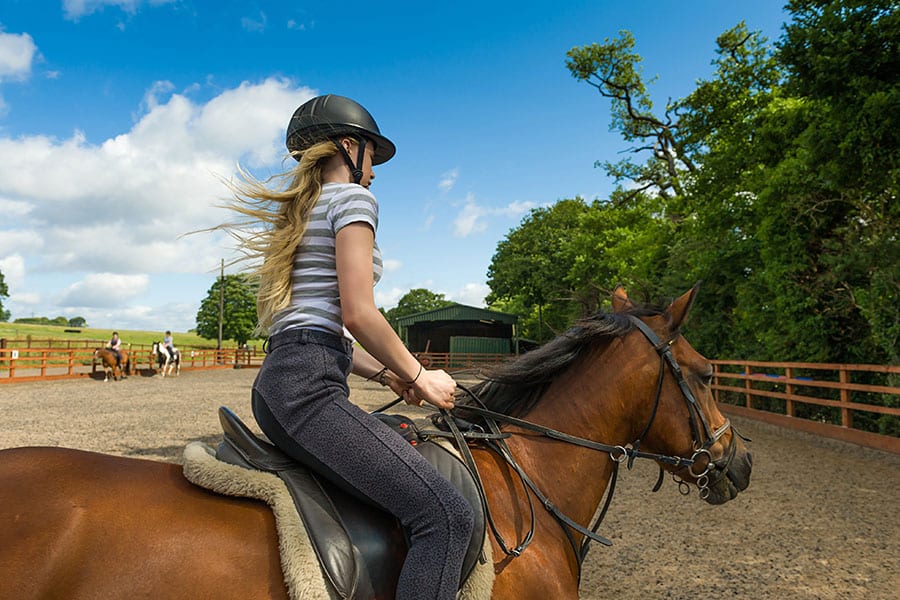
Fiber dose depends on your sand, not arena size. Learn how to size arena fiber correctly with a sand-first approach and avoid costly footing mistakes.
Research from the Racing Surfaces Testing Laboratory confirms that arena footing performance depends more on particle interaction than on additive volume — a finding that reshapes how facility owners should approach fiber sizing. The honest answer to how much fiber your arena needs: it depends on your sand. A 100 × 200 ft arena might need a light hand-spread pass of fiber, or it might need three times that amount. The difference isn't the arena's dimensions — it's what's under the horse's hoof. Fiber dosage is dictated by sand gradation, particle shape, and fines content rather than arena square footage alone, and sizing via a sand-first sieve analysis prevents costly miscalculations and poor footing performance. This guide covers how to size fiber correctly, what a full arena actually needs at typical rates, and the single most expensive mistake owners make when they order fiber before diagnosing the sand.
On this page
The Science Behind Fiber Dosing: Why Sand Properties Drive Everything
Fiber's primary function in arena footing is creating shear strength — keeping sand from displacing laterally under hoof load. When a horse plants a foot at speed, sand particles naturally want to squirt outward from beneath the impact zone. Research by Dr. Mick Peterson at the University of Maine's Racing Surfaces Testing Laboratory demonstrates that loose, unbonded sand surfaces force horses to compensate with muscular effort that should be reserved for athletic performance rather than stability maintenance.
The fiber creates a bridging network between individual sand grains, functioning similarly to how plant roots bind soil. This network causes the sand to push back against the hoof instead of scattering. However, the amount of bridging required varies dramatically based on three sand properties that no tape measure can reveal:
Particle shape determines natural grain-to-grain friction. Angular grains — those with sharp edges and irregular surfaces — mechanically interlock with neighboring particles. According to Penn State Extension's equine facility guidelines, angular sand requires less external binding to maintain structural integrity under load. Rounded grains, typically sourced from riverbeds or weathered deposits, slip past each other freely and demand substantially more fiber to achieve equivalent stability.
Gradation refers to the distribution of particle sizes within your sand. A well-graded sand contains a range of diameters — larger particles create a skeleton while smaller particles fill the voids between them, creating natural density. Single-size sand (also called poorly graded or uniformly graded) leaves air gaps that neither compact well nor resist displacement. Fiber must fill the mechanical role that proper gradation would otherwise provide.
Fines content — the percentage of particles passing a #200 sieve — affects moisture behavior and surface hardness. Sand with excessive fines holds moisture but sets up like concrete when dry. Sand with insufficient fines breaks apart too easily. Both extremes change the fiber dose required to stabilize the working surface, though in different ways.
None of these properties are visible from above. Two arenas at the same address, using sand from two different quarries, can require meaningfully different fiber doses. This is why Performance Footing runs a sieve analysis before quoting fiber loads — you don't diagnose what a horse needs based on its color, and you shouldn't size fiber based on arena dimensions alone.
How Sand Type Translates to Your Arena
Understanding abstract sand properties becomes practical when you match your source material to expected fiber requirements. For a standard 3-inch working depth, fiber doses typically fall within predictable ranges based on sand characteristics:
Angular silica, well-graded: 2.0 – 3.0 oz per square foot. This is the easiest sand to stabilize and needs the least fiber. If your sand came from a quality construction aggregate supplier and was specified for equestrian use, it likely falls here.
Angular silica, single-size: 3.0 – 4.0 oz per square foot. More binding is required to compensate for the particle gap problem. Common in arenas where sand was selected primarily for drainage rather than mechanical properties.
Sub-angular, mixed sources: 3.0 – 4.5 oz per square foot. This is the most common scenario in retrofit situations where sand has been topped up over years from multiple suppliers. The variability in the sand bed widens the dosing range.
Rounded (river or weathered): 4.0 – 5.5+ oz per square foot. Grains slip past each other with minimal friction, requiring the most binding. Many owners with river sand arenas report that "fiber didn't work" — but the failure was almost always under-dosing relative to what their sand actually needed.
These ranges provide planning guidance, not prescriptions. Site-specific dosing requires a sand sample because light dosing on wrong-graded sand is the single most common cause of fiber footing underperformance. The arena sand selection guide covers how to evaluate sand before purchase if you're building new.
Performance Footing's ArenaSpec system begins with sand diagnosis, not product selection. Request a sand analysis kit to get a fiber dose sized to your specific sand — no ballpark, no guessing. Or call 877-835-0878 to discuss your arena.
Step-by-Step: How to Size Fiber for Your Arena
Follow this sequence to arrive at an accurate fiber quantity. The order matters — completing the diagnostic steps before ordering prevents the most expensive mistakes.
Step 1: Measure Your Working Area in Square Feet
Calculate length × width in feet, not linear measurements. A standard 100 × 200 ft riding arena equals 20,000 square feet. For irregular shapes, divide into rectangles, calculate each, and sum. Include only the rideable surface — exclude kick rails, mounting blocks, and equipment storage zones.
Step 2: Confirm Your Intended Working Depth
Most disciplines work best at 3 inches of loose footing over a prepared base. Dressage arenas sometimes run 2.5 – 3 inches for more firmness; reining and cutting may go to 3.5 – 4 inches for sliding stops. Your working depth multiplies against the square footage to determine the volume of sand being treated — fiber dose calculations assume you're binding the full working layer.
Step 3: Pull a Sand Sample from Working Depth
Using a trowel or soil probe, collect sand from three to five locations across your arena at the depth where horses actually work — not the surface crust and not the base layer. Combine these samples in a clean bucket and mix thoroughly. You need about a coffee-can's worth (roughly 1 quart) for laboratory analysis.
Step 4: Submit for Sieve Analysis
A sieve analysis passes your sand through a stack of graded screens, each with progressively smaller openings. The result is a particle-size distribution curve showing exactly what percentages of your sand fall into each size category. This data determines whether your sand is well-graded or single-size, angular or rounded, and what fines content you're working with. Performance Footing includes this analysis with every ArenaSpec sand assessment, returning a fiber dose sized to your specific sand within a few business days of receiving your sample.
Step 5: Match Dose to Sand Grade
With sieve results in hand, your fiber dose moves from a range to a number. The analysis report will specify oz per square foot based on your sand's actual properties. For the 100 × 200 ft arena example at 3-inch depth, this typically translates to:
Well-graded angular sand: approximately 3,000 – 4,000 lbs total fiber
Single-size or sub-angular sand: approximately 4,000 – 5,000 lbs total fiber
Rounded sand: 5,000+ lbs total fiber
These figures represent starting points — your analysis report provides the precise recommendation.
Step 6: Add 5 – 10% Overage
Fiber spreaders aren't perfectly uniform. Arena edges absorb extra material. Some loss occurs during blending. Build 5 – 10% additional material into your order to ensure complete coverage without a second freight charge.
Step 7: Confirm Freight and Delivery Access
Fiber ships in super sacks (large bulk bags) weighing 1,000 – 2,000 lbs each. Confirm that your delivery location can accommodate a flatbed truck with a forklift or that you have equipment to offload. Freight costs vary significantly by distance — finalizing logistics before ordering prevents surprises.
What Happens If You Skip the Sand Test
The mistake owners make isn't buying too little fiber. It's buying the fiber before diagnosing the sand. A perfectly good fiber applied to poorly-graded sand won't rescue the surface, and most "fiber didn't work" complaints online are actually sand-selection failures wearing a fiber's name.
Weight the decision like this:
A sand analysis costs minimal time and is included with an ArenaSpec assessment. Fiber overshoot on wrong-graded sand — ordering based on arena size rather than sand properties — typically wastes hundreds to low thousands of dollars for a mid-size arena. But redoing a full arena because the sand was wrong to begin with runs into five figures, plus downtime, plus the psychological cost of watching an investment underperform.
Under-dosing carries an additional penalty: it wastes material and leaves you with a surface that doesn't perform, meaning you'll be spreading more fiber anyway while your horses work on an unstable surface in the interim. The diagnostic step prevents both failure modes.
Installation: New Build vs. Retrofit
The sizing math is identical in both scenarios — sand determines dose — but installation procedures differ.
New Build (Bare Sand, Clean Install)
Apply the full fiber dose and blend into the top 2 – 3 inches of sand using a power harrow or aggressive arena groomer. The goal is uniform distribution throughout the working layer, not surface application. If using the ArenaSpec system, the FIBR structural matrix goes in first, followed by the LOCK coating for dust suppression and moisture regulation. Most new-build arenas become rideable within 24 – 48 hours of installation.
Retrofit (Adding Fiber to Existing Sand)
Sand-test first. Existing arena sand may have shifted grade over time as fines migrated downward or blew away. Organic material accumulation (manure particles, decomposed bedding tracked in from stalls) may also affect the fiber dose required.
Spread fiber into the top 1.5 – 2 inches rather than full depth — the existing sand below has compacted into a semi-stable layer that doesn't need disruption. Blend with a power harrow set shallow, making multiple passes in different directions. Expect a longer break-in period as the fiber works down into the profile through riding and grooming. Most retrofits stabilize within 2 – 3 weeks of regular use.
Both paths work. Retrofits are the more common scenario — and often the more economical decision if the underlying sand tests within spec. The rebuild vs. refresh guide helps determine which approach fits your situation.
Fiber Maintenance and Longevity
Plant-based fiber decomposes slowly under normal arena use — far slower than it would in a compost pile, because arena conditions lack the moisture and microbial activity that drive rapid breakdown. Most well-installed arenas need a partial top-up pass every 3 – 5 years, driven more by mechanical redistribution (fiber migrating toward arena edges through grooming patterns) than by actual fiber loss.
Proper arena maintenance extends fiber life significantly. Groom in varying patterns rather than always running the same circuit. Avoid over-watering, which accelerates decomposition. Redistribute fiber from arena edges back toward high-traffic zones during seasonal maintenance.
The end-of-life consideration matters for long-term planning. Synthetic (polyester) fiber footing doesn't decompose — once it's blended into your sand, many facilities can no longer accept the spent bed as clean fill, creating disposal costs that don't appear in the original purchase quote. Plant-based fiber breaks down naturally, leaving sand that can be repurposed or spread as fill without landfill requirements.
Do I Still Need to Water My Arena With Fiber?
Far less than a synthetic surface, and often almost no scheduled watering with a properly applied moisture-regulation coating. The LOCK component of the ArenaSpec system is specifically formulated toward low-water or waterless arena operation, binding dust particles and regulating moisture release from the sand profile.
Water demand depends on climate. Arenas in arid regions with single-digit humidity may still benefit from occasional light passes to control dust during extreme conditions. Humid-climate arenas frequently operate without supplemental watering. The goal is consistent moisture in the working layer rather than surface wetness — fiber and coating work together to achieve this with dramatically less water than conventional approaches.
For facilities where watering remains necessary, Performance Footing's irrigation systems deliver controlled application without over-saturating the surface.
What's the Difference Between Fiber and Geotextile?
Both terms appear in footing discussions, sometimes interchangeably, but they describe different products with different implications.
Fiber refers to chopped strands — either plant-based (like the FIBR system) or synthetic (polyester, polypropylene). Fiber blends evenly throughout the sand profile and typically costs less per arena than geotextile alternatives. Plant-based fiber does not shed microplastic and does not create a disposal liability at end of life.
Geotextile pieces are cut fragments of woven or needle-punched fabric, sometimes called "textile footing" or by brand names. The pieces are larger than fiber strands and heavier per arena. Synthetic geotextile does not decompose — the same durability that makes it stable also makes it permanent in the sand bed.
Both bind sand. The choice depends on performance requirements, long-term cost analysis, and environmental considerations. The arena footing solutions overview compares options across these factors.
Is Plant-Based Fiber Safe for Horse Hooves?
Yes. Plant-based fiber is inert to the hoof and has been used in equestrian and horticultural applications for decades without documented hoof-health issues. The fibers are softer than sand particles and create no abrasion risk. Unlike synthetic alternatives, plant fiber doesn't melt or deform under friction, eliminating concerns about material buildup in hoof crevices.
Horses transitioning from hard or unstable surfaces to fiber-stabilized footing often show improved movement quality within the first few rides as they adapt to consistent footing response. The reviews from facility owners document these transitions across disciplines.
The Sand-First Sizing Checklist
Before you buy fiber for your arena, complete these steps in order:
Measure your working area in square feet, not linear feet
Confirm your intended working depth (typically 3 inches for most disciplines)
Pull a sand sample from working depth in three to five spots and combine
Submit for sieve analysis — included with an ArenaSpec assessment
Match dose to sand grade, not to arena size alone
Order with 5 – 10% overage to allow for spread pattern and edge losses
Confirm freight and delivery access before ordering — fiber ships in super sacks
Complete steps one through four before steps five through seven. The diagnostic work prevents the ordering mistakes that account for most fiber footing disappointments.
Research confirms what experienced arena managers have long observed: footing performance depends on matching additives to sand properties, not on following generic dosing charts. A sand-first approach transforms fiber from a variable-outcome purchase into a predictable investment in horse welfare and arena consistency.
Ready to size your arena correctly? Request your ArenaSpec sand analysis kit or call Performance Footing at 877-835-0878 to discuss your project. Your sand has answers — the test reveals them.
Frequently Asked Questions
How much fiber do I need for a 100 × 200 ft arena?
Typically 3,000 – 5,000 lbs of fiber for a standard 3-inch working depth, depending on your sand. Angular, well-graded sand needs less; rounded or single-size sand needs more. Confirm with a sand analysis before ordering.
Can I add fiber to my existing arena sand?
Yes — most fiber applications are retrofits, not new builds. Sand-test first to check for grade shifts, spread fiber into the top 1.5 – 2 inches, and blend with a power harrow. Expect a 2 – 3 week break-in period as the fiber works down into the profile.
How often will I need to reapply fiber?
Plant-based fiber decomposes slowly under normal arena use. Most well-installed arenas need a partial top-up pass every 3 – 5 years, driven more by mechanical redistribution toward arena edges than by fiber breakdown. Proper grooming patterns extend intervals.
Do I still need to water my arena with fiber?
Far less than a conventional surface. With the ArenaSpec system and LOCK coating, many arenas operate with minimal or no scheduled watering. Climate affects requirements — arid regions may need occasional light passes during extreme conditions.
What's the difference between fiber and geotextile footing?
Fiber is chopped strands (plant-based or synthetic) that blend evenly through sand. Geotextile pieces are cut fabric fragments that are larger and heavier. Both bind sand, but plant-based fiber does not shed microplastic and creates no disposal liability at end of life.
This article is for informational purposes only. The information provided reflects published equestrian research, FEI and governing-body guidelines, and Performance Footing's product expertise. Surface conditions, climate, soil type, and facility use vary widely — consult Performance Footing or a qualified arena builder for site-specific recommendations. For current product information, pricing, and availability, visit performancefooting.com or call 877-835-0878.