
Arena Footing Systems
Microplastics in Horse Arena Footing: The Science, the Risks, and the Plant-Based Alternative
Performance Footing · August 27, 2026 · 16 min read
Synthetic arena fibers shed thousands of pounds of microplastics into soil and water. Learn the science and discover plastic-free plant-based alternatives.
A standard 100 × 200 ft synthetic-fiber arena contains approximately 15,000 pounds of plastic—roughly equivalent to 500,000 disposable water bottles by weight. That material doesn't stay static. Every grooming pass, every rainstorm, every UV-exposed afternoon releases microscopic fragments into surrounding soil, groundwater, and air. Microplastics from synthetic arena fibers represent an emerging environmental and horse-health concern that most facility owners haven't yet considered—but regulators, insurers, and welfare-forward operations increasingly are. The direction of both research and regulation favors surfaces that don't introduce plastic in the first place. This article covers what's happening beneath synthetic fiber arenas, why it matters, and how plant-based fiber footing delivers equal or better performance without the environmental liability.
Performance Footing has tracked this conversation since before it reached mainstream equestrian media. What follows is the detail behind the concern—and the working alternative that eliminates it entirely.
What Microplastics Are and How They Enter Arena Surfaces
Microplastics are plastic fragments smaller than 5 millimeters—small enough to move with wind and water, too small to filter out of soil once deposited. The three largest global sources are tire wear, textile laundering, and mechanical breakdown of plastic products. Arena fiber falls squarely into the textile category.
Most synthetic arena fibers are chopped polyester or polypropylene—plastic engineered to look and feel like a natural surface from things like geotextile fabrics or carpet. These materials perform their structural role well: they bind sand, reduce compaction, and create consistent footing. What they also do, over years of use, is fragment.
Two mechanisms drive the shedding:
Mechanical abrasion—Hooves and grooming equipment grind fiber against sand grains. Sand is functionally sandpaper. Every pass releases microscopic strands from the fiber surface.
UV degradation—Sunlight photodegrades the outer layer of plastic fiber, weakening its structure. Subsequent rain washes the loosened surface into the groundwater profile.
The process is invisible day-to-day. A facility owner won't see fibers disappearing or notice the sand changing color. But cumulative shedding over a 10- to 15-year arena lifespan deposits measurable plastic into the immediate environment—soil, drainage systems, and downwind pastures.
Quantifying the Plastic Load in Synthetic Fiber Arenas
The 15,000-pound figure surprises most owners the first time they encounter it. It shouldn't. Synthetic fiber is applied at high doses because the fiber is the primary structural element of the surface—you need substantial volume to achieve the desired shear strength and surface consistency. Higher dose means higher plastic load, which means more material available to shed over the arena's working life.
Not all of that plastic leaves the arena bed. Most remains bound in the sand matrix for the life of the surface. But even a small percentage adds up. A fraction of one percent of 15,000 pounds is still 150 pounds of plastic released into the property's immediate environment over the surface's lifespan—fragments too small to see, too persistent to remediate.
The calculation changes further when you account for multiple arenas, outdoor exposure, high-traffic facilities, and aggressive grooming schedules. A professional training barn with two outdoor synthetic arenas may be introducing hundreds of pounds of microplastic into their watershed without realizing it.
Where Shed Plastic Migrates
Once microplastic leaves the arena surface, it doesn't leave the property. It redistributes in three directions:
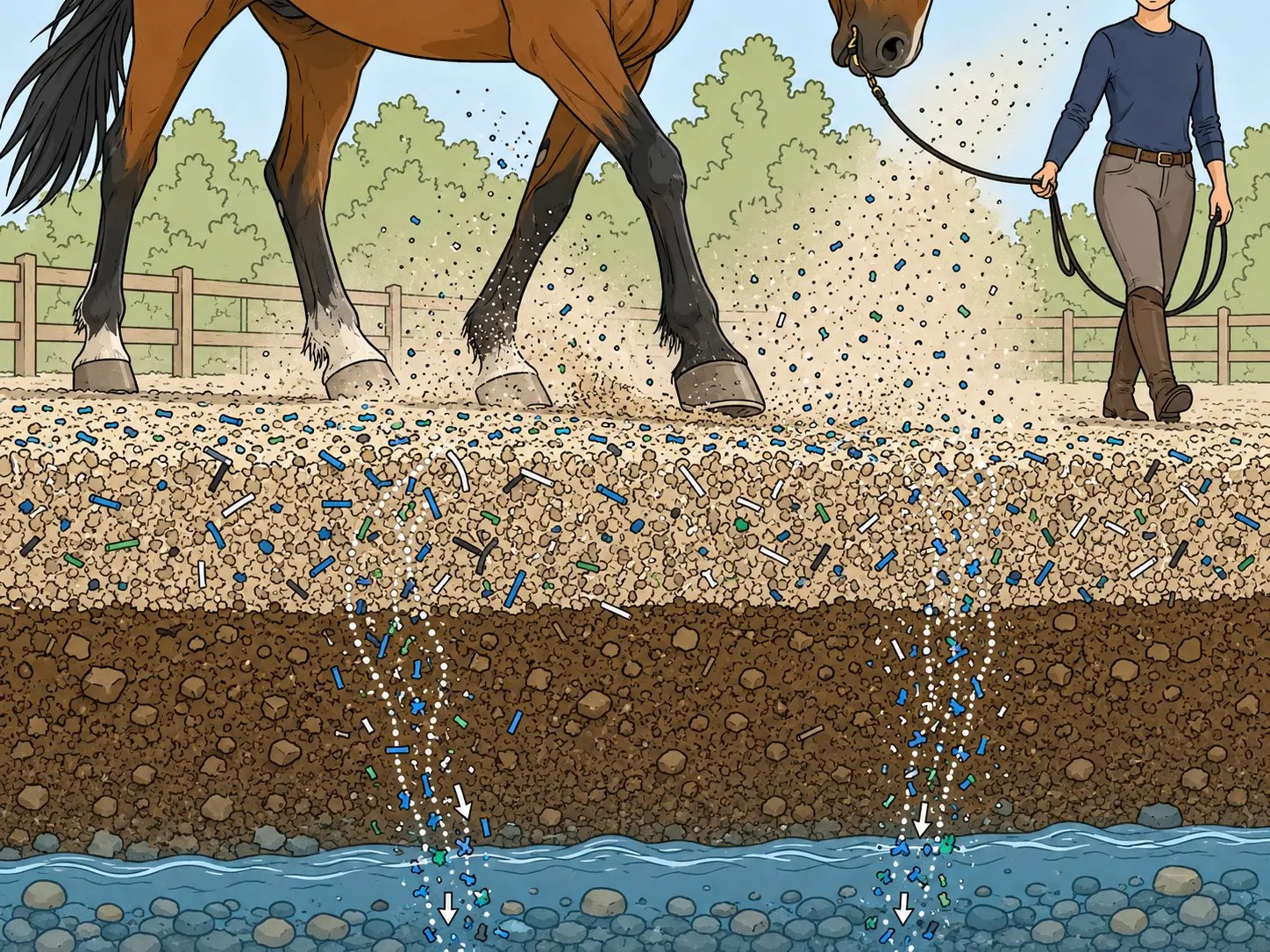
Down—into soil horizons, then into groundwater. Soil-column studies of plastic-heavy surfaces consistently find microplastic accumulation at depth, with migration rates depending on soil porosity and rainfall intensity.
Laterally—with surface runoff. Every rain event carries a small load of fragments into drainage ditches, adjacent pastures, or neighboring watersheds. Properties downstream from synthetic-surface facilities inherit the accumulation.
Airborne—the finest particles become airborne on dry, windy days and settle downwind. A rider's own hay field, water troughs, or neighboring properties can be the unintended destination.
None of these pathways are hypothetical. They're documented in peer-reviewed literature on synthetic turf, tire-crumb infill, and geotextile fabric—three plastic-heavy surface categories with identical physical dynamics to arena fiber. Research published in Environmental Science & Technology and Science of the Total Environment has traced microplastic migration from sports surfaces into surrounding soils and waterways across multiple climate zones.
Microplastics migrate from the arena through groundwater leaching, surface runoff, and wind-borne transport.
What the Science Shows About Accumulation and Persistence
Research on microplastic in agricultural and equestrian soils is early but converging on several clear findings:
Microplastics persist for decades in soil once introduced. Unlike organic matter, plastic doesn't biodegrade on any human-relevant timescale. Fragments fragment further, but they don't disappear.
They act as carriers for other contaminants. Plastic surfaces attract and hold hydrophobic compounds—pesticides, heavy metals, PAHs (polycyclic aromatic hydrocarbons). Microplastic fragments can concentrate these compounds and transport them through soil and water systems.
They accumulate up the food chain. Microplastic has been documented in grazing livestock, drinking water sources, and ultimately in human tissue. The pathway from arena surface to biological exposure is not theoretical—it's measured.
Whether microplastics cause direct harm to horses specifically is a question the veterinary literature hasn't answered decisively. What's documented: horses ingest small amounts of arena surface during turnout and grooming; airborne particles can be inhaled (overlapping with existing concerns about arena dust and respiratory health); and microplastic has been found in the digestive tracts of grazing livestock on contaminated pastures.
The direction of evidence doesn't favor synthetic fiber. The alternative surfaces perform equally well.
The Regulatory Landscape: Europe Leads, the U.S. Follows
The clearest regulatory signal comes from the European Union. In 2023, the EU adopted restrictions on products containing intentionally-added microplastic—covering cosmetic microbeads, detergent capsules, artificial-turf infill, and granular sports-surface additives. Arena fiber wasn't the direct target, but the framework now exists: any product that intentionally introduces microplastic into the environment sits on the regulatory table.
In the United States, the picture is less unified but moving in the same direction:
Several state-level bills targeting synthetic-turf infill have been introduced, with California, Washington, and Connecticut leading the conversation.
Groundwater microplastic testing is expanding in agricultural counties, particularly in regions with high concentrations of synthetic sports and equestrian surfaces.
Insurance carriers are beginning to ask about surface composition in commercial equestrian policies—an early indicator of where liability concerns are heading.
The trend line is clear enough that many new-build commercial arenas are specifying plastic-free surfaces preemptively, ahead of any regulation that would mandate the change. Facilities that retrofit now avoid the scramble later.
Crumb Rubber: The Same Problem, Amplified
Crumb rubber—recycled tire rubber sometimes used as arena infill or mixed with sand—presents the microplastic concern plus additional complications. Tires contain heavy metals, processing chemicals, and PAHs that pure polyester fiber does not. When crumb rubber degrades, it releases both microplastic fragments and these additional compounds into soil and water.
If you're avoiding synthetic fiber for microplastic reasons, avoid crumb rubber as well. The environmental profile is worse, not better, despite the "recycled" positioning.
Considering a surface that eliminates plastic entirely? Performance Footing's ArenaSpec system builds dust-free, waterless surfaces using plant-based fiber instead of polyester. Request a quick quote or call 877-835-0878 to discuss your facility.
The Plant-Based Alternative: How FIBR Solves the Problem
A plant-based fiber surface eliminates the microplastic question by not introducing plastic in the first place. FIBR—part of Performance Footing's ArenaSpec additive system—uses natural plant fiber to bind sand the way roots bind topsoil. It performs the same structural role as synthetic fiber: shear strength, surface consistency, reduced compaction. What it doesn't do is shed plastic.
Plant-based fibers create a stable, high-performance matrix without the use of synthetic materials.
FIBR's fiber source is a renewable byproduct of coconut processing—one of the most abundant plant fibers in the world. At end of life, the spent bed can be composted or spread rather than landfilled. The material doesn't persist in soil for decades; it breaks down into organic matter on a normal biological timescale.
The performance comparison, side by side:
| Property | Synthetic fiber (polyester) | FIBR (plant-based) |
|---|---|---|
| Base material | Polyester or polypropylene | Plant fiber (coconut) |
| Sheds microplastic | Yes, over lifespan | No |
| Biodegradable | No | Yes |
| End-of-life disposal | Sand often can't be reused; many facilities landfill | Spent bed can compost or spread |
| Water demand | Typically 10–15% moisture, watered on schedule | Designed for low-water operation with LOCK coating |
| Plastic load per 100 × 200 arena | ~15,000 lbs | Zero |
The performance question—does plant fiber ride as well as synthetic—comes up every week. The answer is yes, provided the sand underneath is graded correctly. Fiber is a tuning tool for a well-built sand base, and that's true whether the fiber is plastic or plant. A plant-fiber arena on correctly specified sand outperforms a synthetic-fiber arena on wrong-graded sand every time.
The Sand-First Principle: Why Fiber Alone Isn't the Answer
No fiber—plant or plastic—will fix incorrectly graded sand. This is the single most important principle in arena footing, and it applies regardless of what additive system you choose.
Performance Footing's sand analysis service begins every project with a sieve analysis—measuring particle size distribution, gradation curve, and fines content. The additive recommendation flows from the sand diagnosis, not the other way around. FIBR dosing, LOCK coating application rates, and moisture targets are all calibrated to the specific sand in your arena.
This matters because fiber dose isn't universal. A coarse, angular sand requires different fiber integration than a fine, rounded sand. Climate affects fiber performance—humidity, rainfall, freeze-thaw cycles. Discipline matters—a reining arena sees different forces than a dressage court. The sand selection guide covers these variables in detail.
If a vendor isn't asking to test your sand before recommending a fiber product, they're selling material, not a surface.
How Base Construction Influences Microplastic Migration
The environmental story doesn't end at fiber selection. How you build beneath the footing affects where contaminants travel—including microplastic fragments from neighboring properties or legacy synthetic surfaces. A properly engineered base does more than support horses; it controls water movement and prevents pollutants from reaching groundwater.
Effective ground stabilization creates defined drainage pathways that direct runoff away from sensitive areas rather than allowing diffuse percolation through native soil. This matters whether you're building new or rehabilitating an existing arena with synthetic contamination. BASECORE™ geocell systems, for example, establish a stable subgrade that maintains consistent drainage slopes over decades—preventing the settling and ponding that accelerates contaminant migration.
For facilities converting from synthetic to plant-based fiber, base assessment is part of the transition conversation. The arena construction guide walks through the full stack—from native soil preparation through finished surface—so you understand how each layer contributes to both performance and environmental outcomes.
Regional Considerations: Climate Shapes Microplastic Risk
Microplastic shed rates and migration patterns vary significantly by climate zone. High-UV environments accelerate photodegradation; regions with intense freeze-thaw cycles mechanically stress fiber with each expansion and contraction; heavy rainfall areas see faster lateral transport through surface runoff.
A synthetic fiber arena in Arizona faces different degradation dynamics than one in Vermont or coastal Florida. The UV intensity in the Southwest can accelerate fiber surface breakdown by 30–50% compared to northern climates with shorter daylight hours and lower sun angles. Conversely, facilities in freeze-thaw zones experience mechanical fracturing that releases larger fragments more quickly—fragments that then break down further over subsequent seasons.
Performance Footing's regional guidance accounts for these variables when specifying both fiber type and application rates. Plant-based fiber behaves differently than synthetic across climate zones as well—coconut fiber tolerates high-UV environments without fragmenting into persistent microparticles, while its moisture behavior varies with regional humidity patterns. Understanding your specific climate context shapes both the environmental calculus and the performance specification.
The Facility-Wide Perspective: Beyond the Arena Surface
Microplastic concerns extend beyond the riding surface to every area where synthetic materials contact soil. Paddock footing, high-traffic laneways, and wash rack drainage all present potential introduction points. A facility committed to reducing plastic exposure benefits from evaluating the entire property, not just the arena.
Common overlooked sources include synthetic geotextiles beneath gravel pads, plastic-based erosion control blankets on slopes, and rubber stall mats that degrade at their edges. While arena fiber typically represents the largest concentrated plastic load on an equestrian property, these secondary sources accumulate over time—particularly in high-traffic zones where mechanical wear is constant.
Mud prevention systems offer an instructive example: stabilized gravel lanes using geocell reinforcement perform the same function as a loose gravel pad but with dramatically longer service life and reduced material displacement. Less material movement means less abrasion on any geotextile beneath—and alternative base configurations can eliminate the need for plastic geotextile altogether in favor of mineral or natural barriers.
Facilities approaching microplastic reduction holistically often start with the arena—the highest-impact change—then extend the analysis to turnout areas, driveways, and drainage infrastructure. The facility products overview covers the full range of surface and infrastructure options for properties looking to minimize synthetic material across the board.
Making the Decision: Rebuild vs. Refresh for Existing Synthetic Arenas
Facilities with existing synthetic fiber surfaces face a practical question: Is renovation worth the investment, or does it make more sense to wait until the current surface fails completely? The answer depends on fiber age, current performance, and long-term plans for the property.
Several factors favor earlier transition:
Insurance and liability trajectory—If commercial policies begin excluding or surcharging synthetic surfaces, early movers avoid the scramble.
Property sale or lease—Buyers and boarders increasingly ask about surface composition. A documented plant-based system is a selling point; an aging synthetic surface with unknown microplastic load is a liability question.
Cumulative shedding—Every additional year of use deposits more microplastic into your soil and water. The environmental liability compounds rather than holding steady.
Factors that may favor waiting include remaining useful life on a recently installed surface, capital planning cycles that don't accommodate immediate renovation, or a planned facility relocation in the near term.
Performance Footing's rebuild vs. refresh analysis helps owners weigh these variables against current surface condition. In some cases, a phased approach—installing plant-based fiber in a new arena while the existing synthetic surface completes its lifespan—provides the best balance of economics and environmental transition.
Practical Steps for Transitioning to Plastic-Free Footing
Whether you're building new or retrofitting an existing arena, the path to a plastic-free surface follows the same sequence:
Test your sand. Request a sand analysis kit from Performance Footing. The sieve analysis determines whether your current sand supports a plant-fiber retrofit or requires amendment.
Evaluate existing fiber. If you have synthetic fiber already mixed into your sand, removal isn't always necessary—but you need to understand what's there. In some cases, adding FIBR on top of an aged synthetic bed works; in others, surface renovation is the better path.
Specify the complete system. FIBR addresses the structural matrix. LOCK—the dust and moisture controller in the ArenaSpec system—suppresses dust and regulates moisture without watering. The two work together; specifying one without the other leaves performance on the table.
Calculate correct dosing. Fiber application rates depend on arena size, sand type, discipline, and climate. Performance Footing's arena calculators provide preliminary estimates; final specifications come from the sand analysis.
Plan for maintenance. Plant-based fiber requires the same grooming practices as synthetic fiber—regular dragging, consistent depth maintenance, appropriate moisture management. The arena groomers that work for synthetic surfaces work equally well for plant-fiber surfaces.
The timeline for a retrofit depends on arena size and current condition. Most facilities complete the transition in one to two working days once materials arrive.
What to Ask When Comparing Footing Options
If microplastic exposure belongs on your list of concerns—and given the direction of research and regulation, it does—use this buyer checklist when evaluating footing products:
Ask what the fiber is made of. "Recycled fiber" and "engineered fiber" usually mean polyester or polypropylene. If the answer isn't clearly plant-based, assume plastic.
Ask what happens at end of life. If the vendor can't explain how to dispose of the spent bed, that's the microplastic problem in reverse—you're inheriting the liability.
Ask for a mass estimate. How many pounds of material will be in your arena when installation is complete? The number is often larger than expected.
Ask about water demand. Synthetic fibers require moisture to function properly; that's water you'll pay for and infrastructure you'll maintain. Plant-fiber systems paired with moisture-control coatings generally operate with less water—or none at all in dry climates.
Ask about the sand. A vendor who doesn't ask to test your sand is selling you material, not a solution. Surface performance depends on the sand-fiber combination, not fiber alone.
Can microplastic from an arena actually reach groundwater?
Yes. Soil-column studies of plastic-heavy surfaces document microplastic migration to depth, with fragments found in groundwater monitoring wells downstream of synthetic sports surfaces. Migration rate depends on soil type, rainfall intensity, and drainage design—but the pathway is real and measured, not theoretical. Properties with sandy or well-drained soils see faster migration; clay-heavy soils slow but don't stop the process.
This is one reason proper arena base construction—including drainage design and geotextile placement—matters for environmental outcomes, not just surface performance.
Are microplastics harmful to horses?
The equine-specific research isn't complete, but the direction of evidence doesn't favor exposure. Microplastic has been documented in the digestive tracts of grazing livestock on contaminated pastures. Horses ingest small amounts of arena surface during turnout and self-grooming. Airborne particles—the finest microplastic fragments—can be inhaled, overlapping with existing concerns about arena dust and equine respiratory health.
Whether this constitutes a meaningful health risk to any individual horse depends on exposure duration and concentration, data that isn't yet complete for arena fiber specifically. What's clear: an equal-performing alternative exists that doesn't require weighing these unknowns.
Does plant-based fiber perform as well as synthetic fiber?
Yes, provided the sand is graded correctly. Fiber—whether plant or plastic—is a tuning tool for a well-built sand base. The ride quality comes from the sand-fiber combination, not from the fiber alone. A plant-fiber arena on correctly specified sand outperforms a synthetic-fiber arena on wrong-graded sand every time.
Performance Footing's discipline-specific footing guides cover the sand and fiber specifications for dressage, jumping, reining, barrel racing, and general-purpose arenas. The underlying principle is consistent: start with the sand, then tune with fiber.
The Bottom Line
The microplastic conversation is going to intensify, not fade. Regulation is one pressure vector; owner awareness is another; insurance and liability considerations are a third. All three are trending in the same direction. A facility built on synthetic fiber today will face increasingly hard questions in five years—from regulators, from boarders, from buyers if the property changes hands.
There is a working alternative that doesn't require weighing those trade-offs. Plant-based fiber, sized to your sand, applied at zero plastic load, with a coating system built for low-water operation and no disposal liability at end of life.
That's what the ArenaSpec system delivers. Request a quote to start with a sand analysis, or call Performance Footing at 877-835-0878 to discuss your facility's specific conditions.
Frequently Asked Questions
Do all synthetic arena fibers shed microplastics?
Yes, though shed rates vary by fiber type, arena climate, and use intensity. Polyester and polypropylene—the two most common arena fiber materials—both fragment under mechanical wear and UV exposure. Higher-traffic arenas and outdoor surfaces exposed to direct sunlight shed at faster rates than protected indoor surfaces.
How do I know if my current footing contains synthetic fiber?
Examine a handful of your arena surface closely. Synthetic fibers appear as thin, uniform strands—often white, blue, or green—that don't break down when rubbed between your fingers. If you're unsure, contact Performance Footing for guidance on identifying your current surface composition.
Can I add plant-based fiber on top of an existing synthetic fiber surface?
In some cases, yes. The decision depends on the condition of your current surface, the synthetic fiber concentration, and your sand gradation. A sand analysis determines whether overlay or full renovation is the better path for your specific arena.
What disciplines work well with plant-based fiber footing?
Plant-based fiber supports all disciplines when paired with correctly graded sand. FIBR has been installed in dressage arenas, jumping rings, reining pens, and multi-use facilities. The fiber dose and sand specification vary by discipline—the discipline guides cover the differences.
How long does plant-based fiber last compared to synthetic?
Lifespan depends on climate, use intensity, and maintenance practices. Plant fiber does break down over time—that's the point—but properly maintained surfaces typically deliver 5–8 years of performance before requiring top-up applications. The key difference is what happens at end of life: plant fiber composts; plastic fiber persists.
This article is for informational purposes only. The information provided reflects published equestrian research, FEI and governing-body guidelines, and Performance Footing's product expertise. Surface conditions, climate, soil type, and facility use vary widely—consult Performance Footing or a qualified arena builder for site-specific recommendations. For current product information, pricing, and availability, visit performancefooting.com or call 877-835-0878.