
Why Arena Sand Keeps Changing — And How To Stay Ahead
Arena sand varies by quarry, season, and delivery — and keeps drifting after install. Why footing is a process, not a one-time purchase.
There's a comforting story going around the footing world. It goes like this: figure out the "right" sand for your discipline, your climate, and whether you're indoors or out, order it, install it, and you're done. Buy the answer once, ride happily ever after.
It's a nice story. We wish it were true.
After building and consulting on arenas for over 17 years — and after hearing back from more than a thousand arena owners about what actually happened in their footing — we can tell you the part that almost nobody selling a course or a one-time product wants to say out loud:
The sand you ordered and the sand that showed up are rarely the same thing. And even when you nail it on day one, it doesn't stay that way.
That's not a reason to give up. It's the entire reason we built ArenaSpec the way we did. Let's walk through what really happens to sand in the real world, and why "set it and forget it" footing is a myth.
The Promise vs. the Reality
In theory, you should be able to spec the ideal sand: the right particle size range, the right shape, the right fines content for your discipline. We believe in that target. We publish those targets openly — you can take our sieve analysis guide to your local quarry tomorrow.
But there's a gap between the spec sheet and the dump truck. Sand is a natural, mined, screened, stockpiled, and trucked material. Every one of those steps introduces variation. The "ideal sand" exists on paper. The sand in your arena is whatever actually came off the truck — and that's a moving target.
Sand Varies Before It Even Gets to You
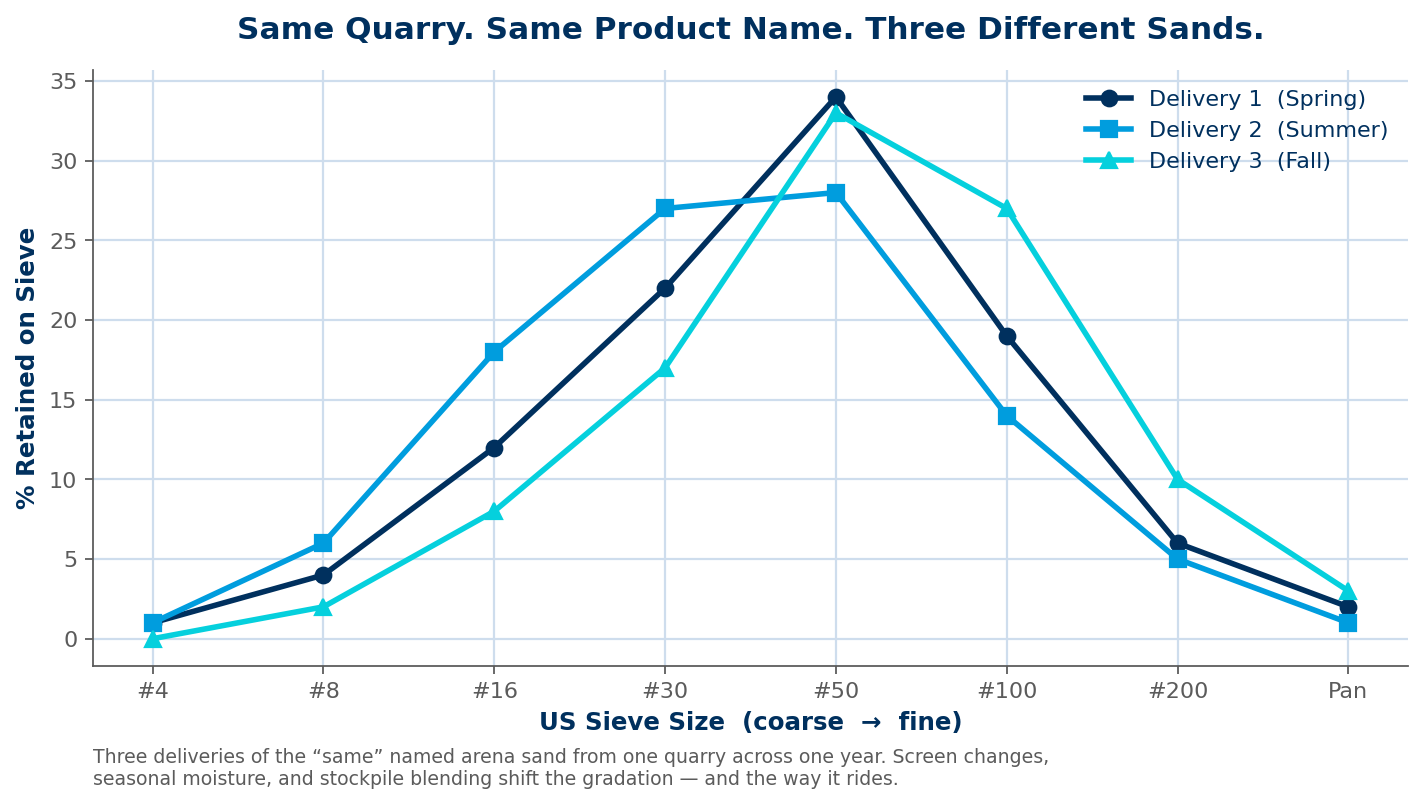
Here's the thing most people never see, because they only order sand once: the same quarry, selling the same product, will give you a different sand depending on when you buy it.
Why does this happen?
- Screens change. Quarries swap and wear out their screening equipment. A worn screen passes coarser material. A new screen passes finer. Same pile, different result.
- Seasons change the stockpile. Moisture, weathering, and how deep into the pile they're digging all shift the gradation. A spring load and a fall load from the same yard can sieve out noticeably differently.
- Stockpiles get blended. When a quarry runs low, they top up the pile from a new batch — and "horse arena sand" becomes a blend of two slightly different materials.
- Sometimes you just get the wrong sand. We've seen it more times than we can count: a trucking company grabs the wrong pile, or the yard loads the wrong product, and an arena owner ends up with material that was never what they ordered. By the time anyone notices, it's spread three inches deep across the whole arena.
This is why we say it over and over: don't trust the name on the invoice. Trust the sieve report. The label "arena sand" is a sales category, not a specification.
The Trucking Trap: Is the "Perfect" Sand Worth Hauling 12 Hours?
When people learn their local sand isn't textbook-perfect, the first instinct is often to chase the perfect stuff — even if it means hauling it in from half a state away.
Before you do that, run the math.
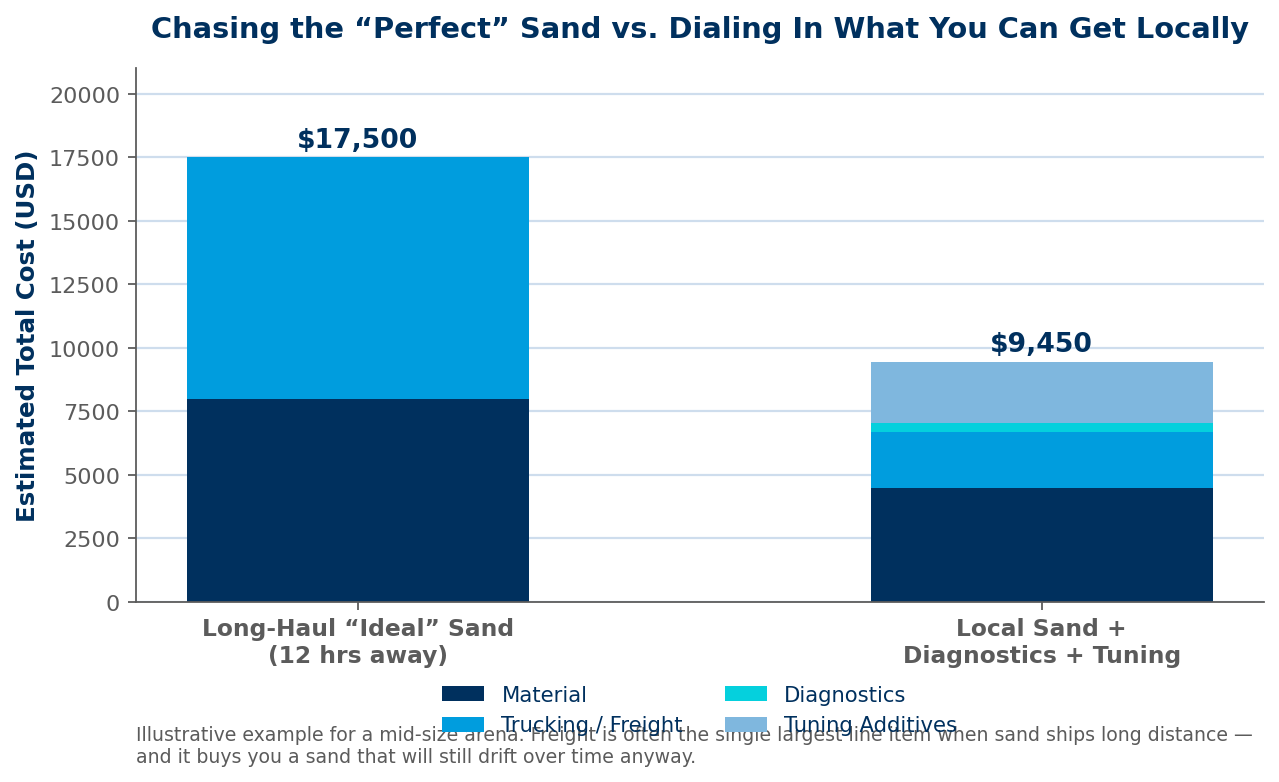
Freight is brutal. Sand is heavy, and trucking is priced by weight and distance. On a long haul, the trucking can cost as much as — or more than — the sand itself. And here's the kicker: that expensive, hauled-in "perfect" sand is still a natural material that will still drift over time, just like the local stuff. You paid a premium for a head start, not a permanent solution.
In the large majority of cases we've worked, the smarter play is to start with a workable local sand, diagnose exactly what you have, and tune it to perform. The right question is almost never "is this the perfect sand?" It's "is this sand workable, and what will it take to make it ride right?"
A horse doesn't care which quarry the sand came from. The horse cares how the surface performs underfoot.
What 1,000+ Arenas Taught Us That a Lab Can't
Theories come from controlled conditions — clean samples, stable humidity, one variable at a time. That's valuable. But it isn't an arena.
Our knowledge comes from real arenas, real climates, real maintenance habits, and real riders telling us what actually happened six months and two years later. Across more than a thousand of those conversations, a few truths show up again and again:
- Every quarry is different, and the same quarry is different from one season to the next.
- Every climate stresses footing differently — Arizona dry, Pacific Northwest wet, Midwest freeze-thaw.
- Every maintenance routine slowly reshapes the surface, for better or worse.
No specification sheet survives first contact with a real arena. That's not a knock on specs — we use them every day. It's just why a spec is a starting point, not a finish line. Diagnostic-first isn't a marketing slogan for us. It's the only honest way to work.
The Misconception Nobody Talks About: Sand Changes After You Get It Right
Here's the part the "buy it once" crowd conveniently skips.
Let's say you do everything right. You test, you spec, you install a beautifully graded sand. It rides like a dream. Are you done?
No. You've just started the clock.
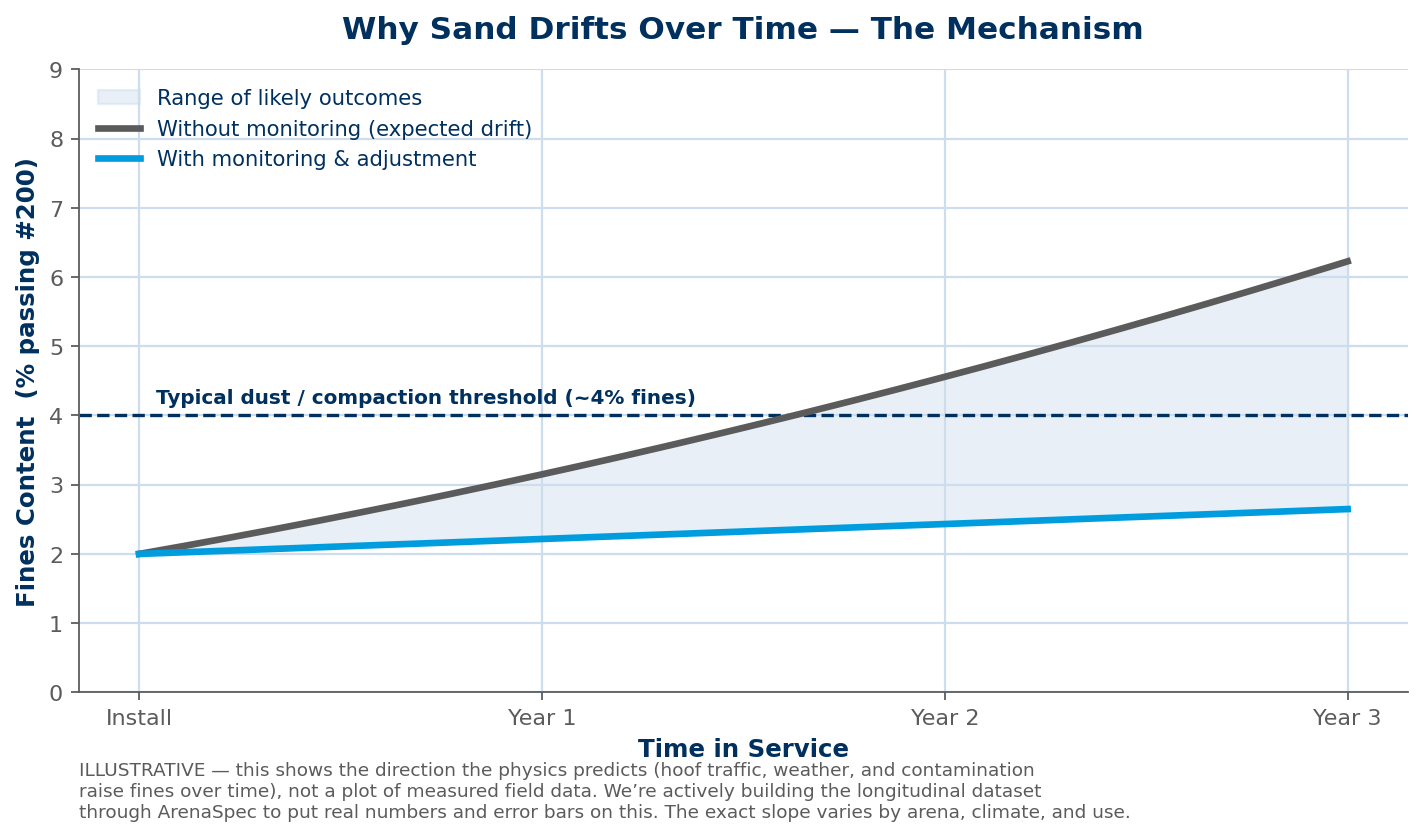
A note on the chart above: this is an illustration of the mechanism, not a plot of measured field data. It shows the direction the physics predicts — fines climbing as the surface breaks down and picks up contamination — and the gap that ongoing monitoring is meant to hold open. The exact slope depends on your arena, climate, and how hard it's used. We're actively building the longitudinal dataset through ArenaSpec to put real numbers and error bars behind this, and we'll publish them as they mature. We'd rather show you an honest model and tell you it's a model than dress a guess up as data.
Sand is not inert. Under a working arena it changes constantly:
- Usage breaks it down. Hooves grind particles against each other thousands of times a day. Sharp angular grains round off and fracture into smaller pieces. The gradation you installed slowly grinds finer. This isn't a defect — it's physics.
- Contamination creeps in. Manure, organic matter, hay, shavings, and dust from outside all work their way into the profile. Organics climb, and so do fines.
- Weather attacks the surface. Wind deposits silt. Rain washes fines around and out. Freeze-thaw cycles fracture grains. UV and heat degrade some additives.
- Additives age. Fibers and binders don't last forever. As they break down, the way your particles lock and cushion changes too.
The result is predictable: fines climb, the surface compacts, dust comes back, and the arena that felt perfect in year one feels different in year two or three. (For the dust side of this specifically, see our guide on creating low-dust arena footing.)
This is the single most important thing we can tell a new arena owner: getting your sand right is not an event. It's an ongoing process. Anyone who sells you a one-time answer and walks away has left out the most important chapter.
A Word About Fineness Modulus
You'll hear fineness modulus (FM) thrown around as the number for footing. It's useful — it's a quick way to compare where a sand sits on the coarse-to-fine spectrum, and the target band genuinely shifts by discipline.
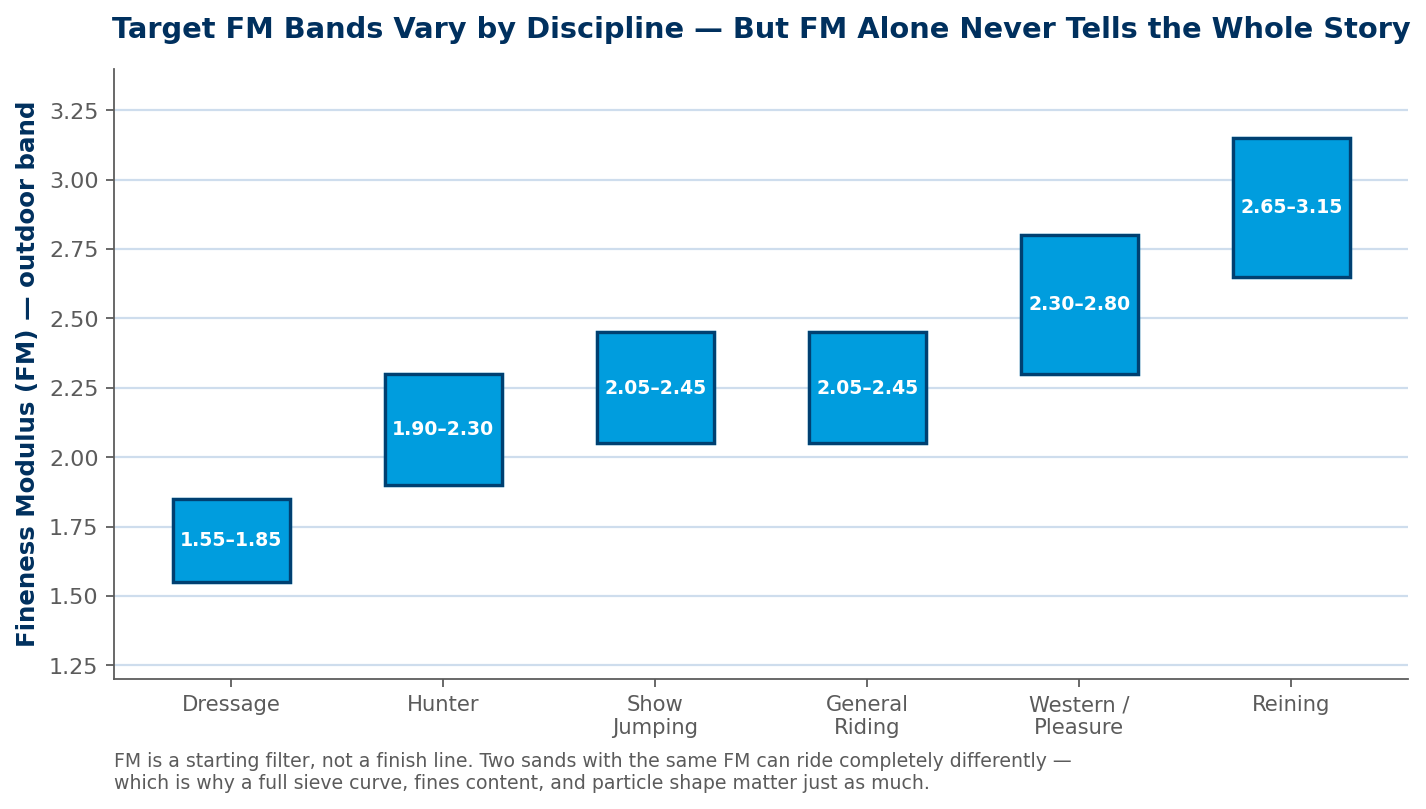
But FM is a starting filter, not the whole story. Two sands can share the same FM and ride differently, because FM is a single averaged number — it can't see particle shape, the spread of the gradation, the fines content, or how the sand drains. That's exactly why a real assessment looks at the full sieve curve, the fines fraction, particle shape, and uniformity — not one number on a page. FM gets you in the neighborhood. The full gradation tells you which house you're standing in. Our precision arena design approach is built around that fuller picture.
Why We Give This Away for Free
Footing is genuinely complex. That complexity can be used two ways.
Some corners of this industry package it up, put it behind a paywall or a closed group, and sell you the "secret." Information filtered through a "buy my course" layer always has a conflict of interest baked into it — the incentive is to keep the knowledge scarce and the answers proprietary. Sell the answer once, move on. Meanwhile your sand keeps right on changing.
We took the opposite path. Our gradation targets, our sieve method, our additive logic, our maintenance guidance — it's all published, free, on this site. We'd rather have ten thousand informed arena owners who can evaluate their own footing than a handful of dependent ones. An owner who understands their sand makes better decisions, builds better arenas, and — yes — becomes a better customer when they do need product. That's a trade we'll take every time.
What "Sand First" Actually Looks Like in Practice
"Start with good sand" is advice, not a method. The method is test, diagnose, tune, and keep testing.
- Test what you actually have. A real sieve analysis (ASTM C136/C117), not the label on the invoice.
- Diagnose the full picture. Gradation curve, fines content, particle shape, uniformity — not FM alone.
- Tune to the sand you have. Only now do additives enter the conversation — as precision tools to dial in a good sand, not as a fix for the wrong one. (Start with our footing additives guide.)
- Re-test on a schedule. Because — say it with us — the sand keeps changing.
And to be clear about additives: they don't fix bad sand. They tune good sand. If your base material is wrong, no fiber, no elastomer, and no binder will save it. We've told plenty of people not to buy from us yet, because their sand needed to be addressed first. That's the job.
Footing Is a Process — So We Built a Tool for the Process
If sand were a one-time decision, you wouldn't need anything but a good spec sheet and a phone number for the quarry. But sand isn't a one-time decision. It drifts before it arrives and keeps drifting once it's down. That's the whole reason ArenaSpec exists.
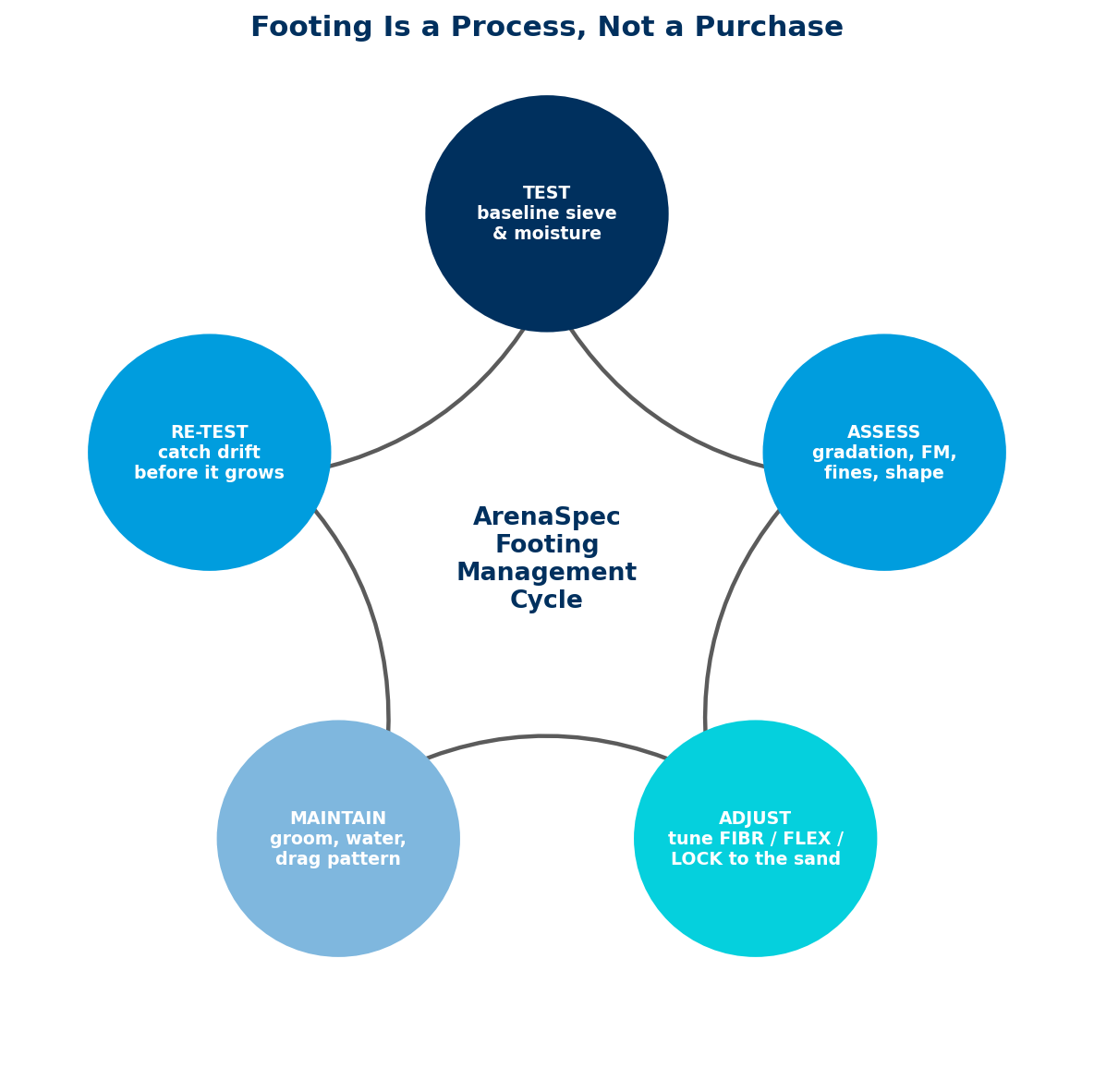
ArenaSpec isn't a single snapshot. It's built to monitor and adjust your footing over its entire life:
- Establish a baseline when your surface is dialed in, so you know what "good" looks like for your arena.
- Track the drift as fines climb and the gradation shifts, before it becomes a dusty, compacted problem you can feel from the saddle.
- Adjust on evidence — knowing when to top-dress, when to add or refresh an additive, when to change your watering or maintenance routine, and when (rarely) it's actually time for new material.
- Catch problems early, when they're a cheap correction instead of an expensive rebuild.
The most expensive footing mistake isn't picking the wrong sand. It's installing the right sand and then never looking at it again until it's failed.
The Bottom Line
Your sand was never perfect, and it never will be — not because anyone got it wrong, but because sand is a natural material in a working environment, and natural materials in working environments change. That's not a problem to be sold a one-time fix for. It's a process to be managed.
Anyone can say footing is complicated. The honest part is admitting it never stops changing — and then giving you the tools to stay ahead of it.
Start where you are. Run a free ArenaSpec assessment and find out where your sand actually stands today — not where the invoice said it should be.
Performance Footing has built and consulted on arenas across the United States and internationally for over 17 years. We publish our methodology openly because we believe an informed arena owner is the best thing for the horse, the rider, and the sport. Explore our full guide library →