
Arena Maintenance Guide Made Simple: Safer Footing and Less Dust
Keep arenas safe and long-lasting with this simple arena maintenance guide—reduce dust, improve footing, and extend sand life with easy, effective tips now.
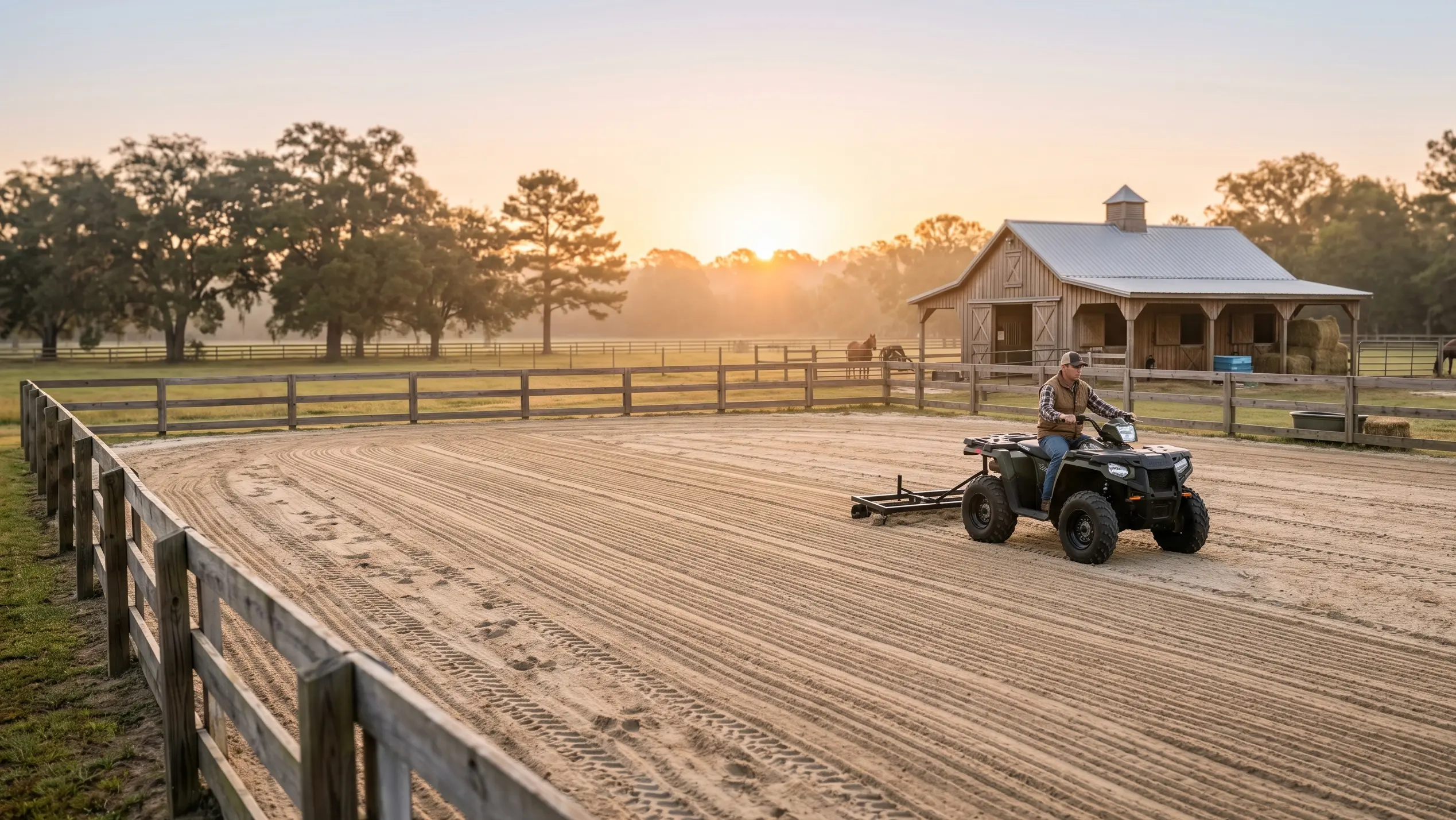
Most arenas don’t fail from one big mistake. They fail from small daily habits — or the lack of them. The good news? Research from Penn State, the University of Kentucky, and the FEI shows that three simple habits do most of the work. You don’t need a mega show facility or a huge budget. Whether you ride three horses at home or run a busy training barn, this guide shows you exactly what to do, when to do it, and how to make it easy.
What Arena Maintenance Really Is
Arena maintenance is the small set of tasks that keep your footing safe, even, and long-lasting. That’s it.
The University of Kentucky’s arena maintenance guide sums up the goal well: keep the surface level, keep the base protected, and keep the footing in the right moisture range for your horse.
When people say their footing is “bad,” they almost always mean one of four things:
- It’s too dusty.
- It’s too deep or too hard.
- It has ruts, holes, or deep spots at the rail.
- It drains poorly after rain.
Every one of those problems traces back to maintenance — not to the sand itself. Even great sand turns into a rough ride without a simple plan.
The Three Habits That Do Most of the Work
Before we talk about tools, let’s talk about habits. If you only do three things, do these.
Habit 1: Pick Manure Every Single Ride
This is the most important one. And it’s free.
Penn State Extension says manure breaks down into tiny particles that add dust and change how your footing rides. Pro groomers call manure “the number one reason footing goes bad.” It also carries bacteria and can make your sand degrade faster.
Keep a muck bucket and fork at the gate. Pick after every ride. Yes, every ride.
Habit 2: Water by Moisture, Not by Feel
Most people water too little or too much. Both cause problems.
Penn State recommends keeping footing evenly damp about three inches deep. A peer-reviewed 2019 study in the Journal of Equine Veterinary Science measured arenas that riders called “perfect” and found the sweet spot for pure sand is about 8% to 13% moisture.
Here’s a simple field test from Kentucky Extension: grab a handful of your footing and squeeze it. If it holds its shape like a loose snowball, you’re in range. If it crumbles apart, you need water. If water drips out, you’ve got too much.
Habit 3: Drag Smart — Never Touch the Base
The base under your footing is the most expensive part of your arena. One deep drag that cuts into it can cost thousands to repair.
The rule from Penn State Extension guidance: your tines should “not penetrate the underlying base material.” The goal is to glide along the base — never dig into it. Kentucky Extension says the same thing: your drag should level the footing without harming the base below.
If you hear scraping or metal-on-gravel sounds, stop and raise your tines.
These three habits — manure, moisture, smart dragging — are what separate arenas that last ten years from ones that fall apart in three.
How Often Should You Drag?
This depends on how much you ride.
For a private arena with 1–3 horses: Drag once or twice a week. A weekly deep drag keeps the base clean and prevents ruts.
For a small training barn (5–10 horses): Drag daily, or at least every other day. Penn State says heavily used arenas “will need the surface dragged once or more daily.”
For a busy training barn (10–20 horses): Drag daily, often twice a day. Also move jumps weekly so the footing under them doesn’t compress into deep spots.
A UC Davis study by researcher Christina Rohlf, published in 2023, found that how often you harrow is one of the biggest factors in reducing horse injury risk. The more you drag, the safer your surface — as long as you do it right.
Change Your Pattern
Don’t drag the same way every time. Same path every day means your tractor tires create the same tracks every day, and those tracks turn into compaction stripes. Kentucky Extension says to rotate your drag pattern and adjust your settings, too. Our guide on the best arena grooming patterns walks through patterns you can cycle through week by week.
Indoor, Covered, and Outdoor Arenas Are Not the Same
One maintenance plan doesn’t fit all three. Here’s how they differ.
Outdoor Arenas
The sun, wind, and rain are your main challenges. Sun dries the surface fast. Wind makes it worse. Rain adds water you didn’t plan for.
You’ll water more often in hot, dry weather and may skip watering after storms. A gentle crown (slope) of 1.5–2% helps rain drain off instead of pooling.
Covered Arenas (Open Sides With a Roof)
Covered arenas are often the driest of the three. No rain hits the footing, but wind passes through and dries it out quickly.
Water like it’s an outdoor arena in summer, but without planning for rain.
Indoor Arenas
Indoor arenas are the biggest dust problem. A 2021 University of Kentucky survey of over 450 indoor arena users found 77% listed dust, moisture, and airflow as their top complaints.
Dust inside matters because horses breathe a lot when they work — up to 1,500 liters of air per minute at a gallop. A 2017 peer-reviewed study in the Equine Veterinary Journal found that watering once a day dramatically reduced dust at both horse and rider breathing heights.
For indoor arenas, a product like Dust Halt can help you stretch each watering. It binds loose dust particles back to the sand so you don’t have to water as often.
The Groomer Features That Actually Matter
Forget brand names for a second. What matters is what features your drag has and how you set them.
Tines
Tines are the metal teeth that break up and mix your footing. Different shapes do different jobs:
- Coil tines are softer and flex. Great for light leveling and fluffing without cutting deep.
- S-shaped tines are more aggressive. They dig and mix, which is perfect for sand and sand-fiber blends that need to stay well-mixed.
- Straight spikes or ripper teeth can cut deep. These are useful for breaking up compacted areas, but set them carefully so they don’t hit the base.
Kentucky Extension says S-tines are “excellent for mixing surface materials, especially for sand and fiber blends.”
Leveling or Floating Bars
A leveling bar drags behind the tines and smooths the top. It’s what makes the surface look nice and ride evenly. Without one, you get a choppy top layer.
Rear Rollers
A rear roller does two jobs. First, it smooths the surface one more time. Second, it acts as a depth reference for your tines — meaning it keeps them at a steady depth the whole way across. This is why drags with rollers give much more even results than basic drags.
Depth Control
This is the most important feature. A depth-control system — usually a top-wind jack or hydraulic cylinder — lets you set exactly how deep your tines go and lock them there.
Why is this a big deal? Because without depth control, tines can drop unevenly, dig into the base, or skim too high. With it, you set the depth once and every pass is the same.
The Rail Wheel
If your drag has a small wheel on the side that follows the kick wall, use it. It keeps the drag from scuffing your boards and, more importantly, keeps depth steady along the rail — where footing gets the most abuse.
How Deep Should Tines Go?
This depends on your discipline:
- Dressage: 2–3 inches
- Jumping: 3–4 inches
- Reining/cutting: 4+ inches
- Driving: as little as 1.5 inches
Penn State’s rule: start shallow, add a half inch at a time, and never go deeper than 6 inches — deeper than that stresses horse tendons.
Watering Smarter, Not Harder
Hand-watering a decent-sized arena takes real time. For a 100×200 ft arena, you can easily spend 20–25 hours a week pulling a hose or filling a water cart. At paid labor rates, that’s thousands of dollars a year.
The Simple Math
A classic formula from Dressage Today magazine is still the standard: for every 1,000 square feet of arena, you need about 19.5 gallons of water to raise moisture by 1%. A 100×200 ft arena that’s dry may need 2,500–4,000 gallons to get to the right moisture range — and even more in hot, dry climates.
That’s a lot of hose-dragging.
How an Automated Sprinkler Helps
A self-propelled sprinkler like SprinklAir rolls itself across your arena. You hook it to a garden hose, set the speed, and walk away. It stops when it’s done.
This cuts labor to about 2–3 hours a week for the same arena. That’s roughly 85–90% less time than hand-watering — and the water goes down evenly, without the dry stripes and puddles you get from a hose.
It also uses less water. Because water is delivered controlled, less is lost to evaporation and runoff.
Tom M., in a review on our site, described switching from a water cart to SprinklAir: he just rolls it out, turns it on, and walks away while it waters the whole arena.
When to Water
Rutgers University says evening watering works best. Less wind, less evaporation, more soaks in. Water the day before you plan to ride, not five minutes before.
Extending Sand Life
Most arena sand lasts 5 to 10 years before it needs major help. Penn State’s guidance: hard quartz sand can last up to 10 years. Softer sands break down much faster.
Three things shorten sand life:
- Horse hooves grinding particles smaller every ride
- Manure and organic matter breaking into fines
- Fines filling up pore space between sand grains, causing compaction
The good news: the three habits above slow all of this down.
Additives That Help
Footing additives like Levitare are wax-coated sand additives designed to reduce dust, hold moisture longer, and reduce watering frequency. FIBR™ fiber footing adds natural fibers that work like a root system — giving sand more stability so it holds its shape under hoofbeats. Both extend sand life by reducing how hard the sand has to work.
The FEI’s big 2014 research report on equine surfaces found that wax-coated additives show “superior long-term performance” across different weather conditions and reduce impact shock on horses’ legs.
When to Test Your Sand
Run a sieve analysis of your sand if:
- Dust suddenly gets worse even when you water normally
- Footing feels deep after every rain
- You’re adding fresh sand and want to match it to what’s there
- Your arena is 3+ years old and you want a baseline
Penn State’s rule of thumb: if more than 5% of your sand passes through a 200-mesh sieve, your footing is getting too dusty and needs refreshing.
Mistakes to Avoid
Research from Penn State, University of Kentucky, UC Davis, and the FEI all point to the same common mistakes. Skip these, and you’re most of the way there.
- Watering the top inch only. Penn State: “just wetting the top fraction of an inch does no good.” Water deeper, less often.
- Dragging the same pattern every day. This creates compaction stripes and doesn’t fix problems.
- Skipping manure pickup. The fastest way to ruin footing.
- Riding frozen footing. Rutgers recommends waiting it out rather than risking injury.
- Leaving jumps in the same spot. Kentucky Extension says move them weekly. Standing pressure creates low spots that deep drags can’t fix.
- Using motor oil for dust control. Kentucky Extension warns it’s linked to cancer and groundwater pollution. Use a purpose-made dust additive instead.
- Letting tines hit the base. A damaged base means a full rebuild later.
A Simple Starting Plan
If you’re starting from scratch, here’s a clean six-step plan:
- Pick manure every ride. Start today. It’s free.
- Get a moisture target. Use the squeeze test or a $20 soil-moisture meter.
- Match your drag to your footing. Use tines that won’t tear up additives; use depth control; use a roller if you can.
- Rotate your drag pattern so you don’t wear tracks into the same lines.
- Automate your watering if you can — a self-propelled sprinkler pays for itself quickly in saved labor.
- Add a dust additive if you still struggle with dust after watering discipline is in place.
That’s the whole program.
Conclusion
Arena maintenance isn’t complicated. Three habits — pick manure, water by moisture, drag without touching the base — do most of the work. The right groomer setup and an easy watering system remove the pain, so the three habits actually happen.
Your next step? Pick the one habit you’re not doing consistently and start there tomorrow. If you need help picking the right drag or sprinkler for your arena, the Performance Footing team can help — call 877-835-0878 or check out our arena sand calculator to size what you need.
FAQ Section
How often should I drag my arena?
For 1–3 horses, drag once or twice a week. For a small training barn with 5–10 horses, drag daily. For heavy use (10–20 horses), drag daily and sometimes twice a day. Always rotate your pattern.
How do I know if my arena has enough water?
Grab a handful of footing and squeeze. If it holds its shape like a loose snowball, you’re in range. Research shows the sweet spot for pure sand is about 8% to 13% moisture. Too dry crumbles; too wet drips.
What’s the best way to stop arena dust?
Water first, then add a dust-control additive if needed. Kentucky Extension research found that disciplined daily watering alone can drop dust below health limits. Avoid motor oil — it’s toxic and illegal in most areas.
How long should my arena sand last?
Hard quartz sand can last up to 10 years with good maintenance, per Penn State research. Softer sands may need replacing in 3–5 years. Picking manure and avoiding base contact with drags are the two biggest factors in longevity.
Is automated watering worth it for a home arena?
Yes, for most owners. Hand-watering a standard arena takes 20+ hours a week. A self-propelled sprinkler cuts that to 2–3 hours and applies water more evenly. The labor savings usually pay for the system within a year.
Disclaimer
This article references publicly available information from Penn State Extension (Riding Arena Footing Material Selection and Management, rev. 2016), the University of Kentucky Cooperative Extension (publications ID-265, ID-266, and ID-267, rev. 2024), Rutgers NJAES Equine Science Center (E296 and FS1142), UC Davis College of Engineering (Rohlf 2023), the FEI Equine Surfaces White Paper (Hobbs et al., 2014), and peer-reviewed studies including Claußen et al. (Journal of Equine Veterinary Science, 2019), Lühe et al. (Equine Veterinary Journal, 2017), and Bulfin et al. (International Journal of Environmental Research and Public Health, 2019). All metrics and recommendations are from documented sources dated 2014–2024. Results described are general guidance; your specific arena’s needs may vary based on climate, use, footing type, and base condition. For product information or to speak with a specialist about your arena, visit performancefooting.com or call 877-835-0878.