


Performance Footing delivers Horse Arena Climate solutions that stabilize temperature, moisture, and footing conditions year round. Our engineered systems improve horse comfort, rider performance, and surface consistency for training and competition arenas. Trust proven technology, expert support, and sustainable designs that protect your investment while maximizing usability in every season with reliable airflow control, dust reduction, energy efficiency benefits included.
Climate determines nearly every construction decision: base depth, drainage configuration, footing composition, and additive selection. This guide breaks down arena specifications for four distinct North American climate zones, providing per-square-foot cost ranges and product recommendations that address each region’s specific challenges. Whether you’re battling freeze-thaw cycles, managing chronic dust, or engineering drainage for 60+ inches of annual rainfall, building for your climate ensures reliable performance year-round.
Understanding Horse Arena Climate Construction
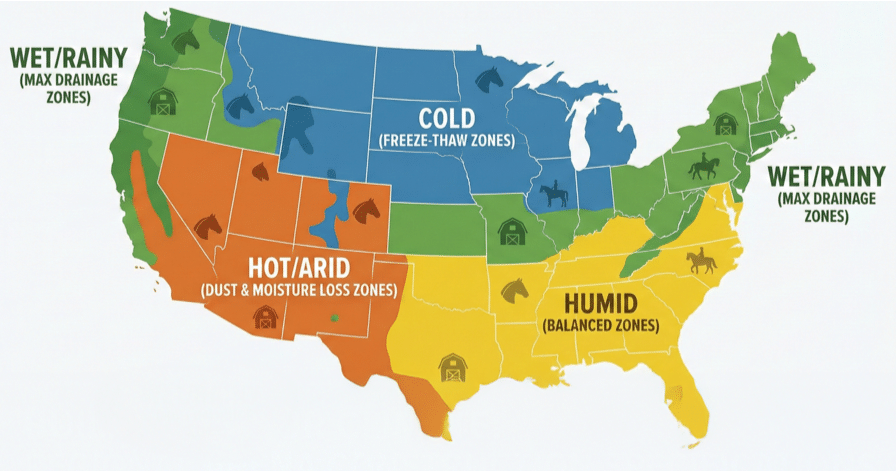
Before selecting materials, understand how your regional climate affects arena performance at every layer.
Temperature Extremes affect base stability. Freeze-thaw cycles heave poorly constructed bases, creating dangerous uneven surfaces. In contrast, extreme heat accelerates footing breakdown as UV radiation degrades organic and some synthetic materials.
Precipitation Patterns determine drainage requirements. Regions averaging 40+ inches annually need robust vertical drainage systems, while areas receiving under 15 inches focus on moisture retention rather than removal.
Humidity Levels influence footing behavior. High humidity helps control dust naturally but can cause compaction in certain footing types. Low humidity accelerates moisture loss, requiring additives that retain water without constant irrigation.
Soil Composition varies regionally. Clay-heavy soils common in the Southeast and Pacific Northwest drain poorly, requiring engineered base systems. Sandy soils in coastal and desert regions drain quickly but provide less natural stability.
The base layer remains the most climate-critical component. As documented in construction research, proper base construction prevents the chronic problems—standing water, frost heave, footing migration—that plague arenas built without regional considerations.
Cold Climate Regions: Northern States, Mountain West, Canada
Primary Challenges: Freeze-thaw cycles, frost heave, shortened riding seasons, frozen footing
Cold climate arena construction prioritizes preventing water from becoming trapped in the base layer where freeze-thaw cycling causes heaving and surface damage. Performance Footing’s documentation on preventing arena freezing emphasizes that proper drainage prevents freezing more effectively than any chemical treatment.
Base System Specifications
Layer 1: Compacted Subgrade
Achieve 95% compaction density with extra-heavy rolling. Cold climate documentation indicates that thorough compaction during construction significantly reduces frost heave by eliminating air pockets where water collects and freezes.
Layer 2: Enhanced Drainage Layer (2–3 inches)
Cold climates benefit from thicker drainage layers using clean, washed angular stone (3/8″ to 1/2″). This layer must sit below the frost line where possible, or provide sufficient drainage capacity to prevent water accumulation before freezing occurs.
Layer 3: Geotextile Separation
Non-woven geotextile prevents fines from migrating into the drainage layer where they could impede water movement and freeze.
Layer 4: BaseCore HD Geocell System
BaseCore HD’s honeycomb structure creates lateral drainage channels throughout the base, allowing water to escape before temperatures drop. The geocell also provides structural stability that resists heaving forces, distributing stress across a wider area than traditional aggregate-only bases.
Layer 5: Cold-Resistant Footing (3–5 inches)
Sand combined with additives that resist freezing and maintain flexibility in cold temperatures.
Recommended Footing Additives
EcoStride excels in freezing climates. Crafted from bio-based, sustainable materials, EcoStride remains flexible and weather-resistant even in freezing conditions. Unlike rubber additives that can become brittle in extreme cold, EcoStride maintains consistent performance characteristics across temperature swings.
FoamFooting provides cushioning that persists in cold weather when other materials harden. The foam particles create air pockets that resist compaction even when surface moisture freezes temporarily.
Cost Range: $4.00–$7.50 per Square Foot
| Component | Cost/SF |
| Site Preparation (heavy compaction) | $0.35–$0.60 |
| Enhanced Drainage Layer (2–3″) | $0.50–$0.75 |
| Geotextile Fabric | $0.10–$0.20 |
| BaseCore HD Geocell + Fill | $1.00–$1.50 |
| Cold-Resistant Sand Footing (4″) | $0.90–$1.40 |
| EcoStride or FoamFooting Additive | $0.60–$1.10 |
| Perimeter Boards/Kickboards | $0.55–$0.95 |
| Total Range | $4.00–$7.50 |
Cold Climate Construction Tips
- Build during dry fall months when ground is firm but not yet frozen
- Grade for rapid surface drainage to minimize water sitting on footing overnight
- Consider darker footing additives that absorb solar radiation and thaw faster—rubber-based additives darken the surface and can accelerate spring thaw
- Install perimeter drainage to prevent snowmelt from adjacent areas flowing onto arena surface
Hot and Arid Climate Regions: Southwest, Texas, Southern California
Primary Challenges: Chronic dust, rapid moisture loss, UV degradation, water scarcity, extreme heat
In regions like Arizona, Nevada, New Mexico, and parts of Texas and California, dust control dominates arena management. Performance Footing’s arid climate documentation notes that traditional sand footings in these regions may require daily watering—consuming thousands of gallons while still producing inconsistent results as water evaporates within hours.
Base System Specifications
Layer 1: Compacted Subgrade
Standard compaction to 95% density. Arid region soils often compact well due to low moisture content.
Layer 2: Minimal Drainage Layer (1–2 inches)
Hot climates require less drainage infrastructure since rainfall is infrequent. However, when monsoon rains do occur, some drainage capacity prevents temporary flooding. A thinner drainage layer (1–2 inches of angular stone) handles occasional heavy rain without over-engineering for rare events.
Layer 3: Geotextile Separation
Prevents footing materials from migrating into base aggregate, maintaining consistent depth.
Layer 4: BaseCore HD Geocell (Optional but Recommended)
Even in dry climates, BaseCore HD provides structural benefits. The geocell prevents footing from shifting under traffic, maintains consistent depth across the arena, and handles the occasional heavy rain event that would otherwise create washouts.
Layer 5: Moisture-Retaining Footing (3–4 inches)
Sand combined with additives specifically designed for moisture retention and dust suppression without constant watering.
Recommended Footing Additives
FoamFooting creates air pockets that retain moisture naturally while providing cushioning. Performance Footing documentation indicates FoamFooting reduces or eliminates watering requirements in many installations, making it ideal for water-restricted regions.
Levitare binds the footing matrix, preventing dust release while improving drainage when rare rains occur. Research from Texas A&M University has demonstrated its effectiveness in dust suppression. Levitare maintains consistent surface characteristics without harming horses or equipment.
EcoStride offers natural moisture retention through plant-based elastomers. It doesn’t crumble under UV exposure like some rubber products and maintains integrity in extreme heat.
Cost Range: $3.00–$6.00 per Square Foot
| Component | Cost/SF |
| Site Preparation | $0.25–$0.45 |
| Minimal Drainage Layer (1–2″) | $0.25–$0.40 |
| Geotextile Fabric | $0.10–$0.20 |
| BaseCore HD (optional) | $0.70–$1.20 |
| Sand Footing (3–4″) | $0.70–$1.20 |
| Moisture-Retention Additive | $0.60–$1.00 |
| Perimeter Boards | $0.40–$0.75 |
| Total Range | $3.00–$6.00 |
Hot Climate Construction Tips
- Select UV-resistant additives that won’t degrade under intense sun exposure
- Install shade structures where possible to reduce evaporation and protect footing materials
Wet Climate Regions: Pacific Northwest, Northeast, Great Lakes
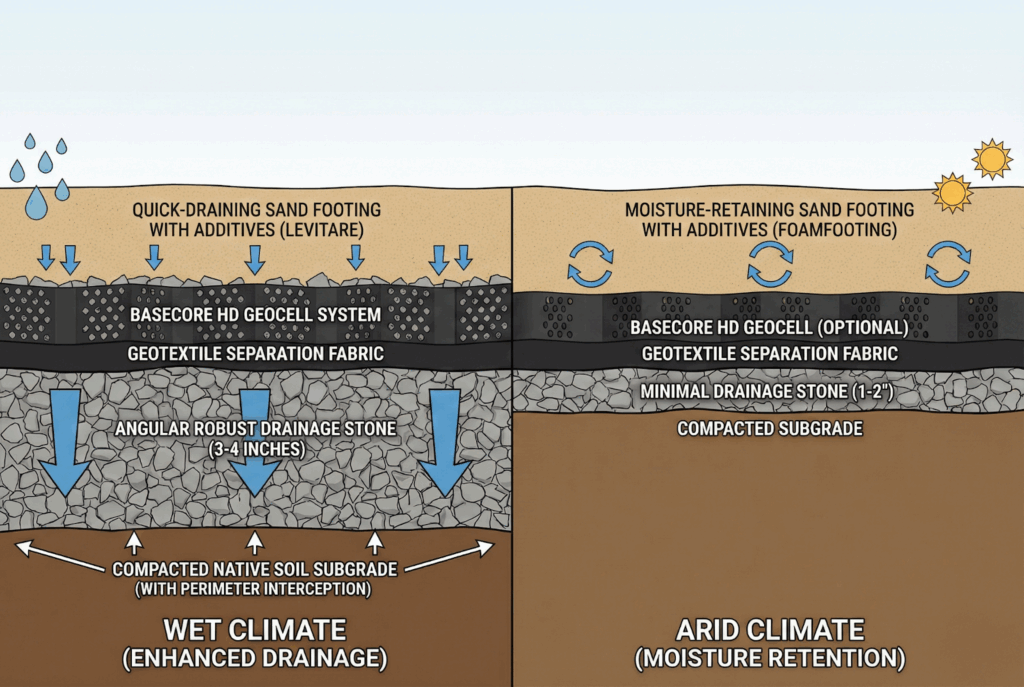
Primary Challenges: Excessive rainfall, waterlogged footing, extended drying times, clay soils
The Pacific Northwest receives 40–60+ inches of annual rainfall. Performance Footing case studies document a dressage facility in Oregon that experienced 68% fewer canceled lessons after upgrading to proper drainage systems. In wet climates, drainage isn’t a nice-to-have—it’s the difference between a functional arena and an expensive mud pit.
Base System Specifications
Layer 1: Compacted Subgrade with Perimeter Interception
Beyond standard compaction, wet climates often require perimeter trenches to intercept runoff from surrounding land before it reaches the arena. Grade surrounding areas away from the arena footprint.
Layer 2: Robust Drainage Layer (3–4 inches)
Wet climate arenas need maximum drainage capacity. Use 3–4 inches of clean, washed angular stone (3/4″ minus) that drains freely. Some installations include perforated drainage pipes in herringbone patterns beneath this layer, spaced every 20–30 feet.
Layer 3: Geotextile Separation
Critical in wet climates to prevent clay particles from native soil migrating upward into drainage layers and reducing permeability over time.
Layer 4: BaseCore HD Geocell System
In regions with heavy rainfall, BaseCore HD proves essential. Performance Footing documentation notes that BaseCore installations handle rainfall events that would leave traditional arenas unusable for days—a Florida hunter/jumper arena withstood 4 inches of rainfall and was rideable within 3 hours using the BaseCore system.
The geocell creates horizontal drainage channels throughout the base while maintaining structural integrity. Traditional French drain systems in a standard 100×200 foot arena typically cost 30–40% more than equivalent BaseCore installations with higher long-term maintenance requirements.
Layer 5: Quick-Draining Footing (3–4 inches)
Coarse, angular sand that doesn’t hold excess water combined with additives that maintain performance in wet conditions.
Recommended Footing Additives
Levitare excels in wet, humid conditions. Blending natural rubber, elastomers, and high-quality fabrics, Levitare provides superior drainage and stability specifically designed for rainy climates. It reduces dust while maintaining a stable surface even after heavy rain.
FoamFooting creates air pockets that allow water to drain through rather than pooling on the surface. The foam maintains cushioning even when surrounding sand is saturated.
Cost Range: $5.00–$8.50 per Square Foot
| Component | Cost/SF |
| Site Preparation + Perimeter Work | $0.45–$0.75 |
| Robust Drainage Layer (3–4″) | $0.60–$0.90 |
| Geotextile Fabric | $0.15–$0.25 |
| BaseCore HD Geocell + Fill | $1.10–$1.60 |
| Quick-Draining Sand Footing (4″) | $0.90–$1.40 |
| Levitare or FoamFooting Additive | $0.70–$1.10 |
| Kickboards (2–3′) | $0.70–$1.00 |
| Drainage Outlets/Grading | $0.40–$0.50 |
| Total Range | $5.00–$8.50 |
Wet Climate Construction Tips
- Never build in low-lying areas that collect water from surrounding terrain
- Plan drainage outlets before construction—water must have somewhere to go
- Schedule construction for dry season (late summer in Pacific Northwest) when equipment won’t create ruts
- Allow extra curing time for compacted layers between rain events
Humid Climate Regions: Southeast, Gulf Coast, Mid-Atlantic
Primary Challenges: Balancing drainage with moisture retention, humidity-induced compaction, seasonal extremes, clay soils
The Southeast presents a unique challenge: enough rainfall to require drainage (40–60 inches annually), but also periods of heat and humidity where moisture retention benefits footing performance. Florida, Georgia, the Carolinas, and Gulf Coast states need arenas that handle both scenarios.
Base System Specifications
Layer 1: Compacted Subgrade
Clay-heavy soils common in the Southeast require thorough compaction and may benefit from soil amendment with angular aggregate before accepting arena construction.
Layer 2: Balanced Drainage Layer (2–3 inches)
Not as aggressive as wet climate specs, but more robust than arid regions. The goal: drain heavy rainfall efficiently while not over-draining during dry periods.
Layer 3: Geotextile Separation
Essential in clay soil regions to prevent upward migration of fines.
Layer 4: BaseCore HD Geocell System
Provides the drainage capacity for summer thunderstorms while the cellular structure maintains footing consistency during drier periods. The geocell prevents the footing migration common when tropical storms dump several inches in hours.
Layer 5: Versatile Footing (3–4 inches)
Sand with additives that perform across humidity variations—controlling dust during dry spells while draining efficiently during wet periods.
Recommended Footing Additives
FoamFooting offers the versatility humid climates demand. It retains moisture during dry periods (reducing dust without irrigation) while allowing drainage during rain events. The foam doesn’t compact in high humidity like some fiber additives.
EcoStride provides natural moisture regulation through plant-based materials. It helps maintain consistent footing feel whether humidity is 40% or 90%.
Cost Range: $4.00–$7.00 per Square Foot
| Component | Cost/SF |
| Site Preparation | $0.30–$0.55 |
| Balanced Drainage Layer (2–3″) | $0.40–$0.65 |
| Geotextile Fabric | $0.10–$0.20 |
| BaseCore HD Geocell + Fill | $0.90–$1.40 |
| Versatile Sand Footing (3–4″) | $0.80–$1.30 |
| FoamFooting or EcoStride | $0.60–$1.00 |
| Perimeter Boards/Kickboards | $0.50–$0.90 |
| Total Range | $4.00–$7.00 |
Humid Climate Construction Tips
- Prepare for seasonal extremes—summer thunderstorms can drop 2–3 inches in an hour
- Monitor compaction during humid periods; high humidity can accelerate footing compaction
- Consider natural airflow when siting the arena; good air circulation helps regulate moisture
- Plan for hurricane season with robust perimeter containment to prevent footing washout
Climate Comparison Summary
| Specification | Cold | Hot/Arid | Wet | Humid |
| Drainage Layer Depth | 2–3″ | 1–2″ | 3–4″ | 2–3″ |
| Primary Challenge | Freeze-thaw | Dust/moisture loss | Water removal | Balance drainage/retention |
| BaseCore HD | Essential | Recommended | Essential | Recommended |
| Best Additive | EcoStride | FoamFooting/Levitare | Levitare | FoamFooting |
| Footing Depth | 3–5″ | 3–4″ | 3–4″ | 3–4″ |
| Cost Range/SF | $4.00–$7.50 | $3.00–$6.00 | $5.00–$8.50 | $4.00–$7.00 |
| Primary Focus | Stability + drainage | Moisture retention | Maximum drainage | Versatility |
Conclusion
Climate-appropriate construction prevents the expensive cycle of repairs, replacements, and lost riding time that plagues arenas built without regional considerations. A Minnesota arena requires freeze-thaw resistance that would be wasteful in Arizona, while the drainage capacity essential in Seattle would over-engineer a facility in Phoenix.
The constants across all climates: proper compaction, geotextile separation, and quality footing materials. The variables—drainage layer depth, additive selection, and base system complexity—should match your specific regional challenges. BaseCore HD geocell technology addresses multiple climate concerns simultaneously, making it valuable across regions despite varying primary challenges.
Your next step: Identify your region’s primary climate challenge from this guide, calculate your arena’s square footage, and contact Performance Footing for product recommendations specific to your location and riding discipline.
Frequently Asked Questions
How does freeze-thaw affect horse arena construction?
Freeze-thaw cycles cause water trapped in base layers to expand and contract, heaving the arena surface and creating dangerous uneven spots. Proper drainage prevents water accumulation before freezing occurs.
What footing additive works best for dust control in dry climates?
FoamFooting and Levitare excel in arid regions. FoamFooting retains moisture naturally, reducing watering needs, while Levitare binds the footing matrix to prevent dust release. Both eliminate constant irrigation requirements.
How much drainage capacity does a wet climate arena need?
Properly drained arenas should clear 1–4 inches of rainfall per hour. Pacific Northwest and similar regions benefit from 3–4 inch drainage layers plus BaseCore HD geocell systems that handle heavy rain events.
Can one footing additive work in all climates?
FoamFooting offers the broadest versatility, providing moisture retention for dry climates and drainage compatibility for wet regions. However, extreme climates benefit from additives specifically designed for their challenges.
Does BaseCore HD work in all climate regions?
Yes. BaseCore HD provides drainage benefits in wet climates, structural stability in freeze-thaw conditions, and consistent footing depth in all regions. It’s essential in wet and cold climates and recommended in arid and humid zones.
This article references publicly available information from Penn State Extension, Oregon State University Extension, Performance Footing technical documentation, Texas A&M University research, and The Horse publication including construction guides, climate studies, and material specifications dated 2020–2025. All costs represent typical ranges and may vary based on specific location, site conditions, material availability, and labor markets. For current pricing and climate-specific product recommendations, consult Performance Footing directly at performancefooting.com.