

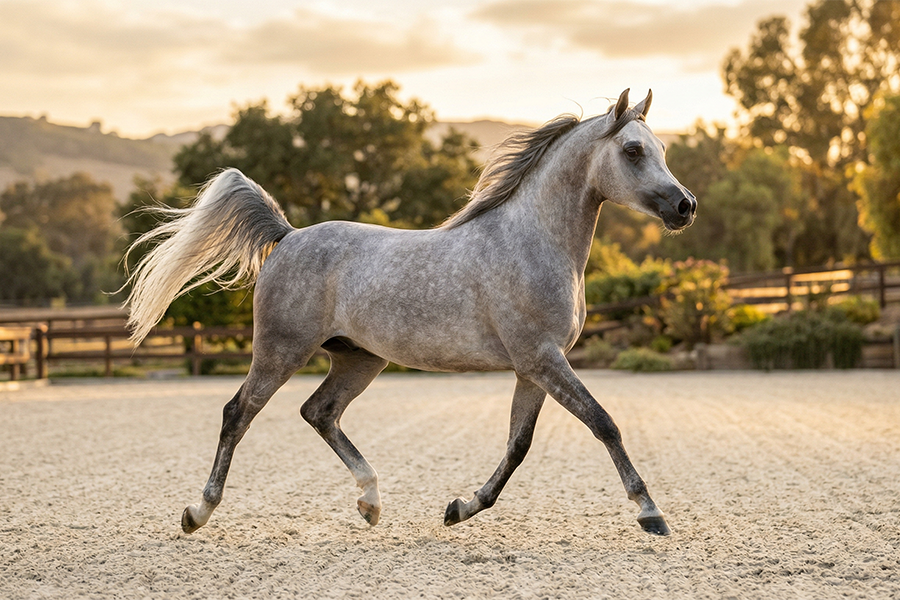
The Arabian horse competes in more disciplines than almost any other breed on earth. According to Wikipedia’s comprehensive breed profile, Arabians participate in saddle seat, Western pleasure, hunt seat, dressage, cutting, reining, endurance riding, show jumping, eventing, and youth equitation — plus breed-specific classes like halter and native costume. The Arabian Horse Association has hosted a dedicated Sport Horse National Championship since 2003, which by 2004 had already grown to draw 2,000 entries. That extraordinary versatility creates a unique footing challenge: the same horse — or at least the same facility — may need to support a floating saddle-seat trot on Monday, a sliding reining stop on Wednesday, and a ground-covering hunter stride on Friday. This article breaks down exactly what Arabian horse owners and facility managers need to know about footing to protect soundness, maximize performance, and support the full range of disciplines Arabians excel in.
Why Arabian Horses Have Unique Footing Needs
Arabians are not built like other breeds, and those physical differences directly affect how they interact with an arena surface.
Lighter Build, Higher Sensitivity
A heavy draft horse requires more cushioning than a lighter Arabian, whose biomechanics demand a different balance of support and response. Arabians typically have dense, strong bone and good hoof walls according to breed documentation, but their lighter frame means they generate different impact forces than a Warmblood or Quarter Horse. A surface that feels appropriately firm under a 1,200-pound Warmblood may feel hard and concussive under a 900-pound Arabian.
This matters because footing that is too hard absorbs little or no impact energy, resulting in increased concussion that can cultivate bone and joint problems over time. On the other end, footing that is too soft and loose forces the horse to expend extra energy adjusting its stride — a particular concern for Arabians in disciplines like English pleasure and dressage, where fluidity and suspension are being judged.
High-Action Movement
Many Arabian show disciplines reward elevated, animated movement. Saddle seat classes evaluate the horse’s brilliance, carriage, and high-stepping action. Hunter pleasure evaluates a forward, ground-covering stride. Dressage tests obedience, flexibility, balance, and suspension. Each of these movement patterns places different demands on the footing surface.
According to research cited in The Horse magazine, scientists at the Swedish University of Agricultural Sciences and France’s Ecole Nationale Vétérinaire d’Alfort have studied how hooves and surfaces interact during the stance phase of a stride, demonstrating that different footing compositions alter the forces acting on tendons, joints, and the hoof capsule in measurable ways. For a breed whose career depends on expressive, athletic movement, the footing under those hooves directly influences long-term soundness.
Respiratory Sensitivity
Arabians are known for their refined, clean throatlatches and large nostrils — features that evolved for desert air but that also make respiratory health a real concern in dusty arenas. Performance Footing’s published dust reduction article documents that arena dust particles stay suspended in the air long after riding ends, and that the threshold where dust becomes harmful is lower than many initially believe. In enclosed indoor arenas where many Arabian training programs operate, dust-free footing isn’t a luxury — it’s a health requirement.
Footing Requirements by Arabian Discipline
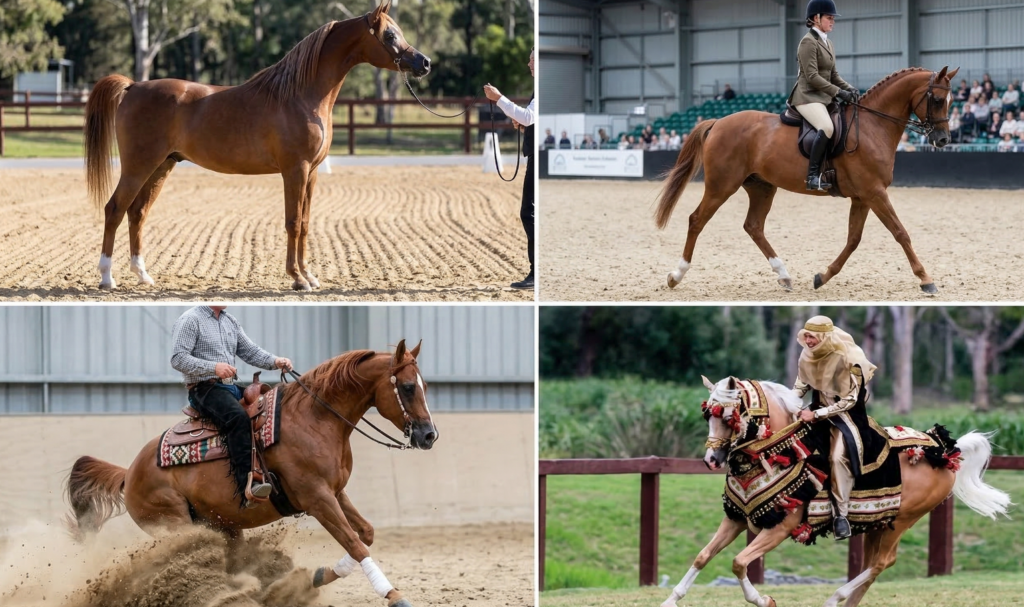
The Arabian Horse Association and USEF recognize an extensive list of competition sections for Arabians. Each places distinct demands on the arena surface. Here’s how footing requirements break down across the disciplines Arabian owners most commonly train and compete in.
Halter and Showmanship
Halter classes evaluate conformation and movement at the walk and trot on a hard, level surface. According to Arabian Horse World’s published judging analysis, Performance Halter classes assess athleticism, conformation, and movement for fluidity, reach, impulsion, and suspension. The footing needs to be firm enough to let judges see clean, accurate footfalls without the horse sinking or struggling for traction.
For halter, a well-compacted surface with minimal depth (2–3 inches of footing) provides the best showcase. Excessive depth obscures leg movement and makes the horse work harder than necessary during an evaluation that should highlight natural balance and correctness.
English Pleasure and Saddle Seat
These classes reward brilliance, elevation, and animated movement. The footing must provide enough grip for the horse to push off confidently into an elevated trot while offering sufficient cushion to absorb the increased concussion that comes with high-action gaits. A surface that is too loose will cause the horse to hesitate and lose impulsion. A surface that is too hard will discourage the elevation judges are looking for.
Performance Footing’s arena sand guide notes that flat work arenas should provide good rebound properties while minimizing excessive movement and remaining consistent throughout rides without developing deep spots. For saddle seat Arabians, a footing depth of 2.5–3.5 inches with angular sand and a stabilizing additive creates the ideal balance of firmness and response.
Hunter Pleasure and Sport Horse
Hunter classes evaluate a forward-moving, ground-covering stride that simulates a pleasurable ride. The footing needs moderate cushioning with reliable traction on turns — the horse should move freely without the surface shifting under each stride. Sport horse under saddle and sport horse in hand classes emphasize athleticism and correct biomechanics, requiring a surface that supports natural movement without interference.
Performance Footing’s sand guide recommends that arenas used for hunters and lower-level jumping balance stability with appropriate shock absorption, often benefiting from fiber or rubber additives to enhance stability and prevent sand shifting during direction changes.
Reining and Working Western
Reining is one of the most demanding disciplines for arena footing. Arabians competing in reining perform spins, sliding stops, and flying lead changes — maneuvers that require a firm base with a controlled amount of slide on top. Performance Footing’s arena sand guide specifies that reining arenas need specialized footing that facilitates sliding stops and quick turns while preventing excessive concussion.
The USEF Arabian Division rules note that sliding plates on rear hooves are permitted in reining classes, which means the footing must accommodate controlled sliding without becoming unpredictable. River sand with its naturally rounded particles can provide some of the controlled movement reining demands, but most high-performance reining arenas use specifically graded sand with additives that allow the top inch to release while maintaining a firm foundation underneath.
Dressage
Dressage tests the horse’s obedience, flexibility, and balance through progressive levels of collected and extended movement. According to the Dressage Today feature on arena surfaces, the footing for dressage arenas needs to maintain consistency across the entire riding surface, with particular attention to moisture levels that affect grip and traction. An inconsistent surface — one with hard spots in some areas and soft spots in others — causes the horse to lose confidence and hold back its performance.
Standard competition dressage arenas measure 20 by 60 meters (approximately 66 by 197 feet). Performance Footing’s precision arena design guide notes that this size totals 12,915 square feet, requiring careful attention to even footing distribution and consistent drainage across the full area.
Native Costume
One of the most beloved Arabian-specific classes, native costume showcases the breed’s desert heritage with traditional Bedouin-inspired tack and attire. While the footing requirements are similar to English pleasure (the horse performs at walk, trot, and canter), the flowing costumes and decorative tack add weight and visual elements that benefit from a consistent, dust-free surface. Dust clouds kicked up during a native costume class don’t just compromise the horse’s respiratory health — they obscure the presentation judges are evaluating.
The Sand Foundation: Getting It Right for Arabians
Sand is the most important ingredient in any arena surface. As Penn State Extension explains in their Riding Arena Footing Material Selection and Management guide, the primary principle of selecting footing materials is to obtain materials that maintain their loose nature without compaction while providing stability for riding activity.
For Arabian facilities that support multiple disciplines, the sand selection must accommodate the widest possible range of demands. Performance Footing’s published sand sieve analysis provides specific grain distribution targets at US Mesh sizes 18 through 270 for both indoor and outdoor arenas. The target distribution calls for the majority of particles (48.50%) to be retained at Mesh 60, with 34.00% at Mesh 100 — a gradation that provides the balance of stability and cushion most Arabian disciplines require.
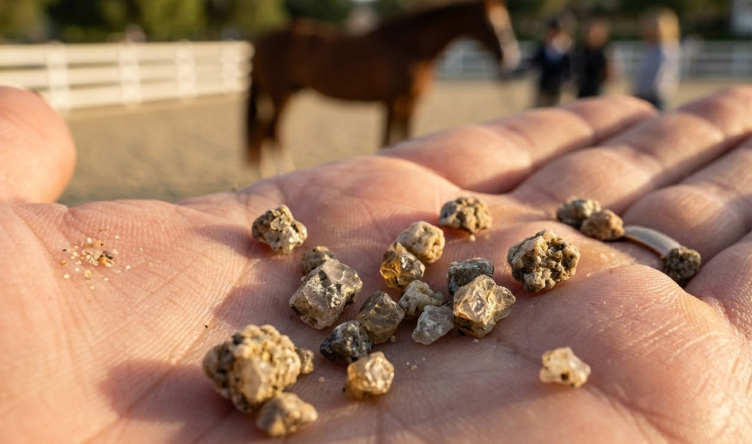
Key sand characteristics to evaluate for an Arabian facility:
- Particle shape. Sub-angular sand interlocks to provide stability. Round sand shifts too easily under the hoof, which is especially problematic for reining and any discipline requiring sharp turns or stops.
- Particle size distribution. A well-graded sand with particles across multiple mesh sizes compacts less and maintains consistent texture longer than a uniformly sized sand.
- Mineral hardness. Silica (quartz) sand resists breaking down under hoof traffic. Softer minerals like limestone will degrade into dust over time, increasing maintenance requirements and respiratory risk.
- Drainage. Outdoor Arabian arenas need sand that drains well without floating or washing out during rain. Indoor arenas benefit from sand that retains moisture longer to reduce watering frequency.
Performance Footing recommends taking their sand sieve analysis report to your local quarry so they can formulate sand to the target specification. For a deeper dive into sand selection, Performance Footing’s comprehensive horse arena sand types and installation guide covers everything from river sand to manufactured options.
Choosing the Right Footing Additive or System
Once you have the right sand, the next decision is whether to enhance it with an additive, replace it entirely with a complete footing system, or go waterless.
Additives That Work With Your Existing Sand
Performance Footing offers several additive products designed to work with a facility’s existing sand base:
- Levitare — A footing additive that enhances cushion and stability without requiring complete sand replacement. Particularly well-suited for multi-discipline facilities that need versatility across different training demands.
- Noviun Natural Fiber — A plant-based fiber that binds with sand to reduce compaction and promote elasticity. Its natural composition makes it a strong choice for owners concerned about environmental impact and horse health.
- FoamFooting — An arena footing additive made from repurposed materials that reduces compaction, improves cushion, and helps control dust when combined with proper moisture management.
- EcoStride — A soft rubber-based additive that integrates with sand to enhance shock absorption and prevent surface hardening, especially useful in climates with extreme cold.
Complete Waterless Footing: Arena Green
For Arabian facilities that want to eliminate watering entirely, Arena Green by Performance Footing provides a complete footing solution — not an additive. It arrives premixed with performance fiber, sub-angular sand, and a 99% biorenewable organic binding agent. It contains no wax, no polymers, and no oil-based ingredients. Arena Green installs directly on a free-draining base and eliminates dust without water.
This is particularly valuable for Arabian training barns where respiratory health is paramount and where multiple horses may share an indoor arena across long training days. Arena Green earned the top footing score on the NARG 2020 Venue Rankings Report and has been installed at FEI 5-Star competition facilities.
Dust Control Solutions
For facilities that aren’t ready for a full footing replacement, Performance Footing’s DustHalt is an eco-friendly additive that binds dust particles to the footing, preventing them from becoming airborne. It’s water-activated and safe for horses — an important consideration for Arabian owners who prioritize their horses’ sensitive respiratory systems.
Building and Maintaining the Base
Even the best footing fails without a proper foundation. Performance Footing’s published article on understanding the elements of your arena base makes the point clearly: an arena is only as good as and will only last as long as its base.
For Arabian facilities, base construction should account for:
- Drainage. Outdoor arenas need a 1–2% crown so water flows away from the riding surface. Indoor arenas need perimeter drains to prevent moisture from undermining the base over time.
- Stability. Performance Footing’s BaseCore geocell system provides ground stabilization that prevents the base from shifting, sinking, or developing uneven spots under repeated hoof traffic. This is critical for multi-discipline arenas where different movement patterns stress the surface differently.
- Levelness. Arabian halter and dressage classes in particular require a perfectly level surface. Laser grading during base installation ensures consistency that can’t be achieved with visual estimation alone.
Maintenance for Multi-Discipline Arabian Facilities
Arabian training facilities that support multiple disciplines need a maintenance routine that keeps the surface versatile rather than optimized for just one use.
- Drag regularly, but vary patterns. Performance Footing’s installation guide recommends alternating dragging direction — north-south one day, east-west the next, diagonals periodically — to prevent directional grooves and maintain consistent texture.
- Monitor depth. Check footing depth weekly in high-traffic areas. Reining work in particular can push footing to the sides of the arena, creating deep spots in the center and shallow spots on the rail.
- Control dust proactively. Don’t wait until you see dust clouds. By the time dust is visible, your horses have already been inhaling particles. Invest in dust prevention before it becomes a respiratory issue.
- Test your footing. As one industry source noted, the best way to evaluate your footing is to check the depth of the hoof print after a horse goes by. If the imprint is no deeper than one inch without the sand shifting around it, your footing is performing well.
The Bottom Line for Arabian Horse Owners
The Arabian horse’s extraordinary versatility is its greatest gift — and its greatest footing challenge. A breed that competes across halter, saddle seat, hunter pleasure, reining, dressage, native costume, sport horse, trail, driving, and endurance conditioning needs a footing surface that can support every one of those demands without compromise.
That starts with the right sand. It continues with the right additive or complete footing system. And it depends on a properly built and maintained base.
Performance Footing offers free footing consultations specifically designed to help you match your sand, your climate, your disciplines, and your budget to the right solution — whether that’s an additive like Levitare or Noviun blended with your existing sand, a complete waterless system like Arena Green, or a combination approach that addresses dust, drainage, and performance simultaneously.
Your next step: Call Performance Footing at 877-835-0878 or visit performancefooting.com to request a free sand analysis and consultation tailored to your Arabian facility.
Frequently Asked Questions
Q: Do Arabian horses need different arena footing than other breeds?
Arabians are lighter-framed than Warmbloods or Quarter Horses, so they’re more sensitive to hard surfaces. Their multi-discipline versatility also means the footing must perform across a wider range of movement demands than most single-discipline arenas require.
Q: What footing depth is best for an Arabian training arena?
Most Arabian disciplines perform well on 2.5–3.5 inches of properly graded footing over a solid base. Halter presentations may benefit from slightly shallower depth (2–3 inches), while reining and jumping need the full 3.5 inches for adequate cushion and slide.
Q: Is dust a bigger concern for Arabians than other breeds?
Dust is a health concern for all horses, but Arabians often train and show in enclosed indoor arenas where airborne particles accumulate. Performance Footing documents that the harmful threshold for dust is lower than most owners expect, making dust-free solutions especially important for Arabian facilities.
Q: Can one footing surface work for both reining and dressage Arabians?
Yes, with the right sand gradation and additive. A well-graded angular sand with a stabilizing fiber or cushion additive can provide enough firmness for dressage while allowing controlled slide for reining. Performance Footing’s team can help design a multi-discipline surface.
Q: What is Arena Green and does it work for Arabian arenas?
Arena Green is Performance Footing’s complete waterless footing system — not an additive. It uses 99% biorenewable binding agents with no wax or polymers. It eliminates dust and watering entirely, making it ideal for Arabian indoor and outdoor arenas where air quality and consistent performance matter most.
Disclaimer: This article references publicly available information from Performance Footing (performancefooting.com), Penn State Extension (extension.psu.edu), the Arabian Horse Association (arabianhorses.org), Arabian Horse World (arabianhorseworld.com), Arabian Horse Life (arabianhorselife.com), Wikipedia, The Horse magazine (thehorse.com), Dressage Today (dressagetoday.com), and the United States Equestrian Federation (usef.org), including official product documentation, breed standards, competition rules, published case studies, and industry reports dated 2018–2025. All metrics and references are from documented sources. Results described may vary based on individual arena conditions, climate, scale, and implementation approach. For current information about any Performance Footing products, visit performancefooting.com or call 877-835-0878.