


A single delivery truck crossing an unstabilized path can deposit enough mud to compromise months of arena maintenance. According to university agricultural extension research on equine all-weather paddocks, contamination control is critical for ensuring arena surfaces perform throughout their lifespan—and that control starts before vehicles ever reach your riding surface. This article reveals how road-construction geocell technology, originally developed by the U.S. Army Corps of Engineers for military operations, now provides equestrian facilities with 75+ year solutions for arena access lanes that prevent footing contamination and protect your investment from the ground up.
What Stabilized Access Lanes Are—Through Real-World Implementation
When facility owners invest in premium arena footing, many overlook the path that leads to it. Performance Footing’s documentation emphasizes that ensuring the site is accessible for trucks delivering materials and maintenance equipment requires stabilized access lanes from roadway to arena—a detail that is often overlooked. Inadequate accessibility can hamper both arena use and maintenance while traffic from non-stabilized access contaminates and diminishes footing performance through mud intrusion.
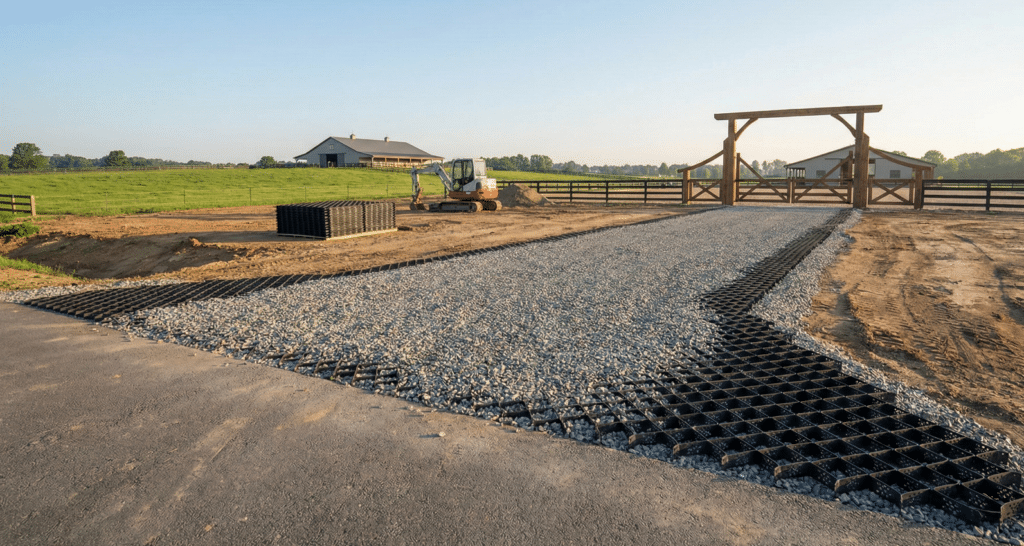
The solution comes from an unexpected source: military road construction. Research and development of cellular confinement systems began with the U.S. Army Corps of Engineers in 1975 to devise a method for building tactical roads over soft ground. Engineers discovered that sand-confinement systems performed better than conventional crushed stone sections and could provide expedient construction over soft ground without being adversely affected by wet weather conditions.
This same technology—now commercialized as geocell systems like BaseCore—transforms how equestrian facilities approach access lane construction. According to Performance Footing’s technical specifications, BaseCore is a collapsible geo-cell typically used for roadways or military applications that eliminates further erosion and allows for immediate foot, vehicle, or horse mobility. The product works by creating a three-dimensional honeycomb structure that confines aggregate materials, preventing the lateral movement that causes traditional gravel lanes to fail and generate mud.
The cellular confinement approach distributes weight across a wider area when pressure is applied from above, such as the weight of delivery vehicles. Performance Footing states that the three-dimensional structure acts like rebar in concrete, providing tensile strength that flat aggregate layers cannot achieve. When properly installed with angular aggregate filling each cell, BaseCore creates a base that is actually stronger than traditional deep stone bases while using 50-70% less material.
How Performance Footing’s BaseCore System Achieves Results
Performance Footing has developed specific implementation protocols for access lane stabilization based on road construction principles. The company’s BaseCore HD system features the smallest cells in the market, with tighter cell structure and thicker virgin plastic construction that creates strength equivalent to 12 inches of gravel without a cellular confinement system.

Implementation Timeline and Process
The installation process follows road construction methodology adapted for equestrian applications:
Site Preparation Phase: Performance Footing’s arena construction guide specifies that all vegetation, stones, roots, and organic matter must be removed from the access lane site. The subgrade surface should be free of topsoil, rocks, vegetation, roots, debris, depressions, mud, standing water, or frozen ground.
Compaction Testing Requirements: Before geocell installation, the subgrade requires compaction verification. According to ASTM D1557, the Modified Proctor compaction test—developed by the U.S. Army Corps of Engineers in 1945—establishes laboratory compaction methods to determine the relationship between moisture content and dry unit weight of soils. For access lanes subject to vehicle traffic, the standard specifies that soil placed as engineering fill for road bases should be compacted to a dense state to obtain satisfactory engineering properties such as shear strength and compressibility.
Agricultural extension construction guidelines recommend that the subgrade be compacted using appropriate equipment, with any necessary fill material placed in lifts of no more than 6 inches in depth, then compacted before additional lifts are added.
Geotextile Installation: Performance Footing specifies commercial-grade non-woven fabric installation, which prevents the foundation from sinking into the subgrade. The company notes that geotextile fabric provides ground stabilization and prevents the foundation from sinking, ensuring your arena base will last much longer than facilities without this support.
Geocell Deployment: BaseCore panels ship collapsed and expand on-site to cover the required area. Performance Footing’s installation guide states that the product requires only simple tools, and two or more people can build a reliable base. The company recommends following specific panel depths for different applications: 3 inches for arenas, runs, parking, and private driveways; 4-6 inches or more for slow draining areas, muddy conditions, erosion control, and slope retention.
Aggregate Fill and Compaction: The cells are filled with 3/8-inch minus crushed angular aggregate and compacted. Performance Footing emphasizes that this dramatically reduces aggregate requirements by up to 50 percent—instead of needing 6-12 inches of base material, only 4 inches of aggregate fills and caps the BaseCore cells.
Measurable Outcomes and ROI from Stabilized Access
The quantifiable benefits of geocell-stabilized access lanes emerge across multiple performance metrics:
Material and Cost Reductions
Performance Footing’s cost analysis indicates that BaseCore HD delivers immediate cost savings by reducing aggregate requirements by up to 50 percent. For a typical access lane installation, this translates to thousands saved in material costs and significantly reduced installation labor. The company’s 2025 construction guide notes that most facilities can achieve professional-quality access lanes for substantially less than conventional construction costs.
Longevity Specifications
According to Performance Footing documentation, BaseCore HD systems are engineered for 75+ year lifespans with minimal maintenance, outlasting multiple footing replacement cycles. The company states that this lifespan means your base investment serves multiple footing replacements over decades.
Scientific research supports these longevity claims through material performance standards. According to published research on cellular confinement technology, ASTM and ISO standards specify that volumetric change above 2% could result in loss of confinement, compaction, settlement, fatigue, or failure. The Dutch standard for reinforcement geosynthetics in roadways emphasizes that the retention of geometry is critical to geocell performance for the lifespan of the project.
Drainage Performance
Stabilized access lanes provide critical drainage benefits that protect arena footing. Performance Footing notes that BaseCore’s engineered perforations allow water to move freely through the system, creating drainage channels that keep your arena rideable even after torrential rains. This prevents water from pooling in access areas where it would otherwise create mud that contaminates arena surfaces.
Contamination Prevention
The primary ROI metric for equestrian facilities is footing protection. When mud from unstabilized access lanes enters the arena, it affects the surface membrane’s ability to drain water, leaving the surface more susceptible to flooding. Performance Footing’s technical materials explain that without a solid base, arena footing becomes uneven no matter how many times you use an arena drag—the same principle applies to contaminated footing from external mud sources.
Comparing Industry Approaches: Road Construction Standards Applied to Equestrian Facilities
The translation of road construction methodology to equestrian applications follows documented standards from multiple authoritative sources:
U.S. Army Corps of Engineers Foundation
Early research published by Bathurst and Jarrett in 1988 found that cellular confinement reinforced gravel bases are equivalent to about twice the thickness of unreinforced gravel bases and that geocells performed better than single sheet reinforcement schemes such as geotextiles and geogrids. This research established the foundation for modern equestrian access lane applications.
ASTM Compaction Standards
The connection between road base construction and arena access lanes centers on compaction testing. ASTM D698 (Standard Proctor) and ASTM D1557 (Modified Proctor) establish the laboratory procedures that determine maximum dry density and optimum moisture content for soil compaction. According to industry technical guidance, the Modified Proctor test specifications are better suited for control of soil compaction in areas like pavements where heavy wheel loads create dynamic forces—directly applicable to arena access lanes serving delivery and maintenance vehicles.
The practical application follows documented protocols: Standard Proctor specifications work well for general embankments, while Modified Proctor specifications apply to subgrade and base courses where 95-98% maximum dry density is required.
University Extension Guidelines
University agricultural extension construction guidelines for equine all-weather surfaces specify that for all-weather vehicle traffic lanes, crushed gravel provides suitable stability. Research notes that construction is virtually the same as needed for an outdoor riding arena and emphasizes that a highly compacted subgrade is necessary to assure good performance for the all-weather surface above it.
Performance Footing Integration
Performance Footing has integrated these road construction principles into their BaseCore system specifications. The company’s documentation draws direct parallels: BaseCore geocell technology represents a paradigm shift in construction by addressing the fundamental challenges of drainage, stability, and longevity that the road construction industry solved decades ago.
Practical Implementation Guide Based on Documented Methodologies
Following the documented approaches from road construction and equestrian facility development, here is the implementation sequence for stabilized access lanes:
Step 1: Site Assessment and Planning
Evaluate the path from the nearest roadway to the arena entrance. Performance Footing recommends choosing a location that allows for good access, noting that positioning to allow for good access can reduce costs by up to 30 percent. Identify areas where water collects and where existing traffic has created ruts or soft spots.
Step 2: Subgrade Preparation
Clear the access lane corridor of vegetation and organic material. Grade the subgrade to direct surface water runoff appropriately—extension research recommends working with a professional engineer to design the pad ensuring proper water drainage.
Step 3: Compaction Verification
Perform compaction testing per ASTM standards. The subgrade should achieve minimum 95% compaction relative to laboratory Proctor test results. Field verification options include nuclear density gauges for rapid results on larger projects, or sand cone methods per ASTM D1556 for individual verification points.
Step 4: Geotextile Installation
Install non-woven geotextile fabric over the compacted subgrade. This layer serves double duty—separating the drainage stone from the base system above while allowing water to pass through freely.
Step 5: Geocell Deployment
Expand BaseCore panels across the prepared surface. Connect panels using the engineered connection system—Performance Footing uses BaseClips, which provide secure, seamless connections built for long-term load distribution.
Step 6: Aggregate Fill
Fill cells with angular aggregate and compact. Overfill by approximately 1 inch to allow for settlement. Use vibratory compaction equipment appropriate for the aggregate type.
Step 7: Surface Finishing
For access lanes that horses will also use, consider a shallow top layer of finer-grade material such as coarse sand or packed stone dust to cushion the rough aggregate surface, as recommended by agricultural extension research.
Conclusion
The delivery truck that began this discussion represents a daily reality for equestrian facilities—yet the mud contamination problem has a documented solution. The same geocell technology that the U.S. Army Corps of Engineers developed in 1975 for military road construction now provides 75+ year access lane stabilization that protects arena footing investments. By applying road construction compaction testing standards and cellular confinement principles, facilities eliminate the mud migration that diminishes footing performance. The next step is clear: before investing in premium arena footing, invest in the stabilized access that protects it. Contact Performance Footing at (877) 835-0878 to calculate specific material requirements and access lane configurations for your facility.
Frequently Asked Questions
Why do unstabilized access lanes damage arena footing?
Mud carried by vehicles and maintenance equipment works through arena surface layers over time, clogging drainage membranes and creating inconsistent riding surfaces that arena dragging cannot correct.
What compaction testing is required for access lanes?
ASTM D1557 (Modified Proctor) testing determines maximum dry density and optimum moisture content. Access lanes typically require 95-98% compaction relative to laboratory values for vehicle traffic support.
How much aggregate does BaseCore geocell reduce?
Performance Footing documentation indicates 50-70% reduction in aggregate requirements compared to traditional construction—4 inches of fill versus 6-12 inches for equivalent load-bearing capacity.
How long do geocell access lanes last?
Performance Footing specifies BaseCore HD systems for 75+ year lifespans when properly installed, outlasting multiple arena footing replacement cycles over the facility’s lifetime.
Can horses use geocell-stabilized access lanes?
Yes. Add a shallow top layer of coarse sand or stone dust over the aggregate surface to cushion hooves. BaseCore HD features smaller cell openings specifically designed to prevent hoof entrapment.