
Testing Sand for Dust: Complete Arena Dust Analysis Guide
Learn how to test arena sand for dust, why respirable fines damage equine lungs, and how to protect your horse. Order a Sand Analysis Test today.
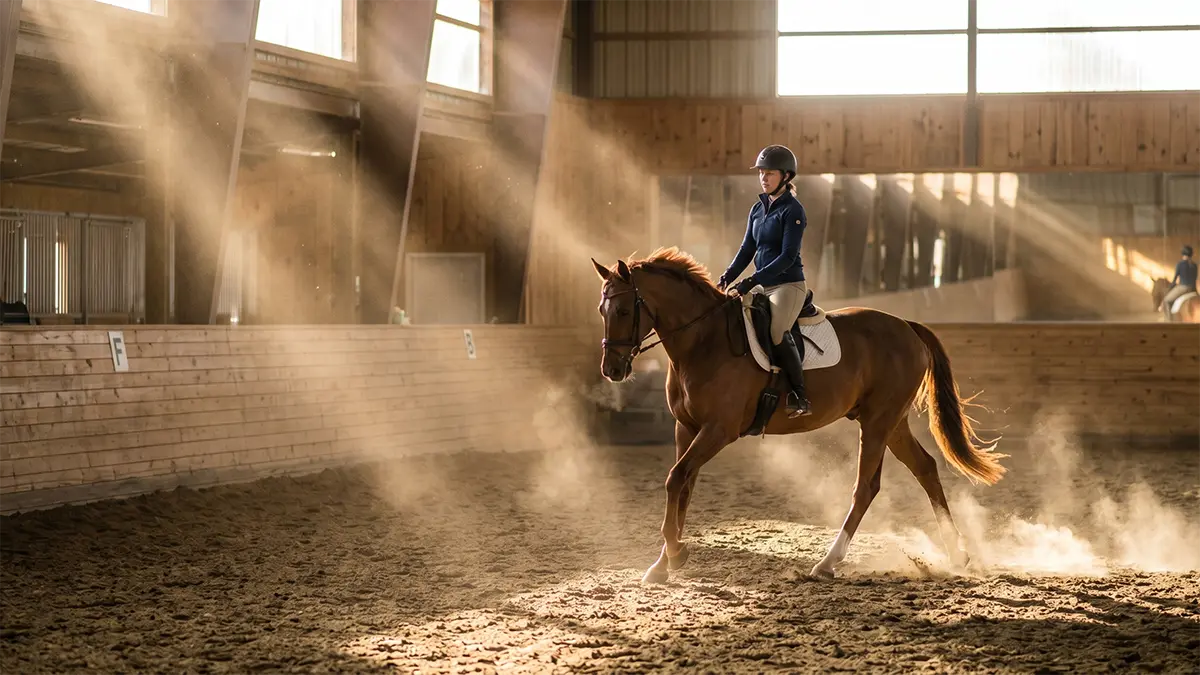
A galloping horse inhales up to 600 gallons of air per minute, according to Penn State Extension documentation. Every particle of respirable dust suspended in that air moves deep into the respiratory tract — past the nasal passages, past the upper airway, into the bronchioles and alveolar regions where the lungs exchange oxygen. The dust load in an untested arena is invisible during casual inspection and undetectable by the human nose at concentrations that damage equine lungs. This is why testing sand for dust, before and during the life of every arena, is one of the most important welfare decisions an arena owner will make. This comprehensive guide explains how dust testing works, what the numbers mean for your horse’s health, and how to work with Performance Footing to order a Sand Analysis Test and a Custom Sand Guide that address dust at the specification stage.
Why Dust Matters More Than Most Arena Owners Realize
Arena dust is not a cosmetic problem. It is a documented occupational hazard for horses, riders, trainers, and barn staff, and it is one of the modifiable risk factors the veterinary research community has linked directly to equine respiratory disease.
The Respiratory Health Evidence
Published research in equine veterinary medicine has established that chronic exposure to airborne particulate contributes to inflammatory airway disease and recurrent airway obstruction, conditions that reduce athletic performance and shorten competitive careers. Indoor arenas concentrate the problem because enclosed air retains suspended particulate far longer than outdoor spaces.
Testing sand for dust matters because dust is the airborne consequence of sand that either came from the quarry with too much fines content or degraded into fines during service. Both problems are preventable at the specification stage, and both are detectable through professional sand analysis.
What Horses Breathe Is Not What Riders Breathe
A horse’s airway sits roughly four to five feet off the ground during normal work, directly in the zone where disturbed sand lofts and lingers. Riders mounted on those horses breathe air that has already been partially filtered upward. Ground-level concentrations of respirable particulate are higher than head-level concentrations during active riding, which means the horse is exposed to a worse dust environment than the rider ever perceives.
This asymmetry is why trainers sometimes discount dust concerns based on their own breathing experience. The horse is exposed to substantially more particulate than the person standing beside them or riding on top of them.
The Stakes of Ignoring Dust
Respiratory disease treatment costs veterinary bills, performance losses, and in severe cases the end of a competitive career. Against those costs, testing sand for dust is inexpensive preventive diagnostics. A single professional Sand Analysis Test produces data that can prevent years of respiratory exposure.
Worried about dust in your arena? Order a Sand Analysis Test through Performance Footing to measure the fines content in your current footing or a prospective sand source. Professional laboratory analysis with expert interpretation. Call 877-835-0878 or visit performancefooting.com.
What “Dust” Actually Means in Arena Sand
Dust is not a single thing. It is a category of particulate that spans a range of sizes with different behaviors and different health implications.
The Particle Size Spectrum
Arena sand contains particles that range from approximately 1 millimeter at the coarsest down to sub-micron dust at the finest. Testing sand for dust focuses on the fine end of that spectrum because that is where respiratory risk concentrates.
- Coarse sand (above 0.5 mm) — Settles quickly when disturbed, does not loft into breathing zone air
- Medium sand (0.15 to 0.5 mm) — Remains on the ground under normal disturbance, occasionally lofts briefly
- Fine sand (0.053 to 0.15 mm) — Can become airborne under active disturbance but settles within seconds
- Fines (below 0.053 mm) — The PAN fraction on a sieve report, loft readily and remain suspended
- Respirable particulate (below 10 microns, or 0.010 mm) — Bypasses upper airway defenses and reaches the deep lung
Testing sand for dust captures this full spectrum by measuring the percentage of the sample that falls into the fines category and below. The finer the fraction, the greater the respiratory concern per unit mass.
The PAN Fraction on a Sieve Report
A standard sand sieve analysis reports the percentage of material passing the #270 sieve, which has 0.053 mm openings. Everything smaller than 0.053 mm collects in the PAN. This PAN percentage is the single most useful dust indicator on a sieve report, but it understates the full dust picture because it does not separate the 0.053 mm material from the sub-micron respirable fraction below.
For more sensitive dust characterization, hydrometer analysis and laser diffraction particle sizing can quantify the sub-PAN distribution in detail. A professional Sand Analysis Test through Performance Footing includes the PAN percentage measurement that directly predicts dust behavior.
Why Fines Matter at Both Ends
Sand with zero fines has its own problems — it lacks cohesion, loses moisture retention capacity, and actually performs poorly as riding footing. A small, controlled fines content is beneficial for cohesion and moisture binding. The dust problem begins when fines content rises above the narrow window where they contribute to cohesion without generating airborne particulate.
This is why testing sand for dust is not about reducing fines entirely but about measuring them precisely and specifying the sand to sit within the optimal fines window.
How Sand Becomes Dust Over Time
Even sand that tests clean at installation can become dust-generating sand years later. Testing sand for dust needs to be an ongoing practice, not a one-time installation check.
Mineralogy and Degradation
Sand mineralogy determines how resistant the grains are to breakdown under repeated hoof impact. Silica and quartz sands at Mohs hardness 7 resist degradation for years. Softer limestone, feldspar-rich, and calcareous sands at Mohs 3 to 6 fragment under hoof impact and generate fines over time.
An arena built with high-silica sand maintains its fines content close to the installation measurement for a decade or more. An arena built with lower-silica sand can see its fines content double or triple within two to four years as the original grains fracture. The result: an arena that tested clean at installation becomes a significant dust source by year three or four without any external contamination.
This is why mineralogy verification belongs in every initial sand analysis. ASTM F3419-22 uses X-ray diffraction to characterize mineral composition, and professional sand testing typically includes or can add this analysis. A sand that passes gradation but fails mineralogy is a time-limited solution regardless of how well it tests at installation.
Traffic and Compaction Effects
High-traffic arenas generate more fines than low-traffic arenas because grain fracture rate scales with hoof-impact frequency. A busy boarding stable with 40 horses working daily produces fines faster than a private facility with three horses working occasionally. The compaction zones near gates and around jumps generate fines faster than lightly-used perimeter areas.
Testing sand for dust should account for this spatial variation by sampling from multiple arena zones including high-traffic and low-traffic areas separately.
External Contamination
Sand can accumulate fines from external sources: wind-blown silt from adjacent fields, organic matter dragged in by hooves, tracked-in barn debris, and hay particles that settle onto the arena surface. Outdoor arenas in agricultural regions are particularly susceptible to silt deposition from prevailing winds.
A sand that tested clean when purchased may require re-testing after a season of exposure to determine whether external contamination has degraded the fines profile.
Industry Benchmarks for Dust Control
Published research and industry standards establish reasonable ranges that well-specified arena sand falls within. These ranges provide a starting framework for interpreting dust test results.
The USGA Benchmark
The USGA putting-green specification, often cited as an adjacent quality benchmark for arena footing, limits combined silt and clay content to 5% of the total sample. Arena specifications generally follow similar logic, often tightening the standard further because arenas experience more aggressive surface disturbance than putting greens.
Published Research Ranges
Quality arena sand typically shows:
- PAN fraction — Usually below 1% in quality specifications, sometimes below 0.5% for premium indoor arenas
- #270 sieve retention — Typically below 2%, often below 1.5% for tight dust control
- Combined fines (everything passing #140) — Usually below 10% total, often below 7% for high-standard arenas
- Silt and clay (sub-0.053 mm) — Below 5% following USGA-adjacent logic
These are industry-wide ranges drawn from published research and standards. Where your sand should sit within each range depends on whether the arena is indoor or outdoor, the discipline practiced, the regional climate, and the ventilation characteristics of the facility. A Custom Sand Guide from Performance Footing translates these ranges into the specific target appropriate for your situation.
Why Indoor Specifications Are Tighter
Indoor arenas concentrate airborne particulate because enclosed air circulates more slowly than outdoor air. The same sand that produces acceptable dust performance outdoors can produce unacceptable dust performance indoors. This is why indoor dust testing specifications typically tighten the fines tolerance compared to outdoor specifications for the same discipline.
Ventilation design partially compensates, but no ventilation system fully helps reduce the difference. Testing sand for dust in indoor facilities requires stricter interpretation of the same laboratory results.
Not sure where your sand should sit within these ranges? Request your free Custom Sand Guide from Performance Footing. Tell us your discipline, climate zone, and indoor or outdoor facility, and receive a specification that addresses dust at the right level for your situation. Call 877-835-0878 or visit performancefooting.com.
How to Test Arena Sand for Dust
Dust testing combines laboratory sand analysis with practical arena observation. The laboratory data predicts dust behavior; arena observation confirms it.
Laboratory Dust Testing
Professional sand analysis for dust characterization includes several specific measurements:
Sieve analysis with PAN measurement — The standard six-sieve test quantifies fines content at the #270 and PAN level. This is the foundation of all dust testing and appears on every professional Sand Analysis Test.
Hydrometer analysis — For sub-PAN characterization, hydrometer testing uses sedimentation rates to quantify silt and clay content below 0.053 mm. This separates the coarse PAN material from the true respirable fines.
Mineralogy verification — ASTM F3419-22 X-ray diffraction identifies the mineral composition and predicts long-term degradation behavior. A high-silica sand with slightly elevated current fines is often preferable to a low-silica sand with low current fines, because the latter will degrade faster.
Moisture content — Because moisture suppresses dust generation, the moisture content at sampling affects how the laboratory results translate to actual arena behavior.
Performance Footing’s Sand Analysis Test includes the core sieve analysis with PAN measurement and can coordinate additional testing for comprehensive dust characterization.
Arena Observation Tests
Laboratory data predicts dust behavior; direct arena observation confirms it. Several simple observation tests complement professional laboratory analysis:
The backlit visual test — With the arena doors open and sunlight entering at a low angle, have a horse canter through the lit zone. Visible dust clouds in backlit air indicate significant respirable particulate. This is a qualitative test that detects gross dust problems but cannot quantify smaller concerns.
The dry surface test — In the driest section of your arena, brush the surface lightly with a boot. Sand that lofts visible dust under light disturbance has excessive fines. Sand that remains in place has acceptable fines content for that moisture level.
The black surface test — Place a black trash bag flat on the arena surface after a riding session. Sand particles that settle onto the bag within 30 minutes indicate airborne particulate generated during the session. The density and fineness of the settled material provide a qualitative indicator.
The air quality measurement test — Professional arena environmental monitoring uses PM10 and PM2.5 meters to quantify respirable particulate concentration during active riding. This is the most precise observation method and is sometimes conducted by equine veterinary researchers studying specific facilities.
When to Test
Arena owners should conduct dust testing at several predictable intervals:
- Before purchasing a property with an existing arena — Test to understand the current dust profile and whether renovation is required
- Before a major arena renovation — Test current sand and any prospective replacement sand
- When dust becomes visibly noticeable — Visible dust during normal riding indicates fines content that has exceeded acceptable thresholds
- When respiratory symptoms appear — Any horse showing coughing, nasal discharge, or exercise intolerance in a specific arena warrants immediate dust testing
- When footing ages past three years — Routine maintenance testing catches mineralogy-driven degradation before it reaches problem levels
- After external contamination events — Flooding, wind storms, and adjacent construction can deposit fines that change the dust profile
Ready to test your arena for dust? Order a Sand Analysis Test through Performance Footing for professional laboratory measurement of fines content, mineralogy, and full gradation. Call 877-835-0878 to start the process.
How to Collect a Sand Sample for Dust Testing
Sample collection quality determines whether your dust test reflects reality. Improperly collected samples produce misleading results regardless of laboratory precision.
Proper Sampling for Dust Analysis
- Sample dry when possible — Moisture in the sample can mask the true fines content during laboratory handling. Sample during a dry period rather than immediately after watering.
- Sample from multiple zones — Collect from at least five arena locations. Include the highest-traffic zones (around jumps, at the track corners, near gates) because these generate the most fines and represent the worst-case dust condition. Also include lower-traffic zones for comparison.
- Sample at full working depth — Pull from the entire depth of the working layer, not just the surface. Fines often concentrate at specific depths based on compaction and moisture migration, and surface-only sampling misses subsurface fines accumulation.
- Combine and mix thoroughly — Blend sub-samples in a clean container before bagging. A poorly mixed composite produces a laboratory result that reflects one zone rather than the arena as a whole.
- Bag in clean plastic — Use a new, clean plastic bag sealed immediately after collection. Dust adhering to used or dirty containers can contaminate the sample.
- Document moisture and conditions — Note the moisture level, time since last watering, ambient humidity, and the arena’s grooming schedule. These conditions affect how laboratory results translate to actual dust behavior.
Performance Footing provides sampling guidance when you order a Sand Analysis Test, ensuring the sample that reaches the laboratory accurately represents your arena.
Dust Control Strategies After Testing
Testing sand for dust tells you where you stand. The next step is using those results to address dust at its source.
Specification-Stage Solutions
The most effective dust control happens at installation, when the sand going into the arena matches a specification that controls fines from the start. This is why testing prospective sand before purchase prevents years of dust problems.
A sand that tests within quality specifications for fines content, has verified high silica mineralogy, and comes from a sub-angular source will generate far less dust over its service life than a sand that misses any of those three characteristics. The Custom Sand Guide approach that Performance Footing offers translates published industry ranges into a specification appropriate for your discipline, climate, and facility type.
Additive-Based Dust Suppression
For existing arenas with dust problems, additives address fines-related dust without requiring full sand replacement.
The DustHalt binder for arena dust control chemically binds fine particulate to larger sand grains, preventing respirable material from becoming airborne. Application and reapplication schedules depend on arena use intensity and climate.
The FLEX™ moisture-retentive additive holds moisture in the sand longer than plain sand, extending the dust-suppressing effect of watering. FLEX™ retains 65% more moisture than plain sand, which directly reduces dust generation in dry conditions.
The ArenaGreen dust-free pre-mixed footing is formulated as a waterless solution for facilities where overhead watering is impractical or where the owner wants to overcome dust as a structural design decision rather than a maintenance practice.
Moisture Management
Water suppresses dust by binding fines to larger grains through capillary water bridges. Arena moisture management is therefore an important part of dust control, particularly for sand that sits near the upper boundary of acceptable fines content.
Effective moisture management depends on arena design, local climate, and watering system capacity. Indoor arenas in arid climates may need daily watering to maintain dust control. Outdoor arenas in humid climates may need only supplemental watering during dry spells. Testing sand for dust informs the moisture management requirement: a cleaner sand needs less water to stay dust-free.
Base and Drainage Considerations
The BaseCore HDPE geocell base stabilization supports the sand layer from below and contributes to dust control indirectly by preventing the sand from compacting into a dense, dust-generating layer. A properly designed base also supports drainage that carries dissolved fines downward rather than letting them accumulate at the surface.
When Full Replacement Is Warranted
Some arena sand fails dust testing badly enough that no combination of additives and moisture management can bring it within acceptable ranges. Low-silica sand that has degraded into 10% or more fines is generally beyond amendment and warrants full replacement.
A professional Sand Analysis Test produces the data that distinguishes amendable arenas from replacement-required arenas. This single piece of information can save tens of thousands of dollars in unnecessary replacement costs for arenas that can be amended, or prevent wasted investment in additives for arenas that need full replacement.
Why Dust Testing Connects to the Full Footing System
Dust is one measurable outcome of arena footing quality, but it is not the only one. The 2014 FEI Equine Surfaces White Paper identifies five functional properties of arena footing — impact firmness, cushioning, responsiveness, grip, and uniformity. Dust is a consequence of how well the sand’s fines content and mineralogy match the specification, which connects to several of those FEI properties.
A sand that tests clean for dust typically also performs well on other FEI properties because the same characteristics that control fines also control cohesion, moisture retention, and grain stability. Testing sand for dust is therefore an entry point to understanding the full footing system, and the Custom Sand Guide approach extends that entry point to a complete specification.
For broader context on how arena footing science developed and how dust testing fits into the larger picture, the arena sand analysis complete guide documents the full spectrum of sand characteristics, and the arena footing history timeline traces the 2,400-year evolution of the welfare concerns that led to modern dust control practices.
Working With Performance Footing From Testing Through Installation
Testing sand for dust is most valuable when it connects to a coordinated plan for addressing whatever the testing reveals.
The Full Consultation Path
When you speak with a Performance Footing arena consultant about dust concerns, the conversation typically covers:
- Current dust observations — What you see, smell, and measure in the existing arena
- Respiratory history — Whether any horses at the facility have shown respiratory symptoms
- Facility type and climate — Indoor, outdoor, or mixed, and what climate conditions influence the dust profile
- Current sand characteristics — What is known about the installed sand and any testing history
- Sampling and laboratory analysis — Arranging for a Sand Analysis Test to quantify the current dust situation
- Specification interpretation — Receiving a Custom Sand Guide that frames the test results against a target appropriate for the facility
- Amendment or replacement decision — Determining whether additives and moisture management can address the dust problem or whether sand replacement is warranted
- Product recommendations — Selecting specific additives and base systems that fit the dust control strategy
- Implementation coordination — Timing, application rates, and maintenance schedules
This coordinated path converts dust testing from a standalone laboratory exercise into an actionable plan.
Conclusion
Testing sand for dust is not optional preventive diagnostics for arena owners who care about equine respiratory health. A galloping horse inhales 600 gallons of air per minute, and every cubic yard of that air passes through the lungs. The fines content of your arena sand, the mineralogy that determines whether that fines content stays stable over time, and the moisture management and additive strategies that control dust generation in daily use — all of these factors either protect your horse’s lungs or compromise them.
Published industry ranges give a starting framework. A professional Sand Analysis Test gives you the specific measurement for your arena. A Custom Sand Guide translates both into the specification appropriate for your discipline, climate, and facility.
Two actions to take today:
1. Order your Sand Analysis Test to measure the fines content, mineralogy, and full gradation of your current footing or a prospective sand source. Professional laboratory analysis with expert interpretation.
2. Request your free Custom Sand Guide tuned to your discipline and regional climate. Dust-controlled sieve targets, additive recommendations, and moisture management guidance delivered to you.
Call 877-835-0878 or visit performancefooting.com to start either service.
FAQ
1. How do I know if my arena has a dust problem?
Visible dust during normal riding, dust settling on tack and barn surfaces, coughing or nasal discharge in horses after work, and respiratory irritation in riders all indicate excessive fines content. A professional Sand Analysis Test quantifies the problem by measuring the exact percentage of fines in your sand. Order one by calling 877-835-0878.
2. What level of fines content is acceptable in arena sand?
Published industry research generally places acceptable PAN fraction below 1% and #270 retention below 2% for quality arena sand, with tighter targets for indoor arenas and sensitive disciplines. The exact target for your situation depends on discipline, climate, and facility type, which is why a Custom Sand Guide is worth requesting alongside laboratory testing.
3. Can I test arena sand for dust without a laboratory?
Simple observation tests — the backlit visual test, the dry surface test, and the black surface test — can indicate gross dust problems. But these qualitative methods cannot quantify smaller concerns or distinguish between fines content and mineralogy-driven degradation. Professional laboratory testing through a Sand Analysis Test is the only way to get precise numbers and plan appropriate dust control.
4. Will watering my arena solve a dust problem?
Moisture suppresses dust temporarily by binding fines to larger grains. Watering is an important part of dust control, but it is not a substitute for proper specification. Sand with excessive fines will generate dust as soon as surface moisture evaporates. The FLEX™ moisture-retentive additive extends the dust-suppressing effect of watering, and the DustHalt binder chemically addresses fines at the source.
5. When should I replace sand versus amending it with additives?
Sand that tests within reasonable range of specification for fines and mineralogy can usually be amended with binders, moisture-retentive additives, and improved moisture management. Sand that has degraded significantly due to low-silica mineralogy, or that was never properly specified in the first place, usually requires replacement. A professional Sand Analysis Test produces the data that distinguishes these two situations and prevents wasted investment in either direction.
This article references publicly available information from the Fédération Equestre Internationale, ASTM International, Penn State Extension, the Racing Surfaces Testing Laboratory, the USGA, and peer-reviewed research on equine respiratory health and arena footing. Source material includes the FEI Equine Surfaces White Paper (2014), ASTM F3400-19 and F3419-22 standards, and published equine veterinary research on inflammatory airway disease and recurrent airway obstruction. Industry ranges cited are drawn from published research and standards rather than any single proprietary specification. Respiratory health information is educational and does not replace veterinary diagnosis or treatment. For professional sand testing, a Custom Sand Guide tuned to your discipline and region, or arena consultation, visit www.performancefooting.com or call 877-835-0878.